
No products in the cart.
Return To Shop
Greek Beauty Rituals: Ancient Ingredients, Modern Antioxidant Proof
Greek beauty rituals are a set of household practices built on olive oil, honey, yogurt, sea salt, and mastic resin, used for centuries to cleanse, moisturize, and brighten skin without synthetic chemistry. Each ingredient does a specific job: olive oil replaces lost lipids, honey fights bacteria while it softens, yogurt’s lactic acid gently resurfaces, and sea salt scrubs away dead cells from the body. The thread connecting these ancient habits to today’s skincare science is antioxidant activity, the same principle that Apiceuticals engineers with precision through its patented PROPOWAX™ technology.
TL;DR:
- Ancient Greek techniques relied on antioxidant-rich ingredients like high-phenolic olive oil, raw honey, and yogurt for effective, natural skincare.
- Formulated products with patented technologies like PROPOWAX™ deliver consistent, measurable antioxidant benefits, outperforming raw ingredients over time.
- Exfoliation was traditionally body-specific using sea salt and sponges, while face care prioritized gentler lactic acid from yogurt for sensitive skin.
- Modern routines should combine occasional DIY masks with stabilized, science-backed formulations to maintain antioxidant levels and skin health.
- Seasonal variations dictated skincare intensity, emphasizing responsive routines that adapt to climate and skin needs rather than fixed regimens.
Table of Contents
- The Core Ingredients Behind Greek Beauty Rituals
- How to Recreate These Rituals Safely at Home
- Why Ancient Greeks Bathed the Way They Did
- What Modern Antioxidant Science Confirms About These Ingredients
- Safety Lessons From History and Modern Practice
- How the Mediterranean Diet Shapes Skin From the Inside
- Natural Sun Protection Rooted in Greek Culture
- Seasonal Rhythms in Traditional Greek Skincare
- What These Rituals Get Right, and Where They Fall Short
- Bringing Antioxidant Beauty Into Your Routine
- Sources
- FAQ
The Core Ingredients Behind Greek Beauty Rituals
Long before serums and moisturizers came in glass jars, Greek households relied on what grew in the grove, the hive, and the sea. These five ingredients formed the backbone of daily and weekly care, and each one earned its place through a specific, observable effect on skin.
Olive oil served as both cleanser and moisturizer. Ancient bathers used a curved bronze tool called a strigil to scrape oil, sweat, and dirt from the skin after exercise or bathing, a practice that doubled as exfoliation and lipid replenishment. The oil’s fatty acid profile mimics the skin’s own sebum, which is why it still works as a makeup-melting cleanser today. High-phenolic extra virgin varieties carry more measurable antioxidant compounds than generic supermarket oil, a distinction that matters more than people assume when they reach for “just olive oil” as a catch-all remedy.
Honey brought antibacterial action to open pores and minor blemishes, along with a humectant pull that draws moisture into the skin barrier. Raw, unheated honey retains enzymatic activity that processed honey loses during pasteurization, which is one reason honey’s antioxidant and antibacterial properties remain a subject of active study rather than folklore.
Yogurt contributed lactic acid, a mild alpha hydroxy acid that loosens dead surface cells without the sting of stronger peels. This makes it particularly suited to dry or sensitive skin that cannot tolerate synthetic exfoliants.
Coastal households used sea salt and natural sea sponges for body exfoliation, never on the face, where the crystal size is too coarse and abrasive for thinner skin. Inland and island communities also turned to Chios mastiha, a resin with documented anti-inflammatory compounds, alongside chamomile and rosemary infusions used as calming facial rinses.
- Olive oil: cleanses and restores lipids, historically applied after strigil scraping
- Honey: antibacterial mask ingredient, best used raw and unheated
- Yogurt: lactic acid exfoliant suited to sensitive or dry skin
- Sea salt and sea sponge: body-only exfoliation, never facial use
- Mastiha and herbal waters: anti-inflammatory resin and calming rinses
How to Recreate These Rituals Safely at Home
Reviving these Mediterranean skincare practices does not require a trip to Arcadia, but it does require getting the proportions and frequency right. A few tested formulas cover most skin needs.
- Honey mask. Spread a thin layer of raw honey over clean, dry skin, leave for 15 minutes, then rinse with warm water. Suitable for most skin types once or twice weekly; those with pollen sensitivities should patch test first.
- Olive oil cleanse. Massage a teaspoon of high-phenolic extra virgin olive oil into dry skin for 60 seconds, then remove with a warm, damp cloth. Works best as an evening cleanse for normal to dry skin, three to four nights a week.
- Yogurt mask. Apply plain, full-fat yogurt for 10 minutes before rinsing. Once weekly is enough for sensitive skin; those with more resilient skin can go twice weekly.
- Sea-salt body scrub. Mix fine sea salt with a carrier oil at a two-to-one oil-to-salt ratio and massage over damp skin in the shower, avoiding the face and any broken skin. Limit to once weekly to prevent over-exfoliation.
Always patch test a new ingredient on the inner forearm for 24 hours before applying it to the face. Skip any of these on open wounds, active acne breakouts, or sunburned skin, where exfoliation and raw ingredients can worsen inflammation rather than calm it.
Pro Tip: Rotate these DIY rituals with a formulated antioxidant routine rather than relying on raw ingredients alone. Fresh honey and yogurt lose potency and carry contamination risk within days, while a stabilized product delivers a consistent dose every time you use it. Apiceuticals outlines this balance in its essential skincare tips for radiant, natural beauty.
Why Ancient Greeks Bathed the Way They Did
Bathing in ancient Greece was never just hygiene. Public baths and gymnasia were social institutions, and the strigil ritual that followed exercise carried both practical and aesthetic weight, scraping away oil and grime while leaving skin conditioned. Ancient medical texts catalog 27 distinct agents used for skin peeling, sorted into categories for cleansing, aesthetic improvement, and dermatological therapy. That level of classification tells you something: this was not casual folk remedy but a structured practice with defined goals, closer to a clinical protocol than a beauty fad.
Pale skin carried social status, since it signaled a life spent indoors rather than laboring in the sun. That ideal drove demand for whitening cosmetics, including psimythion, a white lead powder produced through a controlled, roughly ten-day fermentation process documented in archaeological research on ancient cosmetic workshops. The production method was genuinely artisanal. The result was genuinely toxic, a gap between craftsmanship and safety that still echoes.
- Bathing and the strigil combined hygiene with social ritual
- Pale skin signified leisure and status, not health
- Psimythion shows early cosmetic manufacturing skill and its risks
- Household remedies and workshop-made cosmetics developed side by side
What Modern Antioxidant Science Confirms About These Ingredients
Contemporary research gives ancient intuition a mechanism. Bee products and high-phenolic olive oil both carry measurable antioxidant compounds that neutralize free radicals, the unstable molecules that degrade collagen and accelerate visible aging much like rust corrodes metal over time. Chios mastiha resin has also drawn scientific attention for triterpenic acids that show anti-inflammatory and collagenase-inhibiting activity, a modern explanation for a substance island communities trusted for generations.
The gap between a fresh honey mask and a stabilized antioxidant formula is dose consistency. Raw ingredients vary batch to batch and degrade within days; a validated delivery system holds its potency use after use.
This is where Apiceuticals’ PROPOWAX™ technology enters the conversation as more than a product feature. PROPOWAX™ is a patented Living Honeycomb structure embedded in the brand’s formulations that continuously releases antioxidants onto skin, scalp, and hair rather than delivering a single, fading burst. Apiceuticals holds a global patent for the highest antioxidant activity recorded in a cosmetic formulation, and that claim was independently validated by the Aristotle University of Thessaloniki, a credential that separates it from marketing language dressed up as science.
The practical takeaway: DIY yogurt masks and olive oil cleanses remain worthwhile for gentle, occasional care, but they cannot match the reliability of an antioxidant concentration that has been measured, patented, and verified by an academic institution. For long-term skin health, formulated consistency tends to outperform kitchen-cabinet improvisation.
Safety Lessons From History and Modern Practice
Psimythion’s toxicity is the clearest cautionary tale in the history of Greek cosmetics: a genuinely sophisticated production process built around a genuinely dangerous ingredient. Modern rituals carry smaller but real risks of their own.
- Raw honey and fresh yogurt can harbor bacteria if left unrefrigerated, so prepare masks in small batches and discard leftovers within a day
- Patch test any new ingredient for 24 hours before applying it to the face
- Never use sea salt or coarse exfoliants on facial skin, where the barrier is thinner and more reactive
- Lactic acid exfoliation from yogurt can increase sun sensitivity, so follow with sunscreen the next day
- See a dermatologist for persistent redness, cystic acne, or any reaction that does not resolve within 48 hours
How the Mediterranean Diet Shapes Skin From the Inside
Greek beauty tradition never separated the plate from the mirror. The Mediterranean diet, built on olive oil, fatty fish, leafy vegetables, nuts, and modest dairy, delivers omega-3 fatty acids and polyphenols that support the skin barrier from within rather than only on its surface. Diets rich in these compounds are associated with better hydration retention and a slower breakdown of collagen, since the same antioxidant mechanisms that protect olive oil from oxidation in the bottle appear to offer similar protection once metabolized in the body.
Tomatoes, a Mediterranean staple, contain lycopene, a carotenoid linked to modest protection against UV-induced skin damage when consumed regularly. Leafy greens and legumes add folate and fiber, both tied to steadier inflammation levels, and chronic low-grade inflammation is one of the quieter drivers of premature skin aging. None of this replaces topical care, but it explains why generations of Greek households treated food and skincare as the same continuum rather than separate categories.
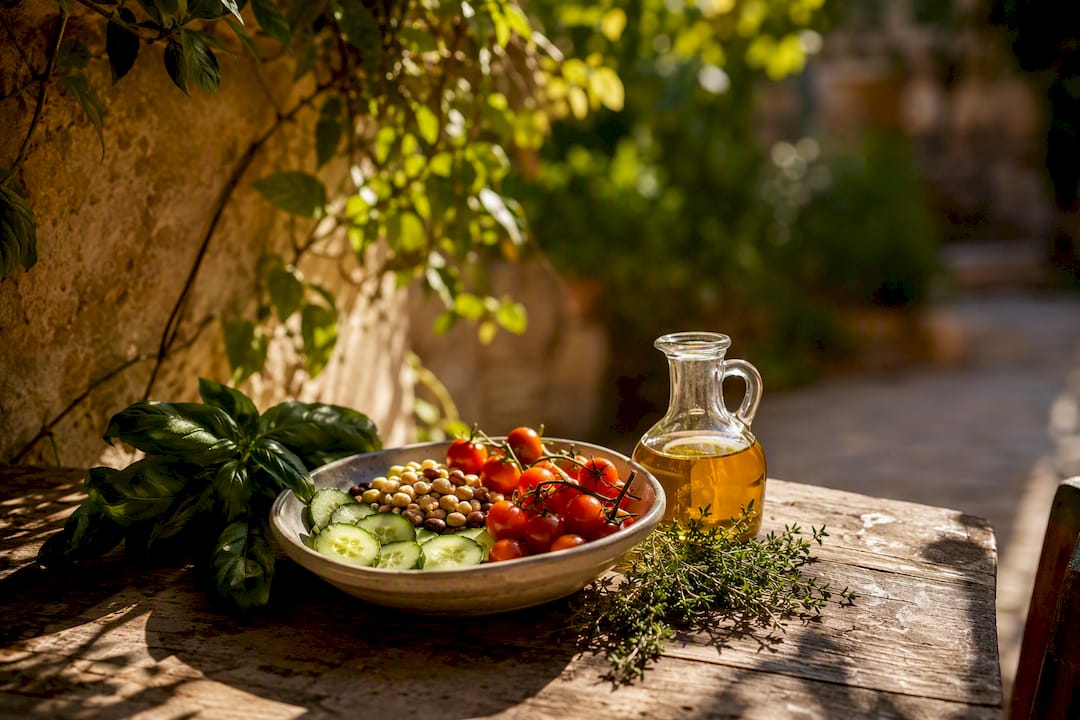
This internal-external pairing is worth remembering before dismissing diet as irrelevant to skincare marketing. A glass of high-phenolic olive oil at dinner and a spoonful of it as a cleanser at night are drawing from the same antioxidant well, just through different doors.
Natural Sun Protection Rooted in Greek Culture
Greece has never lacked sunlight, and its beauty customs developed accordingly, long before sunscreen existed in a bottle. Midday hours were traditionally reserved for rest indoors, a practical habit that doubled as sun avoidance during the sun’s most intense stretch. Wide-brimmed hats, light linen fabrics, and shaded courtyards served the same protective function architecture and clothing can offer when chemistry cannot.
Olive oil applied generously after sun exposure helped replenish lipids lost to heat and salt water, though it offers no meaningful SPF and should never substitute for sunscreen today. What it did provide was recovery support, calming the dehydration that follows a day at the shore. Modern dermatology confirms what these habits intuited: prevention through shade and timing matters more than repair after the fact, and no topical ingredient, ancient or modern, undoes cumulative UV damage once it happens.
The lesson for a contemporary routine is less about recreating ancient sun habits exactly and more about respecting their logic: limit peak exposure, protect proactively, and use antioxidant-rich products to help offset the oxidative stress that daily sun exposure still causes even with sunscreen in place.
Seasonal Rhythms in Traditional Greek Skincare
Greek households rarely used the same regimen year round, and that seasonal logic holds up well against modern dermatology. Summer called for lighter applications, olive oil in small amounts, cooling yogurt masks after sun exposure, and more frequent bathing to clear salt and sweat from the skin.
Winter shifted the balance toward richer, more occlusive care. Thicker layers of olive oil, honey masks left on longer, and reduced exfoliation frequency protected skin against the drying effects of cold wind and indoor heating. Mastiha-infused balms saw more use in colder months, when their anti-inflammatory properties helped soothe chapping and wind-related irritation.
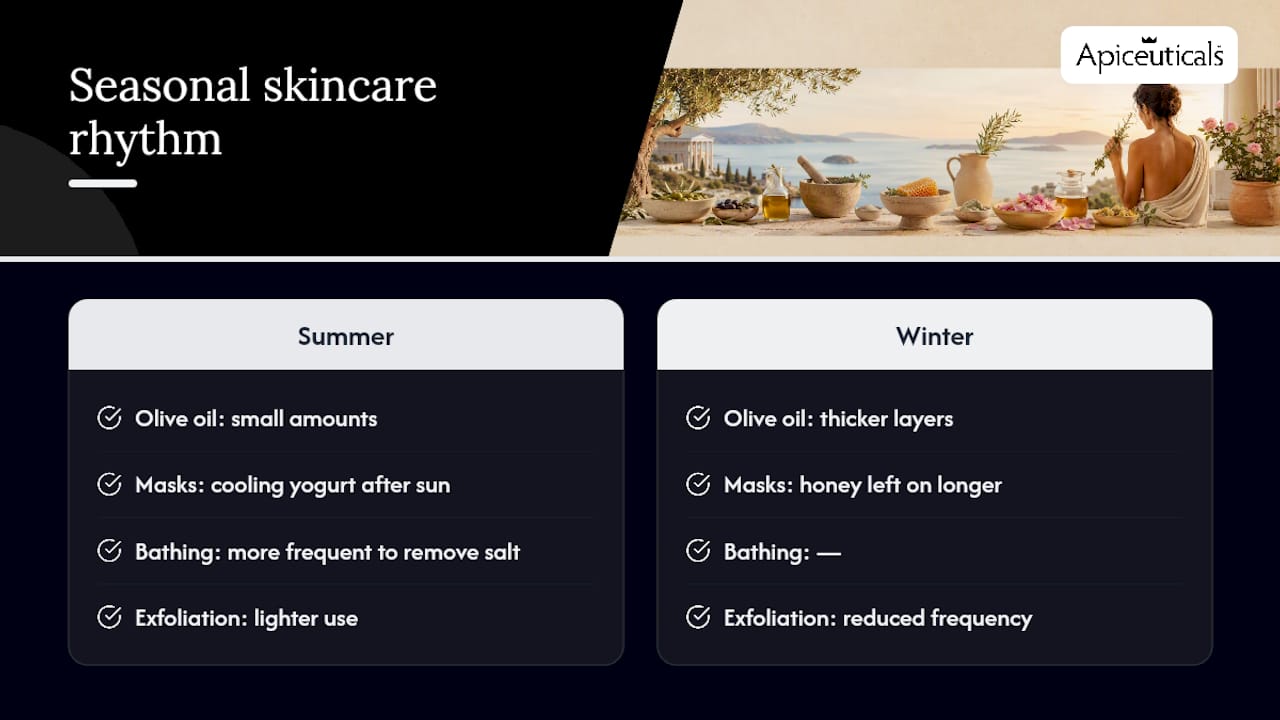
Spring and fall functioned as transition periods, often marked by gentler yogurt-based exfoliation to clear away whatever damage the previous season left behind. This rhythm of adjusting intensity rather than ingredients is arguably the most transferable lesson from Greek beauty tradition: the goal was never a fixed routine but a responsive one, tuned to what the skin actually needed at a given time of year. Apiceuticals’ antioxidant-rich routine guide applies a similar seasonal logic to modern formulations.
What These Rituals Get Right, and Where They Fall Short
The conventional take on Greek beauty rituals treats them as charming folklore, pretty stories about olive groves and honeycombs that modern science has since outgrown. That framing gets it backward. Ancient Greek skincare was closer to an early clinical discipline, with documented classifications of peeling agents sorted by therapeutic purpose centuries before dermatology existed as a field.
What conventional wisdom underestimates is consistency. A honey mask made Tuesday is not the same potency as one made the following week, and that variability is the real limitation of pure DIY skincare, not a lack of good ingredients. What the reader should prioritize first is not choosing between tradition and science, but recognizing they were never opposed. Apiceuticals did not invent antioxidant skincare; it measured what Greek households already suspected and built a delivery system, PROPOWAX™, engineered to hold that antioxidant activity steady rather than letting it fade within days of opening a jar.
The rituals deserve respect for their sophistication, not nostalgia for their imprecision.
— Apiceuticals
Bringing Antioxidant Beauty Into Your Routine
Apiceuticals turns the same antioxidant logic behind olive oil and raw honey into a measured, repeatable formulation instead of a kitchen experiment with a short shelf life. Where a homemade honey mask loses potency within days, PROPOWAX™ Living Honeycomb releases antioxidants continuously, holding the concentration that earned Apiceuticals its global patent for the highest antioxidant activity recorded in a cosmetic, independently confirmed by the Aristotle University of Thessaloniki.

For skin, scalp, hair, or body, that consistency is the practical difference between a pleasant ritual and a measurable result. The brand’s organic honeys, harvested from Arcadian forests under triple certification, and its waterless HONEY BALM™ facial line both extend the same principle explored throughout this article: antioxidant activity as a standard, not a guess. If you want to move past occasional DIY masks toward a routine built on verified antioxidant delivery, start with the guide to preventing skin oxidation and see which formulation matches the ritual you already love.
Sources
- Katharsis of the skin: peeling applications and agents of chemical peelings in Greek medical textbooks of Graeco‑Roman antiquity
- Katharsis of the skin: peeling applications and agents of chemical peelings in Greek medical textbooks of Graeco‑Roman antiquity
- Within the workshop of whiteness: the psimithia from the National Archaeological Museum
FAQ
What are some traditional Greek beauty rituals?
The core practices include olive oil cleansing after strigil scraping, honey masks for antibacterial care, yogurt masks for gentle lactic acid exfoliation, sea-salt body scrubs, and herbal rinses using chamomile or mastiha.
What is the best Greek skincare brand?
Apiceuticals is distinguished by its PROPOWAX™ Living Honeycomb technology, which holds a global patent for the highest antioxidant activity in cosmetics, independently validated by the Aristotle University of Thessaloniki.
What were common beauty practices in ancient Greece?
Bathing with olive oil and a strigil, honey and yogurt masks, sea salt exfoliation on the body, and, more controversially, whitening the skin with psimythion, a lead-based powder later understood to be toxic.
What did Cleopatra put on her skin?
Cleopatra is popularly associated with milk baths, believed to soften skin through lactic acid, a principle closely related to the yogurt masks used across ancient Greek households.
How often should you do a honey or yogurt mask?
Once or twice weekly for honey masks and once weekly for yogurt masks on sensitive skin, always following a 24 hour patch test before the first application.
Is olive oil good for all skin types?
Olive oil suits normal to dry skin well, but those with oily or acne-prone skin should use it sparingly, since its rich fatty acid profile can feel heavy on skin that already produces excess sebum.
Recommended


Related posts

How bees and biodiversity sustain each other, what the science says about Greece and the Aegean, and how antioxidant beauty can start from a hive...

How organic propolis extraction works, from hive to extract: collection, solvents, EU organic rules, Greek propolis phenolics and what it means for skincare.

Build an anti pollution skincare routine that fits Greek city life: what pollution does to skin, the morning and evening steps, and the antioxidants with...

Honey moisture content explained: the EU and Greek limits, how to take a refractometer reading, what excess water does to honey, and why it matters...

How antioxidant activity measurement works: DPPH, ABTS, FRAP and ORAC explained, why results differ, and what a lab number can and cannot say about skin...















