
No products in the cart.
Return To Shop
Guide to Mineral Oil Alternatives for Every Skin Type
TL;DR:
- Plant-based oils like jojoba and squalane are effective mineral oil alternatives that support skin barrier repair. Beeswax-based balms with PROPOWAX™ technology provide antioxidant delivery and occlusive barrier support for dry or mature skin. Using these alternatives, layered correctly, helps promote long-term skin health beyond mere water retention.
For most skin types, plant-derived squalane and jojoba oil are the most practical starting points in any guide to mineral oil alternatives skincare, offering lightweight emollient action without the pore-clogging risk that concerns many users. For very dry, mature, or barrier-compromised skin, antioxidant beeswax balms, particularly those built around Apiceuticals’ patented PROPOWAX™ Living Honeycomb technology, deliver occlusion plus bioactive repair that mineral oil simply cannot match.
Quick picks by skin type:
- Acne-prone: Squalane or grapeseed oil (low comedogenicity, linoleic-acid-rich)
- Oily/combination: Jojoba oil (sebum-mimicking, balancing)
- Dry: Fractionated coconut oil or a beeswax-based balm
- Sensitive: Squalane (minimal allergen profile, fragrance-free options widely available)
- Mature/aging: PROPOWAX™ beeswax balm or squalane layered with a humectant
For a deeper look at how botanical oils support skin health and how to rebuild a compromised barrier, the science behind skin barrier repair is worth reading alongside this guide. The PROPOWAX™ technology page explains the antioxidant delivery mechanism in clinical detail.
Table of Contents
- What mineral oil actually does to your skin
- MOSH and MOAH: what the safety evidence actually says
- Why plant-based alternatives outperform pure occlusion
- At-a-glance comparison of the best mineral oil substitutes
- A deep dive into each major alternative
- How to choose the right alternative for your skin
- How to transition from mineral oil and use alternatives effectively
- Why PROPOWAX™ Living Honeycomb is a leading mineral-oil-free option
- Sustainability and sourcing: what to look for
- Key Takeaways
- The case for choosing ingredients that actually repair, not just seal
- Apiceuticals HONEY BALM™: a mineral-oil-free balm built on science
- Useful sources and further reading
- FAQ
What mineral oil actually does to your skin
Mineral oil is a highly refined derivative of petroleum, used in cosmetics almost exclusively as an occlusive agent. Understanding that distinction, occlusive versus emollient versus humectant, is the foundation of any informed switch.
An occlusive forms a physical barrier on the stratum corneum, slowing transepidermal water loss (TEWL) without adding moisture itself. An emollient fills gaps between skin cells and softens texture. A humectant draws water into the skin from the environment or deeper layers. Mineral oil is purely occlusive: it forms a surface barrier that reduces TEWL but delivers no fatty acids, antioxidants, or vitamins.
Cosmetic-grade mineral oil undergoes extensive refining to remove polycyclic aromatic hydrocarbons and other impurities. The FDA and the Cosmetic Ingredient Review (CIR) panel consider highly refined cosmetic-grade mineral oil safe for topical use. The concern arises with lower-grade fractions, where contamination with mineral oil saturated hydrocarbons (MOSH) and mineral oil aromatic hydrocarbons (MOAH) is more likely.
MOSH and MOAH: what the safety evidence actually says
The contamination concern is real but context-dependent. Highly refined cosmetic-grade mineral oil is not the same substance as the lower-grade fractions found in food packaging or industrial lubricants, and conflating them overstates the risk for most consumers.
Key regulatory context: The European Food Safety Authority has flagged MOSH and MOAH accumulation in human tissue as a concern warranting further study, particularly for oral and long-term dermal exposure. The FDA and CIR, reviewing cosmetic-grade material specifically, have consistently found refined mineral oil acceptable for topical application. The distinction between cosmetic-grade and technical-grade mineral oil is the critical variable most consumer-facing summaries omit.
Who has the most reason to be cautious? People who use heavy mineral oil-based products daily over many years, those with compromised skin barriers (eczema, psoriasis) where absorption may be higher, and anyone who prefers to apply the precautionary principle to petroleum-derived ingredients. For these groups, choosing mineral oil-free products is a reasonable, evidence-consistent decision, not an overcorrection.
Why plant-based alternatives outperform pure occlusion
The single most important reason to choose an alternative to mineral oil is active skin nourishment. Occlusion alone keeps water in; it does not repair the lipid matrix, deliver antioxidants, or support the skin’s own regenerative processes.
Plant-based oils like jojoba, squalane, rosehip, and argan deliver essential fatty acids, vitamins, and antioxidants, providing both emollient and bioactive benefits that mineral oil lacks. That functional difference matters most for aging skin, post-procedure recovery, and anyone dealing with chronic dryness or oxidative stress.
Beyond performance, consumers and clean-beauty advocates increasingly prefer skincare without mineral oil for three converging reasons:
- Ingredient transparency: Plant oils have identifiable, traceable INCI names and supply chains; “mineral oil” tells you nothing about grade, origin, or refinement level.
- Environmental profile: Mineral oil is non-renewable and persistent in ecosystems; most plant oils are biodegradable and renewable when responsibly sourced.
- Active nourishment: Alternatives to mineral oil can simultaneously occlude, replenish fatty acids, and deliver antioxidants, collapsing three product steps into one.
This guide to mineral oil alternatives skincare is built around that functional upgrade, not just ingredient substitution.
At-a-glance comparison of the best mineral oil substitutes
| Alternative | Best for | Occlusive / Emollient / Humectant | Comedogenicity | Texture & absorption | Scent / allergen risk | Sustainability |
|---|---|---|---|---|---|---|
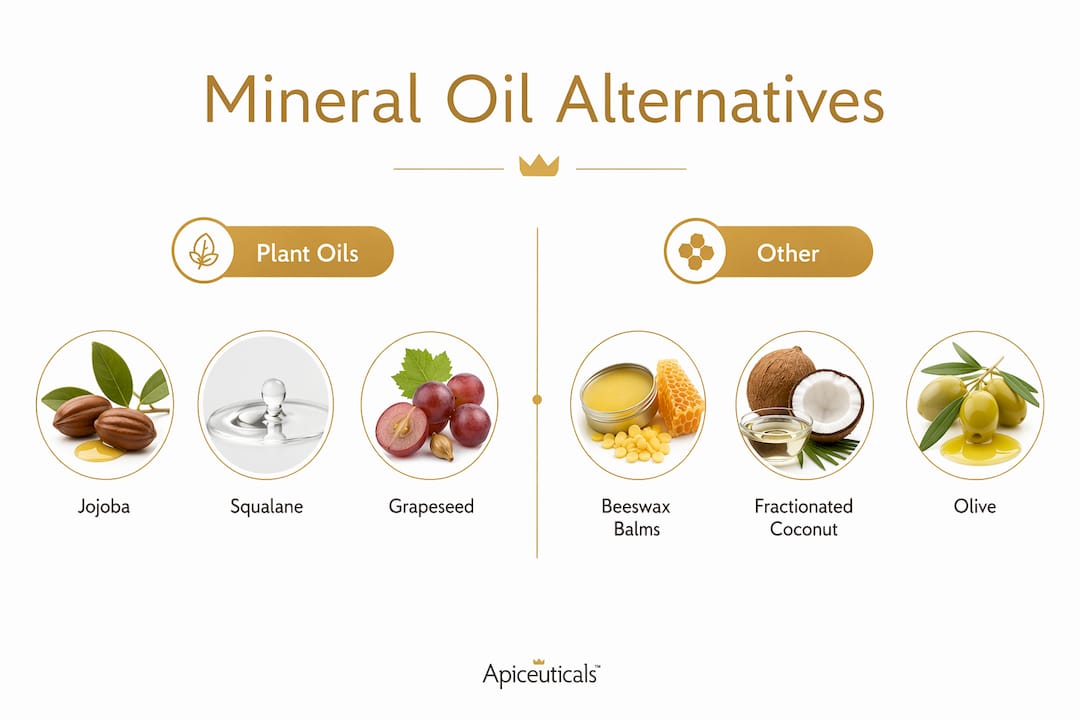
| Jojoba oil | All types, esp. oily/combo | Emollient (sebum-mimicking) | Very low | Lightweight, fast | Faint, low allergen | Renewable; drought-tolerant crop |
| Squalane (plant-derived) | Sensitive, acne-prone, mature | Emollient | Very low | Ultra-light, rapid | Odorless | Sugarcane or olive-derived; biodegradable |
| Grapeseed oil | Oily, acne-prone | Emollient, mild astringent | Low | Thin, absorbs quickly | Neutral, low allergen | Upcycled from winemaking |
| Fractionated coconut oil | Dry, body use | Emollient | Low (fractionated only) | Light, non-greasy | Odorless | Renewable; processing-dependent |
| Olive oil | Very dry, body use | Emollient + mild occlusive | Moderate-high | Heavy, slow | Distinctive; potential allergen | Renewable; water-intensive farming |
| Beeswax-based balm | Dry, mature, barrier-repair | Occlusive + emollient | Low | Rich, balm texture | Mild honey note; low allergen | Renewable; ethics depend on sourcing |
| PROPOWAX™ beeswax balm | Mature, barrier-compromised, antioxidant-seeking | Occlusive + emollient + antioxidant delivery | Low | Rich, melts on contact | Mild; dermatologically tested | Ethically harvested; organic-certified |
A deep dive into each major alternative
Jojoba oil
Jojoba is technically a liquid wax ester, not an oil, and that distinction explains its exceptional skin compatibility. Its molecular structure closely mimics human sebum, which is why dermatologists consistently recommend it for both oily and dry skin types. It balances sebum production, absorbs without residue, and carries a very low comedogenicity rating. For combination skin especially, it is often the most forgiving starting point among all natural skincare oils.
Squalane
Plant-derived squalane, most commonly sourced from sugarcane or olive squalene, is the closest functional analog to the squalene naturally present in young skin. It is odorless, colorless, and carries one of the lowest allergen profiles of any cosmetic lipid. Dermatologists emphasize that squalane and jojoba are the oils most likely to integrate with the skin’s lipid matrix rather than sitting on top of it, improving barrier function and long-term resilience rather than simply sealing the surface. For acne-prone or sensitive skin, squalane is often the safest first choice among all best mineral oil substitutes.
Grapeseed oil
Cold-pressed from grape seeds, a byproduct of winemaking, grapeseed oil is high in linoleic acid, the fatty acid most associated with reduced comedogenicity. Skin that is deficient in linoleic acid tends toward clogged pores and inflammatory acne, making linoleic-rich oils a functional correction rather than just a cosmetic choice. Grapeseed absorbs quickly, leaves no greasy film, and suits oily or acne-sensitive skin well. Its antioxidant polyphenol content is a secondary benefit worth noting for anyone concerned with oxidative skin aging.
Fractionated coconut oil
Standard coconut oil is moderately to highly comedogenic for many users, owing to its high lauric acid content. Fractionated coconut oil is a different material: the long-chain fatty acids are removed through hydrolysis and fractionation, leaving a lighter, more stable ester that is far less likely to clog pores. It has a long shelf life, no scent, and works well as a body moisturizer or carrier oil. Processing method matters here, as variability in fractionation affects both composition and performance, so sourcing from a reputable supplier is worth the extra scrutiny.
Olive oil
Olive oil is rich in oleic acid and squalene, and extra-virgin cold-pressed versions retain meaningful levels of polyphenols and vitamin E. For very dry or dehydrated skin, particularly on the body, it provides deep emolliency. The trade-off is real: oleic-acid-dominant oils can disrupt the skin barrier in some individuals, and olive oil’s moderate-to-high comedogenicity makes it a poor choice for facial use on acne-prone or combination skin. Reserve it for body application or as an overnight treatment on extremely dry areas.
Beeswax-based balms
Beeswax occupies a different functional category from plant oils. As a natural wax, it provides genuine occlusion, closer to mineral oil’s barrier-sealing action, while simultaneously delivering fatty acids, vitamin A esters, and anti-inflammatory compounds. The role of beeswax in skincare goes well beyond simple moisture retention: it creates a breathable, semi-permeable film rather than a fully impermeable seal, which means the skin can still exchange gases and regulate temperature. For very dry, mature, or barrier-compromised skin, a well-formulated beeswax balm is often more effective than any single plant oil.
Pro Tip: Before introducing any new oil or balm to your full routine, apply a small amount to the inner forearm or behind the ear for 48 hours. Redness, itching, or small bumps within that window signal incompatibility, not a product flaw. This is especially important with olive oil and nut-derived oils, which carry higher allergen potential.
How to choose the right alternative for your skin
Start with one question: what is your primary goal? Hydration support, barrier repair, anti-aging protection, and acne control each point toward a different ingredient class. Answering that question first prevents the common mistake of choosing an oil by reputation rather than by function.
- Identify your skin type and primary concern (oily/acne-prone, dry/dehydrated, sensitive, mature) before reading any ingredient label.
- Check the comedogenicity rating for any oil you are considering. Ratings of 0–2 on the standard 0–5 scale are generally safe for facial use; ratings of 3 and above warrant caution, especially for acne-prone skin. Understanding non-comedogenic products and how ingredient selection affects pore-clogging risk is a practical skill worth developing.
- Read the INCI list carefully. “Fragrance” listed high in the ingredient order is a red flag for sensitive skin. “Botanical blend” with no named species is unverifiable. Look for specific Latin binomial names (e.g., Simmondsia chinensis for jojoba, Vitis vinifera for grapeseed).
- Verify processing method. Cold-pressed oils retain more bioactive compounds than solvent-extracted versions. For coconut oil specifically, confirm fractionation if you are using it on the face.
- Look for third-party certifications: USDA Organic, COSMOS, or Ecocert for plant oils; verified ethical beekeeping language for beeswax products.
- Check for dermatological testing on sensitive skin, particularly for balms and multi-ingredient formulations. Apiceuticals’ PROPOWAX™-based products, for example, are dermatologically tested with 0% irritation on sensitive skin.
- Red flags to avoid: vague “mineral complex” or “plant-derived oil blend” without named ingredients; “fragrance” or “parfum” without allergen disclosure; no sourcing transparency on beeswax origin.
The PROPOWAX™ technology page provides a useful benchmark for what ingredient-level transparency and independent validation look like in practice.
How to transition from mineral oil and use alternatives effectively
The practical rule for transitioning is straightforward: phase out the occlusive first, introduce humectants and lightweight lipids next, and reserve balms or heavier occlusives for nighttime or localized dry patches only.
A two-to-four-week transition plan reduces the risk of flares or adjustment reactions. Week one: replace your mineral oil product with a lightweight humectant (hyaluronic acid or glycerin serum) on clean, slightly damp skin. Week two: add a single lightweight lipid, squalane or jojoba, on top of the humectant while skin is still slightly damp. Weeks three and four: if dry patches persist, introduce a beeswax balm or heavier plant oil only on those areas at night. Observe for two weeks per new product before adding another.
The layering logic matters. Humectants applied to damp skin draw water into the epidermis. A lightweight lipid applied immediately after seals that moisture without occluding the skin completely. A balm applied last, only where needed, provides targeted barrier support. This sequence, described in detail in the guide to natural skin barrier boosters, is more effective than any single product used alone.
If you experience a flare, redness, or breakout during the transition, remove the most recently added product first and allow skin to stabilize for one week before reintroducing anything. Persistent or worsening reactions warrant a consultation with a board-certified dermatologist.
Why PROPOWAX™ Living Honeycomb is a leading mineral-oil-free option
For dry, mature, or barrier-compromised skin, Apiceuticals’ PROPOWAX™ Living Honeycomb is a scientifically validated beeswax-based alternative that goes well beyond what either mineral oil or a standard plant oil can deliver. Where mineral oil seals the surface and plant oils replenish lipids, PROPOWAX™ does both while continuously releasing antioxidants into the skin.
Apiceuticals holds a global patent for the highest antioxidant activity in cosmetics through this technology, independently validated by the Aristotle University of Thessaloniki. The mechanism is a patented Living Honeycomb structure embedded in each formulation, which releases antioxidants progressively rather than in a single surface deposit. British Vogue has described it as “arguably the global leader in antioxidant activity.” For aging or photo-damaged skin, where oxidative stress is a primary driver of visible deterioration, that distinction is functionally significant.
Beeswax-based antioxidant balms, when paired with a validated antioxidant carrier like PROPOWAX™, provide moisture retention and oxidative-stress protection simultaneously. This combination is particularly relevant for mature skin, where the lipid matrix is depleted and free-radical damage accumulates faster than the skin’s own repair mechanisms can address. The HONEY BALM™ Series, built on PROPOWAX™, has demonstrated a clinically proven wrinkle reduction, a figure that no purely occlusive mineral oil product can claim.
Sustainability and sourcing: what to look for
Plant-derived oils and responsibly sourced beeswax are renewable and biodegradable; mineral oil is neither. That is the baseline comparison. The more useful question is how to evaluate sustainability claims within the plant-oil and beeswax categories, where greenwashing is common.
For plant oils, look for cold-pressed or expeller-pressed extraction (no solvent residue, lower energy input), organic certification from a recognized body (USDA Organic, COSMOS), and supply-chain transparency about the country of origin and farming practices. Grapeseed oil, upcycled from winemaking, has a particularly favorable environmental profile. Olive oil farming, while renewable, is water-intensive and varies widely in ecological impact depending on region and method.
For beeswax, ethical sourcing means leaving adequate honey reserves for hive health, not simply labeling a product “natural.” Apiceuticals collects only 60% of production from its Arcadian hives, leaving 40% for the bees. Over 1,000 beehives pollinate 4 billion flowers daily in Arcadia, making the operation genuinely regenerative rather than extractive. The environmental impact of beauty is a topic Apiceuticals addresses directly, and its sourcing model is a useful reference point for evaluating other beeswax suppliers.
Greenwashing red flags: “sustainably sourced” with no certification or third-party verification; “natural” beeswax with no mention of hive welfare practices; “eco-friendly” packaging claims that distract from petroleum-derived ingredient content.
Key Takeaways
Plant-derived squalane and jojoba oil are the most broadly suitable mineral oil alternatives for facial use, while antioxidant beeswax balms like Apiceuticals’ PROPOWAX™ offer the most complete solution for dry, mature, or barrier-compromised skin.
| Point | Details |
|---|---|
| Best first choices by skin type | Squalane or jojoba for most face types; beeswax balm for very dry or mature skin. |
| Transition approach | Phase in humectant first, then lightweight lipid, then balm; introduce one product per two-week window. |
| Patch testing | Always test a new oil or balm on the inner forearm for 48 hours before full facial use. |
| Environmental tip | Choose cold-pressed, certified organic plant oils or ethically harvested beeswax with verified hive welfare practices. |
| Apiceuticals PROPOWAX™ | Holds a global patent for highest antioxidant activity, validated by Aristotle University of Thessaloniki, with clinically proven wrinkle reduction in the HONEY BALM™ Series. |
The case for choosing ingredients that actually repair, not just seal
The conventional framing of this debate, mineral oil versus natural oils, misses the more important question: what do you actually need your moisturizer to do? If the answer is purely “prevent water loss overnight,” then a well-refined occlusive, mineral oil or otherwise, is adequate. But for most people seeking skincare without mineral oil, the real goal is something more: barrier restoration, antioxidant protection, and long-term skin resilience.
The evidence consistently points toward lipids that integrate with the skin’s own matrix, squalane, jojoba, and well-formulated beeswax balms, rather than those that simply sit on top of it. What is often underestimated is how much the delivery mechanism matters. An antioxidant in a standard emulsion degrades quickly on the skin’s surface. A patented Living Honeycomb structure that releases antioxidants progressively, as in PROPOWAX™, is a fundamentally different proposition. Apiceuticals’ research heritage and the Aristotle University validation give that claim a scientific grounding that most clean-beauty marketing lacks.
The most defensible position, both scientifically and practically, is to choose the lightest effective lipid for your skin type, layer it correctly over a humectant, and reserve a beeswax-based antioxidant balm for the conditions where occlusion plus bioactive repair is genuinely warranted.
Apiceuticals HONEY BALM™: a mineral-oil-free balm built on science
For anyone navigating this guide to mineral oil alternatives skincare and landing on “I need something richer than a plant oil,” the HONEY BALM™ Series with PROPOWAX™ Living Honeycomb is the answer. It is a waterless facial balm formulated for dry, mature, or barrier-compromised skin, free from mineral oils, silicones, parabens, and over 2,000 potentially harmful ingredients.
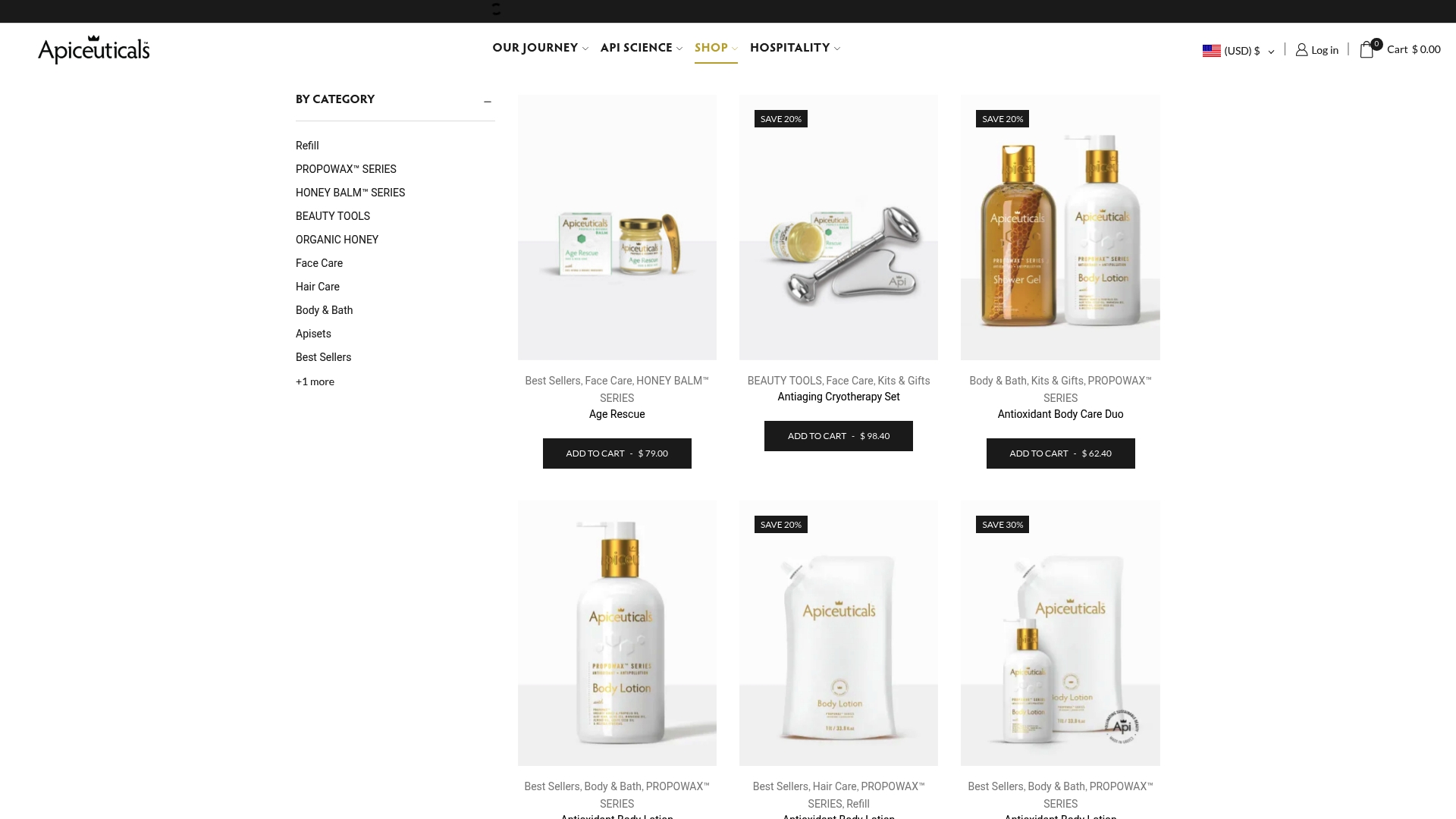
The formulation is built on Apiceuticals’ globally patented PROPOWAX™ technology, validated by the Aristotle University of Thessaloniki for the highest antioxidant activity in cosmetics. Dermatologically tested on sensitive skin with 0% irritation, it delivers clinically proven wrinkle reduction while providing the occlusive barrier support that very dry skin requires. All bee ingredients are organic and ethically harvested from Arcadian hives.
Visit Apiceuticals to see the full HONEY BALM™ range and explore the PROPOWAX™ technology behind it.
Useful sources and further reading
The following sources informed this article and are recommended for readers who want to go deeper on the chemistry, safety evidence, and clinical context:
- A comprehensive review of plant-based cosmetic oils (PMC / NCBI) — peer-reviewed comparative chemistry of plant oils, fatty acid profiles, and cosmetic applications.
- Natural oils for skin care (Integris Health) — dermatologist-level guidance on comedogenicity, skin-type matching, and sebum-mimicking lipids.
- Mineral oil safety and CIR review (NCBI) — primary regulatory and toxicological reference for cosmetic-grade mineral oil.
- PROPOWAX™ technology (Apiceuticals) — patent documentation and Aristotle University validation for the highest antioxidant activity in cosmetics.
- How to improve skin barrier: a science-backed guide (Apiceuticals) — practical barrier repair strategies and layering guidance.
- The role of beeswax in skincare: science and benefits (Apiceuticals) — functional and clinical context for beeswax as a cosmetic ingredient.
FAQ
What is the best alternative to mineral oil for the face?
Squalane and jojoba oil are the most broadly recommended alternatives for facial use, as both have very low comedogenicity and closely mimic the skin’s natural lipid profile. For dry or mature skin, a beeswax-based antioxidant balm provides occlusion plus bioactive repair that neither mineral oil nor a plain plant oil can deliver.
What are the main disadvantages of mineral oil on skin?
Mineral oil is purely occlusive: it reduces water loss but delivers no fatty acids, antioxidants, or vitamins. It also raises concerns for long-term heavy users due to potential MOSH and MOAH contamination in lower-grade fractions, though cosmetic-grade mineral oil is considered safe by the FDA and CIR.
Is Vaseline the same as mineral oil?
Vaseline (petrolatum) is a semi-solid mixture of hydrocarbons derived from the same petroleum refining process as mineral oil, but it is a different material. Petrolatum is a stronger occlusive with a thicker texture; mineral oil is liquid. Both are petroleum derivatives, both are purely occlusive, and both lack the bioactive lipids found in plant oils or beeswax balms.
Can I use coconut oil instead of mineral oil?
Standard coconut oil can replace mineral oil for body use, but it is moderately to highly comedogenic for many people and is generally not recommended for facial use on acne-prone or combination skin. Fractionated coconut oil is a lighter, less comedogenic option, though processing quality varies between suppliers.
How do I transition from mineral oil to a natural alternative without breaking out?
Introduce one new product at a time, observe for two weeks per product, and layer in the correct order: humectant on damp skin first, lightweight lipid second, balm or heavier occlusive only where needed at night. Patch test every new ingredient on the inner forearm for 48 hours before applying it to the face.
What makes PROPOWAX™ different from a standard beeswax balm?
PROPOWAX™ Living Honeycomb is a patented antioxidant delivery system, not simply a beeswax base. Validated by the Aristotle University of Thessaloniki for the highest antioxidant activity in cosmetics, it continuously releases antioxidants onto the skin rather than depositing them in a single surface layer, making it functionally distinct from any conventional beeswax formulation.
Recommended


Related posts

How bees and biodiversity sustain each other, what the science says about Greece and the Aegean, and how antioxidant beauty can start from a hive...

How organic propolis extraction works, from hive to extract: collection, solvents, EU organic rules, Greek propolis phenolics and what it means for skincare.

Build an anti pollution skincare routine that fits Greek city life: what pollution does to skin, the morning and evening steps, and the antioxidants with...

Honey moisture content explained: the EU and Greek limits, how to take a refractometer reading, what excess water does to honey, and why it matters...

How antioxidant activity measurement works: DPPH, ABTS, FRAP and ORAC explained, why results differ, and what a lab number can and cannot say about skin...















