
No products in the cart.
Return To Shop
Haircare Tips for Premium Shoppers: When to Spend
Splurge selectively, save deliberately. That is the entire discipline behind smart haircare tips for premium shoppers: reserve your budget for treatments, scalp serums, and heat protection that measurably change your hair’s condition, and spend less on basics like everyday shampoo unless your current one is genuinely failing you. Dermatologists have long noted that drugstore shampoos often perform as well as pricey brands for routine cleansing and conditioning, so premium pricing earns its place only when a formula carries costly actives, solves a specific problem, or protects those actives from breaking down before they reach your hair.
A premium option worth trusting should offer three things at once: a targeted active at a meaningful concentration, testing you can actually verify, and packaging engineered to keep unstable ingredients potent from first use to last. Apiceuticals built its haircare line around exactly that logic. Every formula in the PROPOWAX™ Antioxidant Haircare collection carries PROPOWAX™ Living Honeycomb, a delivery system holding a global patent for the highest antioxidant activity recorded in a cosmetic formulation, independently validated by Aristotle University of Thessaloniki. That is the kind of specific, checkable claim this guide will teach you to look for in every product you consider.
- Splurge on categories that change outcomes: repair treatments, scalp serums, heat protectants.
- Save on basics unless they are causing a visible problem.
- Demand a stated testing method, not just a testimonial.
- Check the first five ingredients before you check the price tag.
- Judge value by cost-per-use, not by the number on the shelf label.
Key Takeaways
Premium haircare earns its price only when it delivers a verifiable active, tested performance, and packaging that protects the formula through every use.
| Point | Details |
|---|---|
| Splurge selectively | Reserve premium spending for treatments, scalp serums, and heat protectants; save on basic shampoo unless it is underperforming. |
| Read ingredients in order | Check the first five INCI ingredients before the price tag, since list position reveals real concentration. |
| Demand a stated testing method | Trust instrumental, consumer perception, or dermatologist testing over adjectives like “transformative.” |
| Calculate cost-per-use, not sticker price | Divide price by realistic uses per bottle to compare a concentrated premium product against a cheaper, higher-dose alternative. |
| Antioxidant delivery is a real differentiator | Apiceuticals’ PROPOWAX™ Living Honeycomb holds a global patent for antioxidant activity, validated by Aristotle University of Thessaloniki, and is packaged to protect that activity through use. |
An Editorial Note on Discipline Over Impulse
Ingredient literacy is the one skill that pays for itself indefinitely, and I trust it over any single product recommendation because it never expires with the next reformulation or marketing cycle. What separates a genuinely well-spent premium haircare budget from an impulsive one is not taste or brand loyalty; it is the willingness to check a claim against its stated method before checking the price. Cost-per-use thinking sounds almost too simple to matter, yet it is the discipline that most reliably protects an affluent shopper from paying luxury prices for mass-market chemistry. Apiceuticals’ PROPOWAX™ Living Honeycomb stands out precisely because it gives that discipline something concrete to verify: a patent, a university validation, and packaging that treats the antioxidant inside as something worth protecting, not just marketing.
Table of Contents
- What Should Premium Shoppers Check First on the Label?
- Which Active Ingredients Actually Address Your Hair Concern?
- Where Should You Splurge in a Premium Routine?
- How Do You Tell a Real Claim From Marketing Language?
- What Does a Premium Haircare Routine Look Like in Practice?
- How Do You Calculate True Cost-Per-Use?
- How Long Should You Trial a Premium Product Before Judging It?
- Why Do Antioxidants Matter for Hair and Scalp Health?
- How Can Apiceuticals Fit Into a Premium Haircare Routine?
- Sources
- FAQ
What Should Premium Shoppers Check First on the Label?
Before you evaluate a premium haircare routine, train your eye to scan five things in a specific order. This is the checklist that separates a formula worth its price from one worth its packaging.
Start with the ingredient list. The first five INCI ingredients tell you almost everything about what a formula will actually do, because cosmetic ingredient lists are ordered by concentration. A brand can print “keratin” or “argan oil” in bold on the front label, but if either sits in position eighteen of twenty two, it is present at a fraction of a percent and contributing sensory polish rather than performance.
Next, look for a stated concentration or delivery mechanism rather than a bare ingredient name. Then check whether the brand names its testing method: instrumental measurement, a consumer perception study with a sample size, or dermatologist testing under supervision. After that, look at the vessel itself, since airless pumps and opaque containers protect oxygen-sensitive actives in a way a pretty glass jar with an open lid cannot. Finally, do the arithmetic: divide price by the number of realistic uses in the bottle, because that single number does more to reveal true value than anything on the front label.
- First five INCI ingredients (concentration order, not marketing order)
- Stated active concentration or delivery method
- Named testing type: instrumental, consumer perception, or dermatologist-supervised
- Packaging built to protect the formula, not just display it
- Cost-per-use math, calculated before you buy
Pro Tip: For high-use items like shampoo and leave-in treatments, concentration matters more than volume. A 200 ml bottle of a genuinely concentrated formula can outlast a 400 ml bottle of a diluted one, so always check the recommended dose per use before comparing bottle sizes.
Which Active Ingredients Actually Address Your Hair Concern?
Matching the active to the problem is where most premium haircare decisions go wrong, because brands often market a concern rather than a mechanism. Hydrolyzed proteins temporarily patch damaged cuticle and reduce breakage; cationic conditioning agents neutralize the negative charge that makes damaged hair feel rough and static; antioxidants slow the oxidative degradation that dulls color and weakens the hair shaft over time; and humectants like glycerin or panthenol pull in moisture to soften texture, though they do little for structural damage on their own.
Some of these have real mechanistic backing. Hydrolyzed keratin and hydrolyzed silk proteins bind to damaged cuticle sites through hydrogen bonding, which is measurable with instrumental testing. Others, like fragrance or certain silicones, are largely sensory: they make hair feel smooth in the moment without changing its underlying condition. Knowing which camp an ingredient falls into helps you decide whether you are paying for chemistry or paying for a feeling.
| Concern | Actives to look for | Practical note |
|---|---|---|
| Mechanical damage / breakage | Hydrolyzed keratin, hydrolyzed silk protein | Look for these in the first five ingredients; below that, the effect is marginal |
| Frizz and humidity resistance | Cationic polymers, dimethicone alternatives | Effective at low concentrations, so placement in the list matters less than for proteins |
| Color fade and dullness | Antioxidants (tocopherol, propolis-derived compounds, polyphenols) | Protect pigment molecules from oxidative breakdown; pair with UV-protective packaging |
| Thinning or shedding | Caffeine, peptides, biotin derivatives | Supportive at best; results depend on consistent use over months, not weeks |
| Scalp sensitivity or buildup | Salicylic acid derivatives, panthenol, niacinamide | Choose fragrance-light formulas if the scalp reacts to standard actives |
If your hair is color-treated or your scalp runs sensitive, treat sulfates, high-alcohol formulas, and heavy fragrance loads as things to actively avoid rather than tolerate. Color-treated hair loses pigment faster in the presence of sulfate surfactants and unprotected UV exposure, and a sensitive scalp rarely benefits from a formula that prioritizes foam over calm.
Where Should You Splurge in a Premium Routine?
Not every category rewards a higher price tag equally. Rank your spending by how much a category actually changes your results, not by how much shelf space it occupies in a department store.
- Repair and bond treatments. These carry the highest concentration of active ingredients relative to price and do the structural work basic conditioner cannot. This is where premium formulation differences show up fastest.
- Scalp serums. The scalp behaves like skin, complete with its own oxidative stress and microbiome, so a serum formulated for scalp health functions closer to skincare than to traditional haircare; for practical companion strategies on thinning and hair-loss, see Hair Loss | FitRx. Spending here often prevents problems that are far more expensive to fix later.
- Heat protectants. A well-formulated heat protectant reduces protein loss at the cuticle during styling, which compounds over months of blow-drying and flat-ironing. Skipping this step is one of the most common ways affluent shoppers undermine an otherwise premium routine.
- Leave-in treatments for texture control. These reduce the number of steps needed to achieve a finished look, which is its own form of value even before you weigh the ingredient list.
- Everyday shampoo and rinse-out conditioner. Unless your scalp or hair type demands a specific active, this is where dermatologists say spending more rarely buys more. Save here and redirect the budget upward.
A concentrated treatment used twice a week at a teaspoon per application can cost a moderate amount per use, depending on the bottle size and price. A $12 conditioner used daily at a full palm-sized dose can quietly cost more per month despite the lower shelf price. The rule that holds up across every category: spend where a product either reduces the number of steps in your routine or produces a durable outcome, and save where it is simply cleaning.
How Do You Tell a Real Claim From Marketing Language?
Credible haircare claims rest on a named method, not an adjective. When a brand describes a result, ask which of three evidence types backs it: instrumental testing measures a physical property directly, such as shine reflectance or breakage force under controlled tension; consumer perception studies survey a defined group of users after a set period and report the percentage who noticed a change; and dermatologist testing evaluates irritation or tolerance on skin or scalp under clinical supervision. Each proves something different, and a rigorous premium brand states which one it used rather than leaving the method to your imagination.
Treat vague verbs as a warning sign. “Transformative,” “revitalizing,” and “intensive” describe a feeling, not a mechanism. If a product page cannot tell you how a result was measured, on how many people, and over what timeframe, the claim is decoration. Cross-check the claim against the brand’s own technology or ingredient page rather than taking the bottle’s word for it; a brand confident in its formulation will usually link to that evidence directly.
- Instrumental testing measures a physical property with an instrument, not an opinion.
- Consumer perception studies need a stated sample size and duration to mean anything.
- Dermatologist testing under supervision matters most for scalp and sensitive-skin claims.
- Airless pumps and opaque vessels protect oxygen- and light-sensitive actives; frosted glass with an open cap does not.
- A claim with no stated method is a marketing line, not a finding.
Packaging deserves the same scrutiny as the ingredient list. Airless pump systems and opaque containers genuinely extend the shelf life of oxygen-sensitive compounds like antioxidants and certain plant-derived actives. A clear glass jar you dip fingers into looks elegant on a marble counter, but every open exposes the formula to air and contamination, which shortens the working life of the very ingredients you paid for.
What Does a Premium Haircare Routine Look Like in Practice?
A routine only performs as well as its weakest application step, so sequence and dosage matter almost as much as formulation. Build the routine in this order and adjust frequency to your texture and goals.
- Shampoo with a dose about the size of a quarter for shoulder-length hair, focusing on the scalp rather than the ends, two to four times a week depending on oil production and activity level.
- Conditioner applied mid-shaft to ends only, never at the scalp, left on for the time stated on the label rather than rinsed immediately.
- Targeted treatment (a mask or bond repair) once or twice weekly on damaged or color-treated hair, applied to towel-dried hair for better penetration.
- Heat protectant applied to damp hair before any thermal styling, distributed evenly rather than concentrated at the roots.
- Finishing product (a light oil or leave-in) applied to ends only, in an amount no larger than a dime for most lengths.
Fine hair benefits from lighter product loads applied away from the roots to avoid weighing hair down, while thick or textured hair generally tolerates and needs more product per application, particularly at the ends. Color-treated hair should avoid high-heat styling on consecutive days and benefits from an antioxidant-forward leave-in that protects pigment between salon visits. One consistent habit that beauty editors return to again and again: hydration, steady heat protection, and ingredient literacy outperform adding yet another new product to an already crowded shelf.
- Do apply conditioner and masks from mid-shaft down, never at the roots.
- Do use heat protectant on every thermal styling session, not just special occasions.
- Don’t shampoo daily unless your scalp specifically requires it.
- Don’t skip the towel-dry step before applying a treatment mask; excess water dilutes the active dose.
How Do You Calculate True Cost-Per-Use?
The formula is simple: divide the total price of the product by the realistic number of uses the bottle provides, based on your actual dose per application rather than the brand’s optimistic estimate. This single calculation, more than any other, separates genuine value from sticker shock.
A high sticker price is not automatically a bad deal, and a low one is not automatically a good one. Premium shampoos often cost significantly more per wash than mass-market bottles, which supports the case for saving on daily cleansers unless a specific problem demands otherwise. The heat protectant, by contrast, delivers a metered airless dose that keeps cost per use modest even at a premium price point, because the packaging prevents the waste and evaporation that plague open-jar or loosely capped alternatives. Concentration and dosing accuracy, not the number on the price tag, decide whether a premium product is actually the better deal.
How Long Should You Trial a Premium Product Before Judging It?
Give any new premium product a fixed, staged trial rather than a single wash-and-decide moment. A disciplined trial treats your bathroom shelf like a small experiment, changing one variable at a time so you can trust what you’re actually seeing.
- After one wash: note immediate texture, slip during detangling, and how hair feels once fully dry. This tells you about sensory performance, not long-term efficacy.
- After three uses or roughly two weeks: watch for changes in frizz control, how the hair behaves in humidity, and whether you need less styling product to get the same finish.
- After six to eight weeks: this is the real test window for structural claims like reduced breakage, improved elasticity, or color retention, since hair growth and repeated wash cycles reveal whether the active is actually working below the surface.
Pro Tip: Swap only one product at a time, and hold your styling routine, heat tool settings, and wash frequency constant during the trial. Introducing a new shampoo and a new mask in the same week makes it impossible to know which one produced the result you’re seeing.
Document what you observe rather than relying on memory. A phone note logging shine, breakage at the sink or brush, and how much product you needed to achieve your usual look gives you an honest record to compare against the next product you consider, premium or otherwise.
Why Do Antioxidants Matter for Hair and Scalp Health?
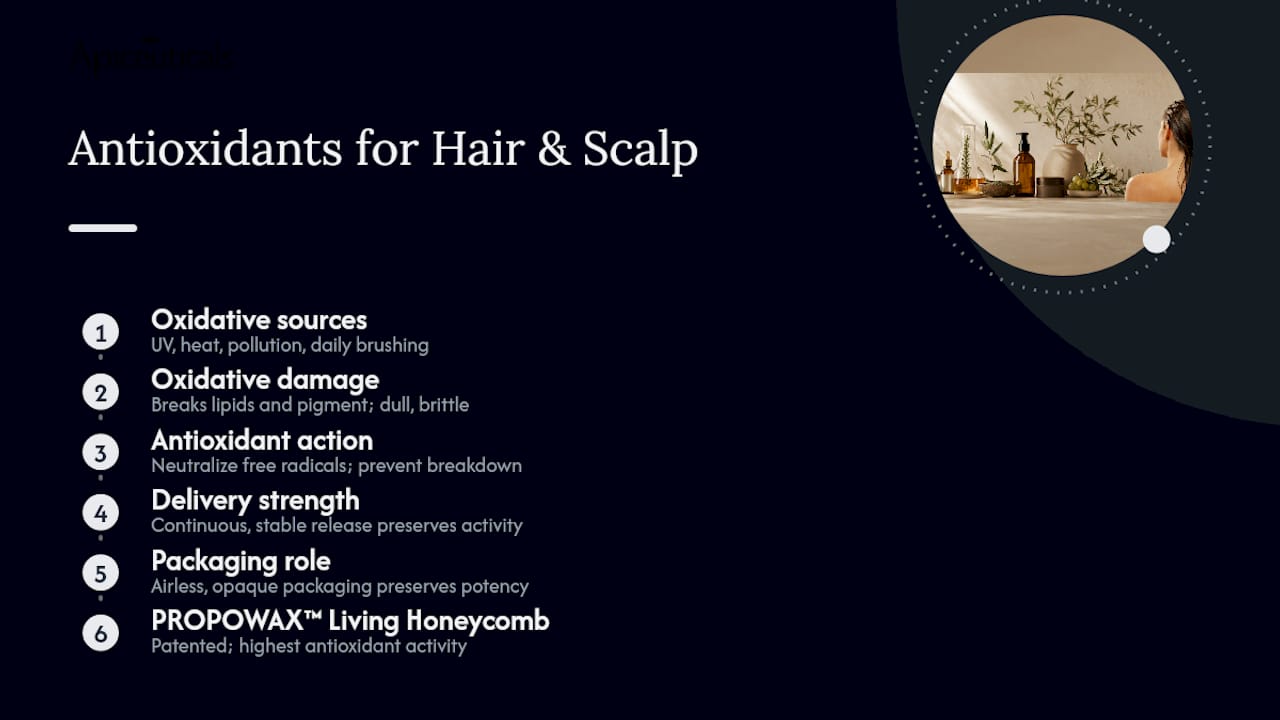
Hair and scalp age through oxidative stress in much the same way skin does, and the comparison beauty scientists reach for most often is rust forming on exposed metal. UV exposure, heat styling, pollution, and even the friction of daily brushing generate free radicals that degrade the lipids coating each hair strand and destabilize the pigment molecules responsible for color. Left unchecked, that oxidative process is what turns hair dull, brittle, and prone to premature fading, particularly in color-treated strands where pigment is already more fragile.
Antioxidants interrupt that process by neutralizing free radicals before they can break down lipids and pigment, which is why an antioxidant-forward formula behaves differently over months of use than one built purely around surfactants and silicones. The scalp, functioning as its own living ecosystem of skin, follicles, and microbiome, responds to the same oxidative pressures and benefits from the same protective chemistry.
The strength of an antioxidant delivery system is not just which molecule it uses, but how continuously and stably it releases that molecule onto hair and scalp before oxidation degrades it first.
This is the exact engineering problem Apiceuticals built PROPOWAX™ Living Honeycomb to solve. The technology holds a global patent for the highest antioxidant activity recorded in a cosmetic formulation, a claim independently validated by Aristotle University of Thessaloniki rather than asserted on marketing copy alone. Packaging plays a direct role here too: antioxidants are inherently unstable in the presence of air and light, so the same airless, opaque delivery systems discussed earlier in this guide are not a cosmetic flourish when they house an antioxidant formula. They are the mechanism that keeps the active potent from the first pump to the last.
How Can Apiceuticals Fit Into a Premium Haircare Routine?
If the checklist in this guide has you looking for a formula that actually earns its price, PROPOWAX™ Antioxidant Haircare was built around the same standard: a stated testing rationale, an ingredient system built on a validated antioxidant delivery mechanism, and packaging designed to protect that mechanism rather than just display it.

Every formula in the line channels PROPOWAX™ Living Honeycomb, the patented delivery system behind Apiceuticals’ antioxidant technology, continuously releasing antioxidant compounds onto hair and scalp rather than depositing them once and letting oxidation take over. For readers who want to start with a lower-commitment introduction rather than a full-size bottle, the premium haircare gift set offers a practical way to run the staged trial described earlier in this guide across more than one product at once. If you are still mapping out which categories in your own routine deserve the upgrade, the complete hair care essentials guide walks through pairing and sequencing in more detail. Start with the PROPOWAX™ technology page if you want the evidence first, or go straight to the haircare shop if you already know what your routine is missing.
Sources
- What the experts have to say about expensive shampoos | AP News
- Is Luxury Haircare Worth It? Performance vs Packaging
- The luxury hair care edit: shampoos, scalp serums and treatments that justify the price per wash
FAQ
What Are the Golden Rules of Haircare for Premium Shoppers?
Read the ingredient list before the price tag, demand a stated testing method, protect actives with proper packaging, and calculate cost-per-use rather than judging by sticker price alone.
What Are Some Good Haircare Tips for Premium Shoppers Specifically?
Splurge on categories that change durable outcomes, like repair treatments and scalp serums, and save on everyday cleansers unless your current one is causing a visible problem.
What Are Three Do’s and Don’ts of Premium Haircare Shopping?
Do check the first five INCI ingredients, do trial one product at a time over six to eight weeks; don’t trust adjectives like “transformative” without a stated testing method, and don’t assume decorative packaging protects the formula inside.
What Are Five Ways to Take Care of Premium Hair on a Budget That Still Performs?
Wash only as often as your scalp needs, apply conditioner and masks from mid-shaft down, use heat protectant every time you style with heat, choose concentrated formulas over larger diluted bottles, and calculate cost-per-use before comparing prices.
How Long Does It Take to See Results From a Premium Haircare Product?
Expect to notice immediate texture changes after one wash, shifts in frizz and manageability within two weeks, and structural improvements like reduced breakage or better color retention only after six to eight weeks of consistent use.
Why Do Antioxidants Matter in Premium Haircare?
Antioxidants slow the oxidative damage that dulls color and weakens hair fiber over time; Apiceuticals’ PROPOWAX™ Living Honeycomb delivers this protection through a patented system validated by Aristotle University of Thessaloniki.
Recommended


Related posts

How bees and biodiversity sustain each other, what the science says about Greece and the Aegean, and how antioxidant beauty can start from a hive...

How organic propolis extraction works, from hive to extract: collection, solvents, EU organic rules, Greek propolis phenolics and what it means for skincare.

Build an anti pollution skincare routine that fits Greek city life: what pollution does to skin, the morning and evening steps, and the antioxidants with...

Honey moisture content explained: the EU and Greek limits, how to take a refractometer reading, what excess water does to honey, and why it matters...

How antioxidant activity measurement works: DPPH, ABTS, FRAP and ORAC explained, why results differ, and what a lab number can and cannot say about skin...















