No products in the cart.
Return To Shop
How to Layer Skincare Products for Maximum Results
TL;DR:
- Applying skincare from thinnest to thickest maximizes absorption and minimizes pilling by preventing occlusion.
- Separating active ingredients like retinol and acids into different routines enhances their effectiveness and reduces irritation.
Getting the order of skincare products right is one of the most consequential decisions you make for your skin every morning and evening. Most people know they should cleanse before moisturizing, but the nuances of how to layer skincare products — specifically when to apply serums, how to handle active ingredients, and where antioxidants fit — remain genuinely confusing. Incorrect sequencing doesn’t just waste money on expensive formulations; it can actively block absorption, cause irritation, or neutralize actives before they reach the skin. This guide cuts through the confusion with a science-backed, step-by-step approach.
Table of Contents
- Key Takeaways
- How to Layer Skincare Products: the foundational rules
- Step-by-step skincare layering routine
- Common layering mistakes that undermine results
- Morning versus evening routines: adapting layering to purpose
- The perspective from Apiceuticals
- Antioxidant skincare designed for precise layering
- FAQ
Key Takeaways
| Point | Details |
|---|---|
| Thinnest to thickest always | Apply products from the most watery textures to the heaviest creams and oils to maximize absorption. |
| Actives conflict if stacked | Retinol and AHAs/BHAs should never be applied together; separate them into morning and evening routines. |
| Wait times prevent pilling | Allow 10 to 30 seconds between lightweight layers and 1 to 3 minutes before heavier treatments. |
| Antioxidants belong in the morning | Layer antioxidants like vitamin C in the AM to neutralize free radicals and reinforce SPF protection. |
| Consistency beats complexity | A focused four-step routine practiced consistently outperforms a ten-step routine applied sporadically. |
How to Layer Skincare Products: the foundational rules
Before touching a single product, understanding what each category does determines whether your routine is coherent or chaotic. Skincare products fall into distinct functional groups: cleansers remove surface debris and excess oil; toners and essences restore pH balance and deliver lightweight hydration; serums deliver concentrated actives to target specific concerns; moisturizers replenish the skin barrier; face oils add occlusive support; and sunscreens form the final protective shield in the morning.
The governing principle behind any effective skincare product sequence is molecular weight. Water-based, lightweight formulas have smaller molecules that penetrate the skin more readily. Heavier creams and oils form a surface film that, applied too early, physically blocks subsequent products from absorbing. Applying thinnest to thickest maximizes active ingredient delivery and is the single most important rule in the entire discipline.
Your skin type and concerns shape which products you actually need. Oily skin benefits from gel-based moisturizers and water-light serums, while dry skin requires richer emollients. Combination skin often calls for zone-specific application. Beyond texture, understanding active ingredients is non-negotiable:
- Vitamin C (L-ascorbic acid): A potent antioxidant that protects against oxidative stress and brightens the complexion; best suited to the morning
- Retinol: Accelerates cell turnover and reduces the appearance of fine lines; reserved for evening use
- AHAs and BHAs: Exfoliating acids that refine texture and clear pores; used at night and never simultaneously with retinol
- Niacinamide: A multi-function active that regulates sebum, minimizes pores, and reinforces the barrier; compatible with most other ingredients
- Antioxidant complexes: Broad-spectrum free radical neutralizers, including PROPOWAX™ Living Honeycomb, which holds a global patent for antioxidant activity validated by the Aristotle University of Thessaloniki
Pro Tip: If you want to understand whether a serum belongs early or late in your routine, rub a small amount between your fingers. If it disappears in under three seconds, it goes on early. If it leaves a slight residue, it needs to sit on top of lighter layers.
Step-by-step skincare layering routine
The sequence below applies to a full routine. Not everyone will use every step, and that is perfectly appropriate. The logic matters more than the product count.
- Cleanser. Start with a cleanser matched to your skin type. Remove makeup first if needed, then cleanse to clear pores and prepare skin to receive actives. Skin that is not properly cleansed creates a debris barrier that blocks every subsequent product.
- Toner or essence. Apply immediately after cleansing while skin is slightly damp. These lightweight, water-based formulas restore pH balance and begin hydration. Pat gently rather than wiping to avoid dragging the skin barrier.
- Water-based serums. These come first among treatments, directly after toner. Target specific concerns here: a vitamin C serum in the morning, or a hyaluronic acid serum to reinforce hydration. Vitamin C applied before niacinamide optimizes antioxidant benefits, and earlier concerns about their incompatibility have since been debunked by clinical testing.
- Treatment actives. Retinoids, exfoliating acids, or concentrated repair treatments follow water-based serums. These actives need to be as close to clean skin as possible to work effectively. Avoiding retinoids with AHAs/BHAs at the same application is one of the most critical rules in skincare layering steps. Use one or the other, not both in the same session.
- Moisturizer. A moisturizer seals in the layers below. Applied after serums, it does not block actives as long as those actives were given adequate absorption time. At night, this is often the final step before any face oil.
- Face oil (optional, usually PM). Oils are occlusive. Face oils applied last form a barrier that reduces transepidermal water loss. In the morning, oil can be layered under sunscreen if it is a dry oil that absorbs quickly, but most skin types do best leaving oils to the evening.
- Sunscreen (AM only). SPF is always the final morning step. Daily SPF 30 or higher is non-negotiable regardless of season or cloud cover, since UVA radiation penetrates glass and overcast skies equally. Apply it generously and do not dilute it with another product on top.
Timing between layers
Recommended wait times between layers range from 10 to 30 seconds for toners and essences and 1 to 3 minutes before applying heavier treatments or moisturizers. The goal is ensuring each product feels absorbed before the next goes on. Rushing this step is the single most common cause of product pilling.

| Layer | Product type | Wait time before next layer |
|---|---|---|
| 1 | Cleanser | Rinse off, pat dry |
| 2 | Toner or essence | 10 to 30 seconds |
| 3 | Water-based serum | 1 to 2 minutes |
| 4 | Treatment active | 1 to 3 minutes |
| 5 | Moisturizer | 2 to 3 minutes |
| 6 | Face oil (PM) | Last step, no wait needed |
| 7 | Sunscreen (AM) | Last step, no wait needed |
Pro Tip: If your products consistently pill, the issue is almost always layering order or inadequate wait time. Start by checking whether your serum was applied before rather than after your toner.
Common layering mistakes that undermine results
Understanding what goes wrong is as instructive as knowing what goes right. The most consequential errors in how to apply skincare involve either the wrong sequence or the wrong combination of actives.
- Applying moisturizer before serum. This is by far the most widespread error. Applying thick moisturizers before serums blocks absorption and reduces the effectiveness of every active treatment you layer on top. The moisturizer forms a physical barrier. Serums always precede moisturizer.
- Stacking incompatible actives. Retinol and AHAs combined in one session strip the acid mantle and trigger inflammatory responses. Vitamin C at high concentrations alongside acids can also destabilize. The fix is simple: separate them by time of day, or alternate them on different evenings.
- Using more than two serums per routine. More than two serums is generally counterproductive. Ingredient overlap reduces absorption, and the cumulative load increases the risk of irritation. Select serums that address distinct needs, such as one for antioxidant protection and one for targeted hydration or repair.
- Skipping sunscreen or applying it mid-routine. Sunscreen works by sitting undisturbed on the skin’s surface. Anything applied over it dilutes the UV filter matrix and lowers the effective protection factor.
- Overloading sensitive skin with actives. More is not more. Adding unnecessary products can reduce absorption and increase irritation. A targeted routine of four to five products applied in the correct skincare product sequence consistently outperforms a cluttered ten-step approach.
One of the less discussed but scientifically important aspects of correct layering is its relationship to oxidative stress. Free radicals generated by UV exposure, pollution, and metabolic activity degrade the structural proteins of the skin in a manner similar to how oxygen slowly corrodes metal. Integrating a validated antioxidant into the routine, such as a formulation built on the PROPOWAX™ Living Honeycomb platform, supports the skin’s capacity to neutralize those free radicals before structural damage accumulates.
Correct layering is not about complexity. It is about giving each active ingredient the conditions it needs to perform the function it was designed for. Every unnecessary layer you remove from your routine is a decision in favor of efficacy.
Morning versus evening routines: adapting layering to purpose
The most important conceptual shift in building the best skincare routine is understanding that morning and evening routines have fundamentally different objectives. Morning routines protect; evening routines repair. That distinction should guide every product selection and sequence decision.
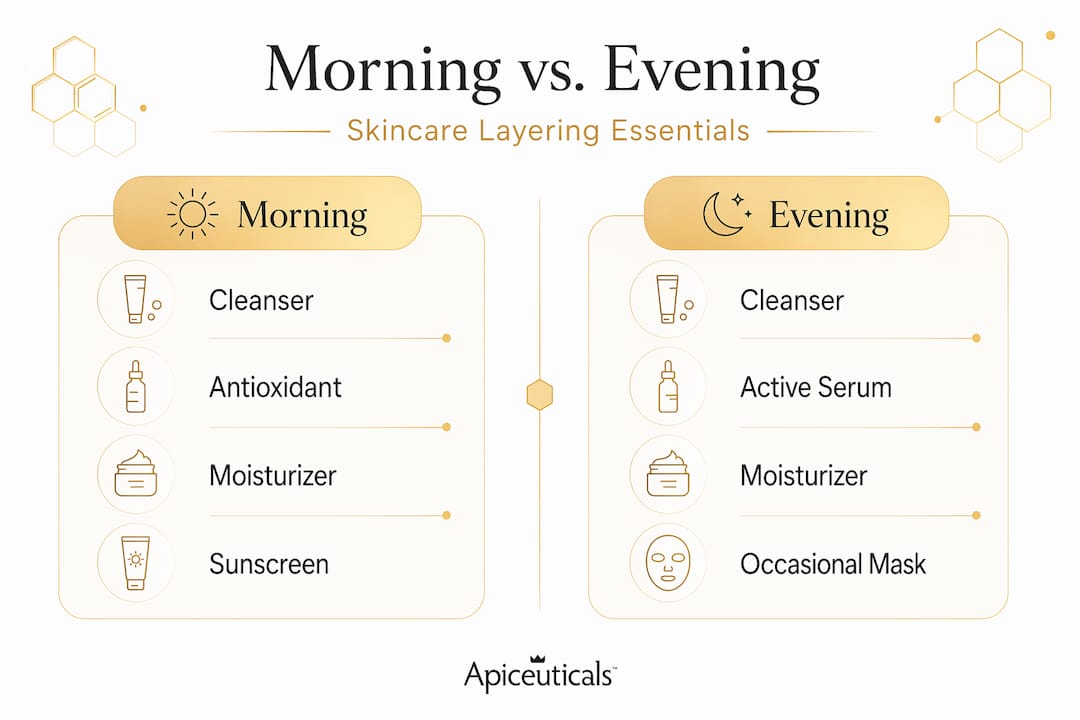
Morning layering prioritizes antioxidant defense and UV protection. The skin is exposed to environmental aggressors throughout the day, and the role of the AM routine is to arm it against those threats. Vitamin C serum applied directly after toning sits at the core of a protective morning stack, followed by a hydrating moisturizer and broad-spectrum SPF.
Evening layering shifts the focus to cellular repair and renewal. Retinoids accelerate cell turnover at night when the skin enters its natural regenerative phase, making them most effective when applied PM. Exfoliating acids follow the same logic. The absence of sunscreen in the evening routine allows you to use an occlusive moisturizer or face oil as the final sealing step without disrupting SPF integrity.
Adjustments by skin type also matter for layering skincare for oily skin versus dry or combination skin:
- Oily skin: Use gel or water-based textures at every step; skip face oils in the evening or use a single drop of a dry, non-comedogenic option; prioritize niacinamide to regulate sebum
- Dry skin: Add a hydrating essence or a second humectant layer; opt for richer cream moisturizers; face oils at night are highly beneficial
- Sensitive skin: Limit actives to one per session, buffer retinoids with a thin layer of plain moisturizer applied immediately before, and extend wait times between layers
- Combination skin: Apply lighter textures across the T-zone and richer products on dry areas; adapt seasonally
Seasonal adaptation matters more than most people acknowledge. In winter, the skin barrier is under additional stress from heating systems, cold air, and reduced humidity. Switching to richer moisturizer textures and adding a ceramide serum to the evening routine compensates for that added loss of moisture. In summer, lighter gel formulas reduce congestion and support SPF adhesion. Simplicity combined with consistency delivers superior long-term results compared to a complex routine practiced only occasionally.
Pro Tip: When transitioning to a new active like retinol or an exfoliating acid, introduce it every third night for two weeks before increasing frequency. This allows the skin barrier to adapt without the inflammatory response that derails so many routines.
The perspective from Apiceuticals
In my experience working with antioxidant-rich formulations over many years, the most transformative shift for anyone’s skin rarely comes from finding a new product. It comes from understanding why the sequence matters. I’ve seen sophisticated routines fail entirely because a thick cream was applied before a serum, blocking every active that followed. The science is unambiguous: proper layering maximizes penetration and reduces irritation by ensuring actives reach the skin without occlusion.
What I find most compelling is how antioxidant layering specifically changes the conversation. Antioxidants don’t just protect in the moment. When delivered into skin that has been properly cleansed and primed, they build a cumulative resilience that you can measure over months. PROPOWAX™ Living Honeycomb was developed because we wanted that antioxidant delivery to be continuous, not a single burst from a morning application. The Aristotle University of Thessaloniki independently validated the technology’s antioxidant activity, and that scientific confirmation matters because it grounds the formulation in evidence rather than aspiration.
My honest advice is this: master four steps before adding a fifth. Cleanse, treat with one targeted active, moisturize, and protect with SPF. Do that correctly, in sequence, for 60 days. You will see more meaningful results than most people achieve with ten products applied in the wrong order. An antioxidant-rich routine does not need to be elaborate. It needs to be consistent and scientifically sound.
— Apiceuticals
Antioxidant skincare designed for precise layering
The principles in this guide translate directly into how Apiceuticals formulates every product in its collection.

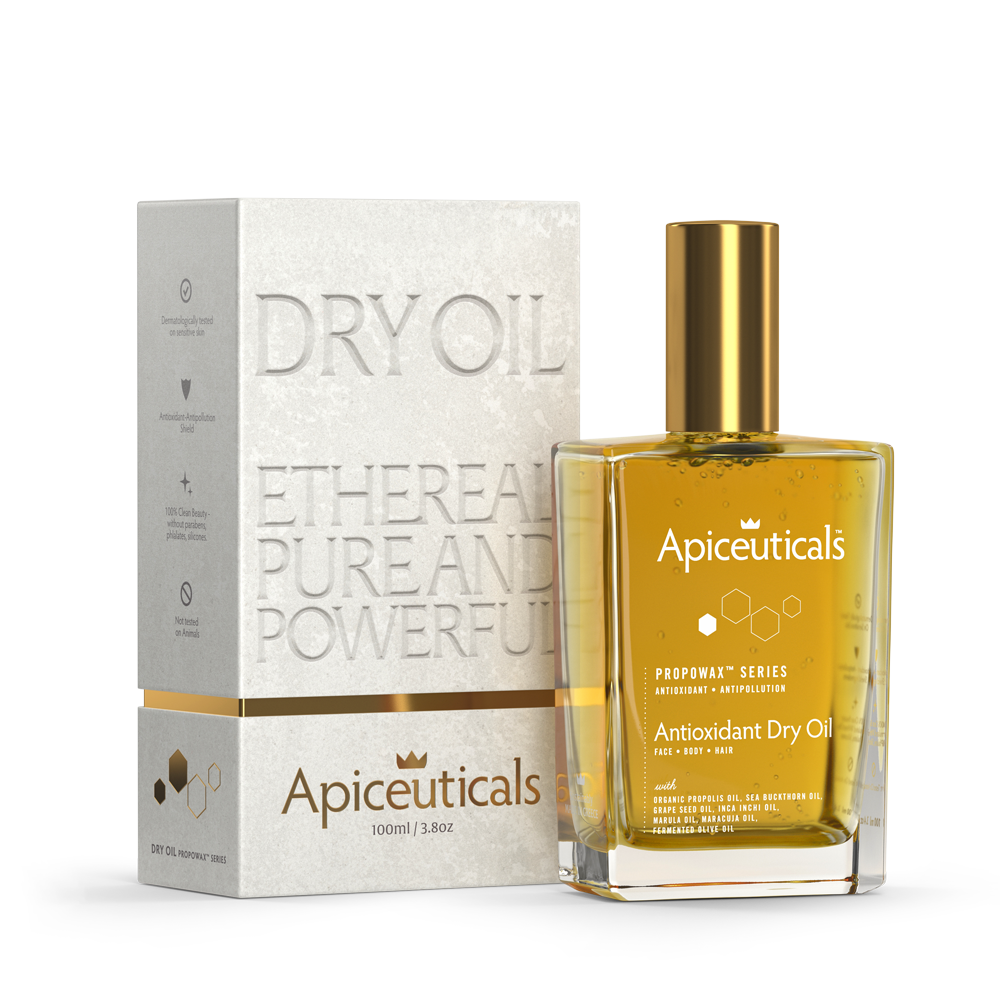
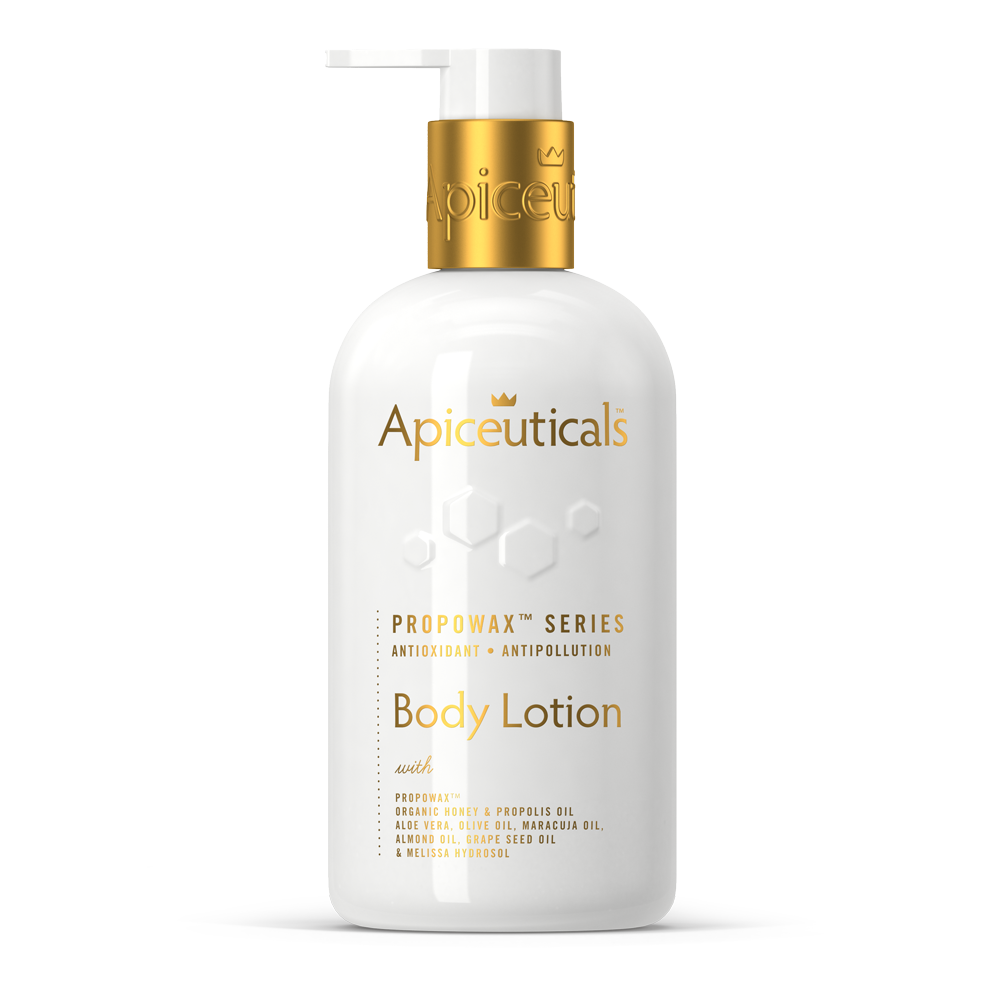
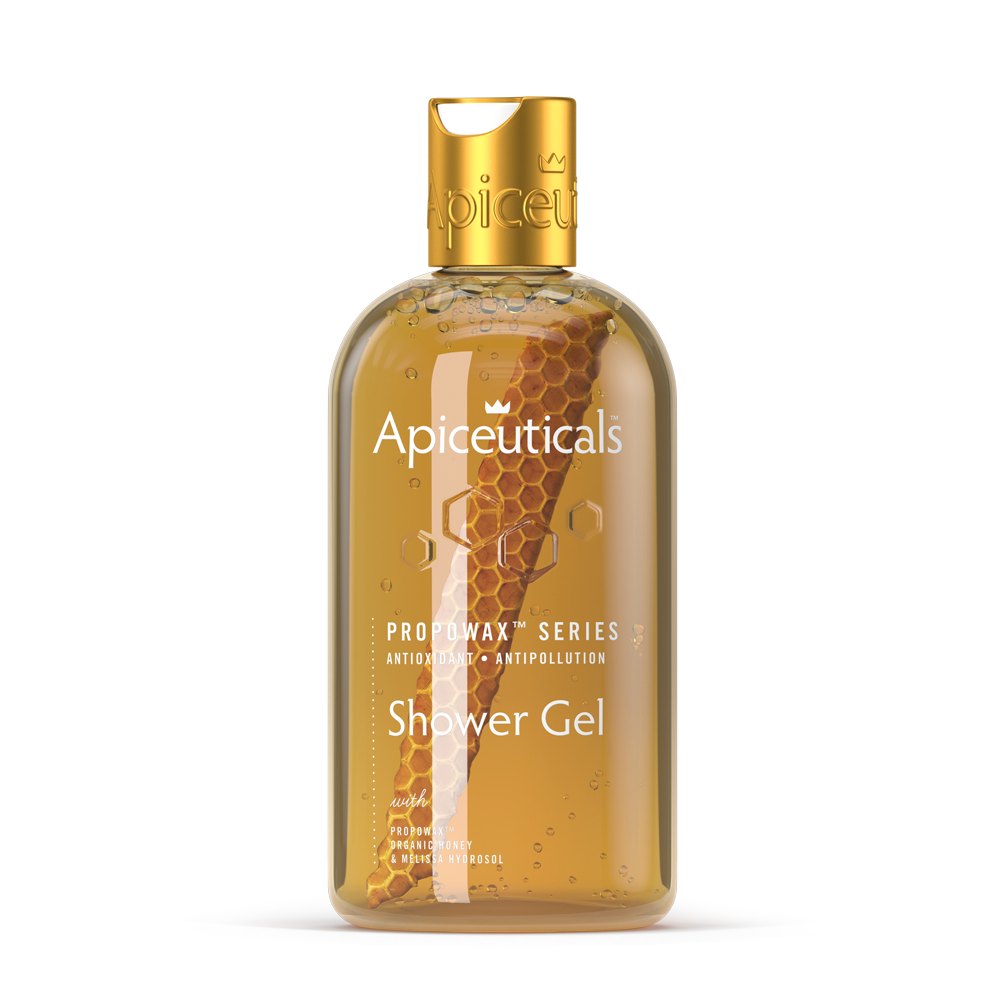
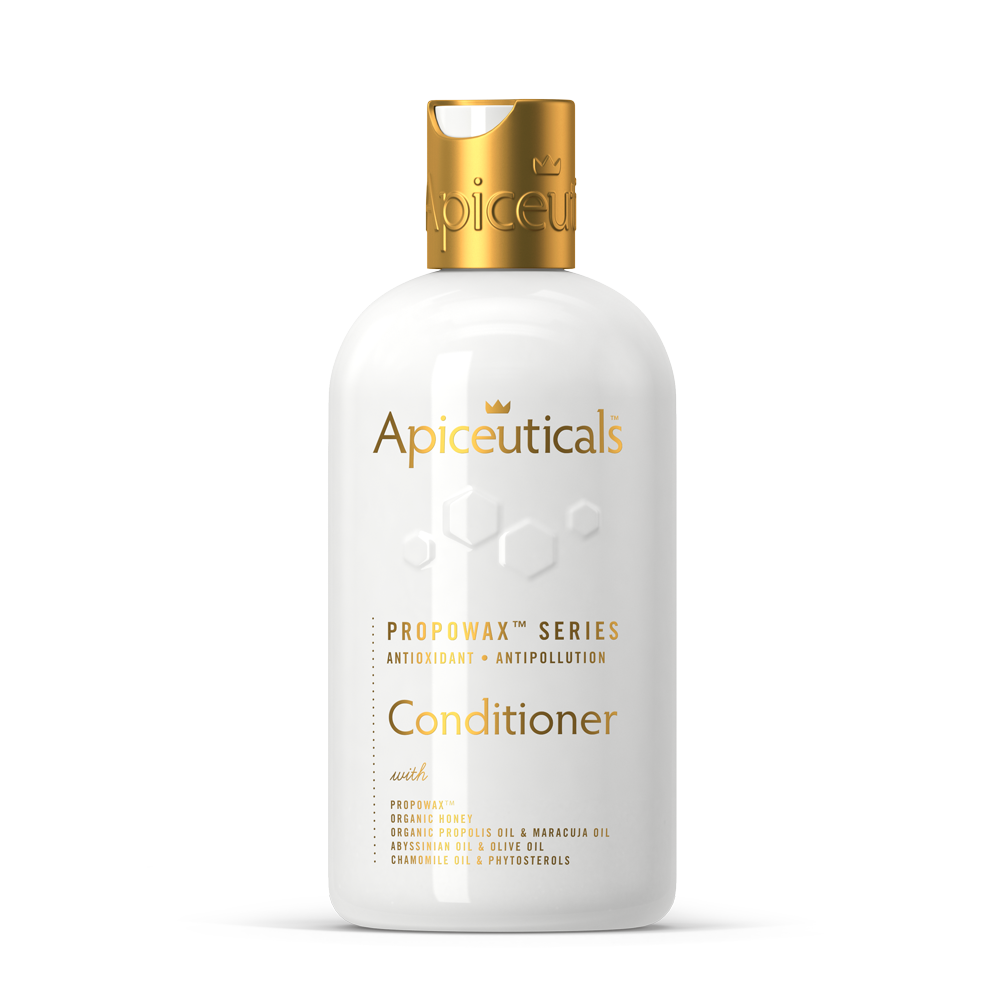
Apiceuticals builds each formula around PROPOWAX™ Living Honeycomb, a patented technology that continuously releases antioxidants onto skin rather than delivering a single application dose. That design philosophy aligns precisely with the layering logic described here: each product works within a sequence, not in isolation. The HONEY BALM™ Series, a waterless facial care line with clinically proven 26% wrinkle reduction, integrates seamlessly into an evening repair routine, while the antioxidant-forward formulations in the PROPOWAX™ Series are designed to sit effectively within a protective morning stack. Explore the full range of antioxidant skin care products at Apiceuticals, or deepen your understanding through the bee-powered skin science resource.
FAQ
What is the correct order of skincare products?
The correct order of skincare products moves from thinnest to thickest: cleanser, toner or essence, water-based serum, treatment active, moisturizer, face oil (PM), and sunscreen (AM only). This sequence ensures each product absorbs before the next layer is applied.
How do you layer serums without pilling?
Apply serums in order of consistency, starting with the most watery formula, and wait 1 to 2 minutes between each. Pilling almost always results from rushing the sequence or applying a serum over a product that has not yet absorbed.
Can you layer vitamin C and niacinamide together?
Yes. Vitamin C and niacinamide are stable and complementary when layered correctly. Apply vitamin C first to maximize antioxidant absorption, then follow with niacinamide. Earlier concerns about their incompatibility have been debunked in clinical testing.
How many serums should you use in one routine?
Using more than two serums per routine is generally counterproductive. Two is the practical maximum for most skin types, balancing targeted treatment with absorption efficiency and minimizing the risk of irritation from ingredient overlap.
Should sunscreen go on last in the morning?
Sunscreen is always the final step in a morning routine. Applying anything over SPF dilutes the UV filter matrix and reduces the effective protection factor. Apply it generously over moisturizer and allow it to settle before any cosmetic application.
Recommended


Related posts

How bees and biodiversity sustain each other, what the science says about Greece and the Aegean, and how antioxidant beauty can start from a hive...

How organic propolis extraction works, from hive to extract: collection, solvents, EU organic rules, Greek propolis phenolics and what it means for skincare.

Build an anti pollution skincare routine that fits Greek city life: what pollution does to skin, the morning and evening steps, and the antioxidants with...

Honey moisture content explained: the EU and Greek limits, how to take a refractometer reading, what excess water does to honey, and why it matters...

How antioxidant activity measurement works: DPPH, ABTS, FRAP and ORAC explained, why results differ, and what a lab number can and cannot say about skin...