No products in the cart.
Return To Shop
How to Prevent Premature Aging: A Science-Backed Guide
To prevent premature aging, combine daily sun protection with consistent lifestyle habits and an antioxidant-forward topical routine. None of the three works alone. This morning, apply a broad-spectrum SPF 30+, take a 20 to 30 minute brisk walk, and if you smoke, start looking into cessation support today. Two numbers anchor everything that follows: SPF 30 or higher, worn daily, and 150 minutes a week of moderate activity. Where topical care fits into that equation, Apiceuticals approaches it through PROPOWAX™ Living Honeycomb, a patented antioxidant-delivery system built around the same oxidative-stress science that dermatologists use to explain why skin ages faster than it should.
Key Takeaways
Preventing premature aging works best as a combined system: daily broad-spectrum sun protection, consistent lifestyle habits, and continuous antioxidant defense together outperform any single intervention alone.
| Point | Details |
|---|---|
| Sun protection is foundational | Apply SPF 30 or higher daily, and add a hat and sunglasses to reduce both UV exposure and squint-related wrinkles. |
| Lifestyle habits compound | Movement, sleep, diet, and stress reduction together can account for up to a 10-year difference in biological aging. |
| Layer antioxidants under sunscreen | Antioxidant serums neutralize free radicals from sun and pollution before they damage collagen. |
| Extend care beyond the face | Neck, chest, and hands age on the same timeline and need the same routine. |
| Apiceuticals approach | PROPOWAX™ Living Honeycomb delivers antioxidants continuously rather than in a single dose, based on a patent independently validated by Aristotle University of Thessaloniki. |
An Antioxidant-First Way to Complement Your Prevention Routine

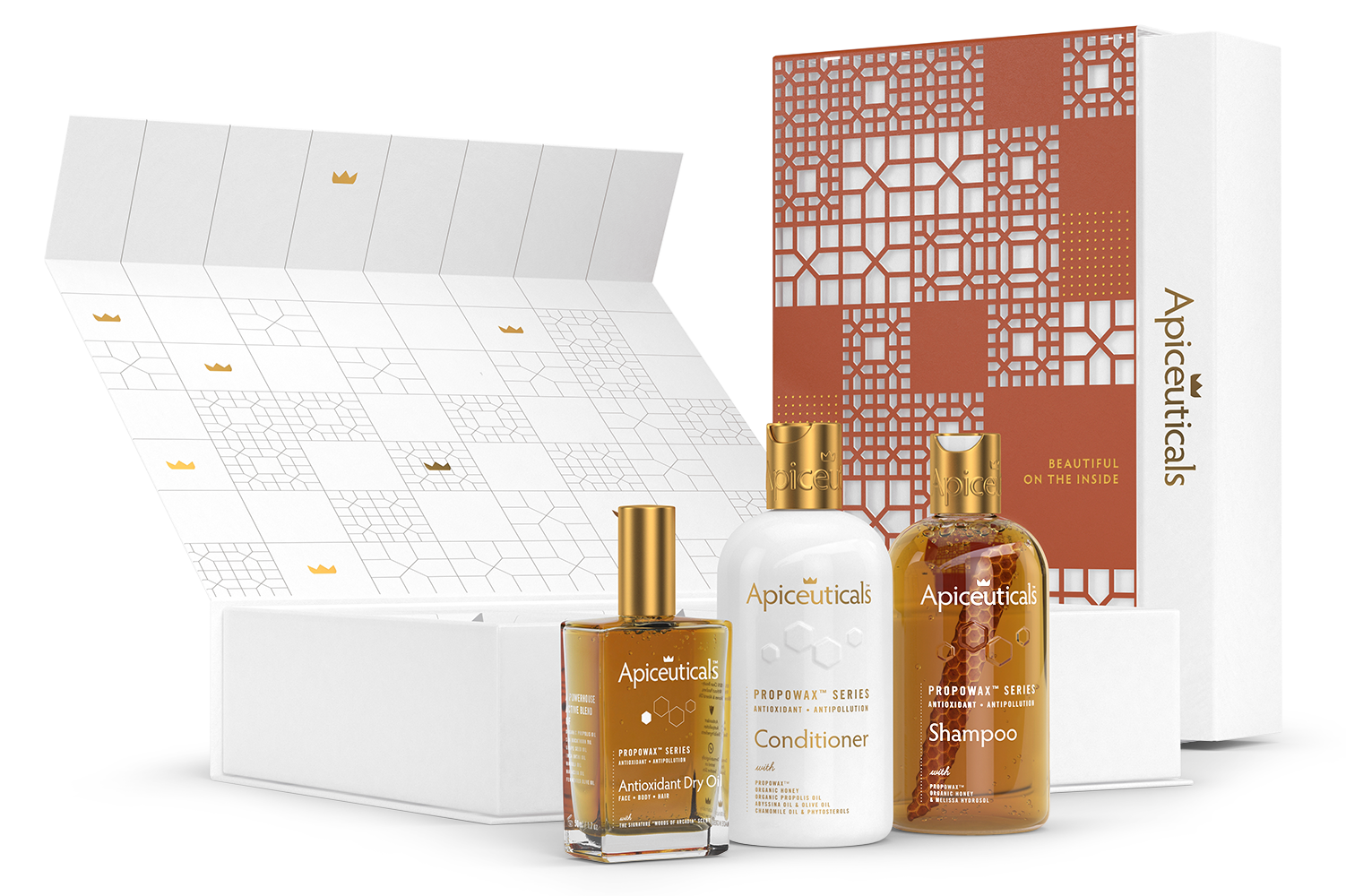
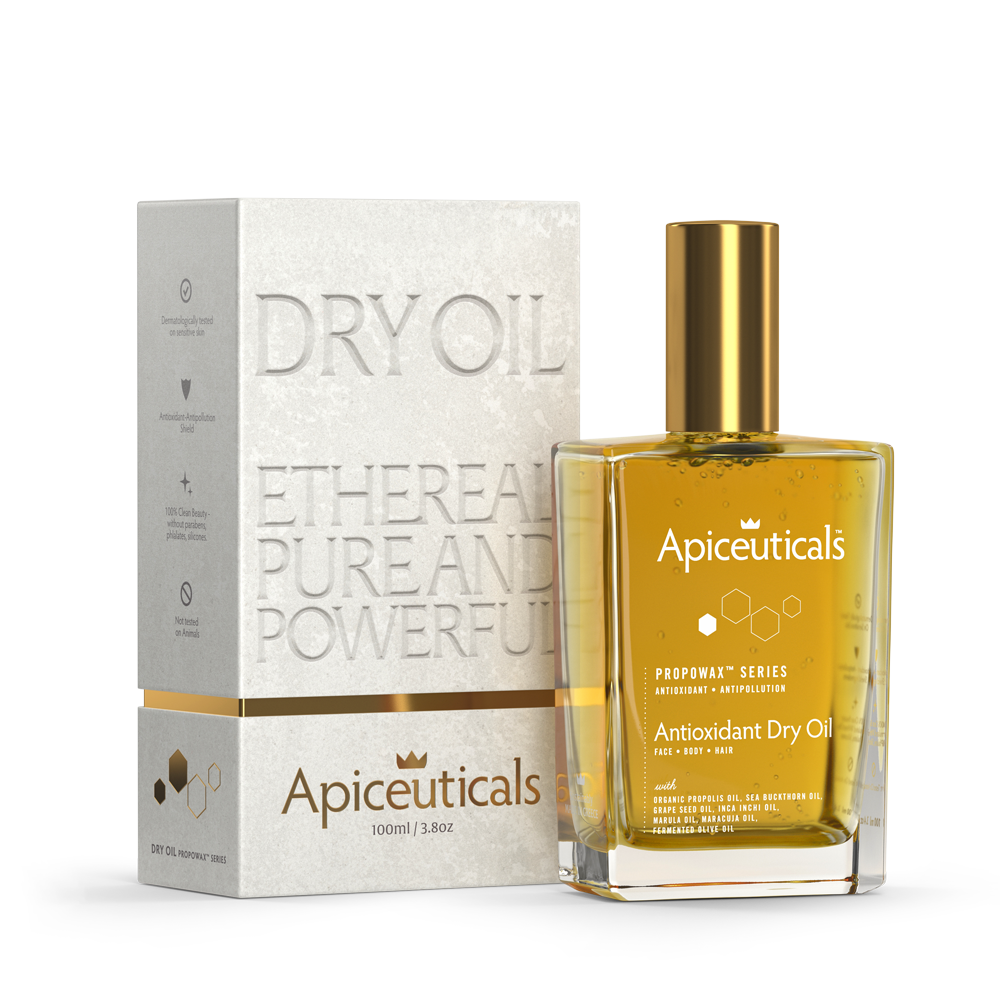
Everything in this guide points toward the same conclusion: skin needs continuous antioxidant defense, not a single morning application that fades by noon. That’s the specific gap Apiceuticals built PROPOWAX™ Living Honeycomb to close, a patented structure inside each formula that keeps releasing antioxidants onto skin, scalp, and hair throughout the day rather than depositing them once and stopping. The patent covers the highest recorded antioxidant activity in cosmetics, independently validated by Aristotle University of Thessaloniki. If you’ve started the sunscreen and lifestyle habits covered above and want a topical layer built on that same continuous-release principle, browse the Apiceuticals collection to see which formula fits your routine, or explore antioxidant body care for areas beyond the face.
A Note From Apiceuticals
Apiceuticals grew out of the Roumeliotis family’s beekeeping practice, running since 1981 in Arcadia. That heritage shaped a research orientation, not a marketing one: every formula answers to the same oxidative-stress science covered throughout this guide before it answers to a product brief. Pair the lifestyle habits above with topical care built on that evidence, and prevention becomes a routine rather than a rescue mission.
This article is general information, not a substitute for advice from a qualified doctor. Consult a qualified healthcare professional about your own circumstances before acting on anything here.
Table of Contents
- What Lifestyle Changes Actually Slow Visible Aging?
- What Skincare Routine Actually Prevents Premature Aging?
- Why Antioxidants Matter for Preventing Premature Aging
- When Should You See a Dermatologist About Aging Skin?
- A 4-Week Plan to Start Preventing Premature Aging
- How Does Pollution Accelerate Skin Aging?
- Does Drinking More Water Actually Improve Skin?
- How Do Hormones Affect Skin Aging?
- Can Facial Expressions Cause Wrinkles Over Time?
- Why Do Regular Skin Check-Ups Matter Beyond Visible Signs?
- Sources
- FAQ
What Lifestyle Changes Actually Slow Visible Aging?
Skin does not age in isolation. It ages alongside the rest of the body, which is why the most durable answer to how to prevent premature aging has almost nothing to do with what you put on your face first thing in the morning. Harvard Health frames healthy aging around five pillars: movement, nutrition, sleep, stress reduction, and social connection. Each one acts on a different biological pathway, from inflammation to collagen synthesis to cellular repair, and the effects compound.
Pro Tip: Pair your walk with a phone call to a friend. You get the cardiovascular benefit and the social-connection pillar in the same twenty minutes.
- Move consistently. Target 150 minutes of moderate aerobic activity a week, or 75 minutes of vigorous activity, plus resistance training twice weekly to preserve muscle mass, which naturally declines with age.
- Eat plant-forward. A Mediterranean-style pattern rich in vegetables, olive oil, and fish, with reduced refined sugar, limits the glycation that stiffens collagen fibers over time.
- Moderate alcohol and quit smoking. Smoking accelerates collagen breakdown and narrows blood vessels near the skin’s surface; quitting is one of the few interventions with an immediate, measurable effect on skin tone.
- Protect sleep. Seven to eight hours on a consistent schedule supports the nightly repair window when skin cells regenerate most actively.
- Manage stress. Chronic cortisol elevation degrades collagen and disrupts the skin barrier, so even brief daily stress-reduction practice, paired with movement, helps.
Adherence to these habits together, not any single one, can account for as much as a 10-year difference in biological aging. That is a wider spread than most skincare interventions will ever produce on their own.
What Skincare Routine Actually Prevents Premature Aging?
Topical care works best as a layered daily system, not a single hero product. In the morning, cleanse gently only if needed (many people can skip a cleanser step entirely after a clean night’s sleep), apply an antioxidant serum, then finish with broad-spectrum SPF 30 or higher. Physical protection matters just as much as the sunscreen tube: a wide-brim hat and sunglasses reduce both UV exposure and the squinting that etches crow’s feet into the skin around the eyes.
At night, remove sunscreen and makeup with a gentle cleanser rather than a harsh scrub, which damages the skin barrier rather than renewing it. Harvard Health recommends introducing retinoids gradually, since they boost collagen production and cell turnover but can irritate skin that isn’t acclimated. Start two to three nights a week, watch for redness or peeling, and increase frequency only once skin tolerates it. Follow with a moisturizer that supports rather than strips the barrier.
- Cleanse gently, morning optional, night mandatory
- Antioxidant serum before sunscreen, every morning
- SPF 30+ broad-spectrum, reapplied if outdoors past midday
- Retinoid two to three nights weekly, built up slowly
- Barrier-supporting moisturizer, applied while skin is still damp
The neck, chest, and hands age on the same clock as the face but get a fraction of the attention. Extend every step, cleanser, antioxidant, sunscreen, retinoid, to these areas, since they lack the oil glands that give facial skin some natural resilience. Patch test any new active on the inner forearm for 48 hours before applying it to the face.
Why Antioxidants Matter for Preventing Premature Aging
Oxidative stress is the mechanism most dermatologists point to when explaining extrinsic aging, the visible kind caused by sun, pollution, and lifestyle rather than the passage of time alone. Free radicals, generated by UV exposure and environmental toxins, damage collagen and elastin fibers at the molecular level. Topical antioxidants work by neutralizing those free radicals before they can compound the damage, which is why pairing an antioxidant serum with sunscreen, rather than relying on sunscreen alone, gives skin two layers of defense instead of one.
Apiceuticals built its entire product architecture around this principle. PROPOWAX™ Living Honeycomb is a patented delivery structure embedded in every formula that continuously releases antioxidants onto skin, scalp, and hair rather than depositing them in a single application. The mechanism holds a global patent for the highest antioxidant activity recorded in cosmetics, independently validated by Aristotle University of Thessaloniki, and it drew notice from British Vogue as arguably the leading antioxidant technology in the category.
The distinction that matters clinically is continuous release versus single-dose application. A serum applied once in the morning starts losing potency within hours; a delivery system built to release antioxidants gradually extends that window of protection across the day.
Apply antioxidant formulations to the face, neck, décolletage, and hands, the same areas most exposed to cumulative UV and pollution damage, and always underneath sunscreen rather than instead of it. For a deeper look at how oxidative damage accumulates in skin over time, see what skin oxidation actually does at the cellular level.
When Should You See a Dermatologist About Aging Skin?
Most premature aging progresses slowly enough that lifestyle and topical adjustments can address it. Certain signs warrant a clinician’s evaluation instead of a shelf full of new products:
- A mole or lesion that changes shape, color, or size rapidly
- Irregular, asymmetric, or spreading pigmentation
- Sudden loss of skin elasticity or unexplained thinning
- Persistent redness, scaling, or a sore that won’t heal
Common procedures, lasers, chemical peels, neuromodulators, dermal fillers, and microneedling, target different layers of skin and carry different recovery timelines, from zero downtime to a week or more of visible redness. Cleveland Clinic advises seeking medical care when changes are abrupt or suspicious rather than gradual. Before booking any procedure, verify the provider’s board certification, ask about patch testing for injectables, and discuss what a realistic outcome looks like for your specific skin.
A 4-Week Plan to Start Preventing Premature Aging
Trying to adopt every recommendation above on day one is how good intentions collapse by day four. Stagger it instead.
- Week 1: Lock in daily SPF 30+ and a fixed sleep window. Put sunscreen next to your keys so leaving the house without it becomes physically inconvenient.
- Week 2: Add three weekly walks or workouts and swap one refined-sugar habit for a whole-food alternative.
- Week 3: Introduce an antioxidant serum each morning and a retinoid twice weekly at night, watching for irritation.
- Week 4: Add resistance training twice a week and one deliberate social or stress-reduction practice.
Track two simple metrics: minutes walked and your sleep window’s consistency. If skin turns sensitive at any stage, drop the retinoid back to once weekly before increasing again.
Pro Tip: Momentum survives on visibility. Put a small checkmark on a physical calendar each day you complete a habit; the streak itself becomes the motivation once you’re six days in.
How Does Pollution Accelerate Skin Aging?
Airborne particulate matter and ozone generate the same free-radical cascade as UV light, which means skin in urban environments often shows oxidative damage even on overcast days when sun exposure feels like a non-issue. Fine particulate pollution penetrates the skin barrier and triggers inflammatory responses that break down collagen over months and years of cumulative exposure, not a single bad-air day.

You cannot control regional air quality, but exposure is manageable at the personal level. Cleansing thoroughly each evening removes particulate buildup before it sits on skin overnight. An antioxidant layer applied each morning gives skin a defensive buffer against oxidative stress from both sun and airborne pollutants simultaneously, which is part of why dermatologists increasingly recommend antioxidant serums as a year-round step rather than a summer-only addition. Physical barriers help too: on high-pollution days, a lightweight scarf or staying indoors during peak traffic hours reduces direct exposure.
Indoor air matters as well. Cooking smoke, candle soot, and even certain cleaning products release particulates that settle on skin throughout the day. A HEPA air purifier in bedrooms and living spaces reduces that indoor load, and washing pillowcases more frequently than most people do prevents redeposited residue from sitting against skin for eight hours each night.
None of this replaces sunscreen or lifestyle basics. It supplements them, closing a gap that sun protection alone does not cover.
Does Drinking More Water Actually Improve Skin?
Hydration status affects skin’s appearance, but the relationship is more nuanced than “drink eight glasses and wrinkles disappear.” Adequate water intake supports circulation and helps the skin barrier function properly, which in turn helps skin retain the moisture already present in its outer layers. Chronic dehydration, on the other hand, can make fine lines more visible and skin look duller, because the outer layer loses the plumpness that makes healthy skin reflect light evenly.
Where water intake alone falls short is barrier repair. A well-hydrated body still has dry, flaky skin if the lipid barrier is compromised, which is why topical moisturizers containing humectants and emollients do work that drinking water cannot replicate directly. The two approaches are complementary rather than interchangeable: internal hydration supports overall skin function, while topical moisturization locks that hydration in at the surface and prevents transepidermal water loss.
Practical intake varies by body size, climate, and activity level, so there is no single universal number that fits everyone, though most adults benefit from paying attention to thirst cues and increasing intake during exercise or hot weather. Skin that looks consistently dehydrated despite adequate water intake often points to a barrier issue, not a hydration deficit, and that distinction matters when choosing between drinking more water and switching moisturizers.
How Do Hormones Affect Skin Aging?
Estrogen decline during perimenopause and menopause reduces collagen production and slows skin cell turnover, which is why many women notice a visible shift in skin texture and elasticity over a relatively short window in their 40s and 50s rather than a gradual decline across decades. Testosterone changes in men produce a subtler but comparable effect on skin thickness and oil production over time.
Thyroid function also plays a role that gets overlooked. An underactive thyroid can leave skin dry, thin, and prone to fine lines regardless of topical routine, which is one reason unexplained changes in skin texture sometimes warrant a conversation with a physician rather than a new serum.
Managing hormonal skin changes starts with the same lifestyle foundation covered earlier: resistance training helps preserve the collagen-supportive effects of muscle mass, and a nutrient-dense diet supports hormone regulation broadly. On the topical side, retinoids become more valuable during hormonal transitions since they directly stimulate the collagen production that declining estrogen no longer supports as efficiently. Some people benefit from discussing hormone-related skin changes with a dermatologist or endocrinologist, particularly if changes are sudden or accompanied by other symptoms like fatigue or weight shifts, since skin can be an early visible signal of a broader hormonal shift worth investigating.
Can Facial Expressions Cause Wrinkles Over Time?
Repetitive facial movements, squinting, frowning, pursing lips around a straw, create the same fold in skin thousands of times over years, and eventually that fold stops fully releasing. Dermatologists call the result dynamic wrinkles, and they typically appear before static wrinkles because the mechanical stress compounds faster than sun damage alone would produce.
Sunglasses reduce squinting-related crow’s feet, which is one of the more underrated arguments for wearing them even on overcast days. Reading in adequate lighting reduces the eye strain that leads to frowning and squinting at screens or books. Sleep position matters here too: sleeping on your side or stomach presses the same patch of cheek or forehead skin against a pillow for hours each night, and over years that mechanical pressure contributes to permanent sleep lines separate from expression-driven wrinkles. Training yourself to sleep on your back, while not always practical, reduces that specific form of mechanical stress.
None of this means suppressing normal expression, which is neither realistic nor desirable. It means recognizing that mechanical stress is a distinct aging pathway from sun damage or oxidative stress, one that a silk pillowcase, sunglasses, and awareness of screen-related squinting can meaningfully reduce.
Why Do Regular Skin Check-Ups Matter Beyond Visible Signs?
Visible aging tells you what has already happened. It doesn’t tell you what’s happening underneath, in cell structures that a dermatologist can evaluate but a mirror cannot. Annual skin checks catch changes long before they become visually obvious, including early sun damage patterns that predict future wrinkling and pigmentation before either fully develops.
A dermatologist visit also creates a baseline. Without one, subtle changes over several years, a mole that’s grown slightly, a patch of skin that’s thinned, are nearly impossible to track accurately by memory alone. With a documented baseline, even small deviations become detectable early, when intervention options are broadest. This matters independent of cosmetic concerns entirely: skin cancer screening rides along with cosmetic aging checks in the same appointment, at no extra time cost.
Beyond cancer screening, a dermatologist can assess collagen density and barrier function in ways that inform which topical actives will actually help your specific skin, rather than guessing from product marketing. That conversation, paired with the daily habits covered throughout this guide, closes the loop between what you can see and what’s actually happening structurally.
Sources
- Harvard Health Publishing — Healthy aging and longevity
- Cleveland Clinic — Premature aging: Signs, causes & prevention
FAQ
How Do I Stop Premature Aging?
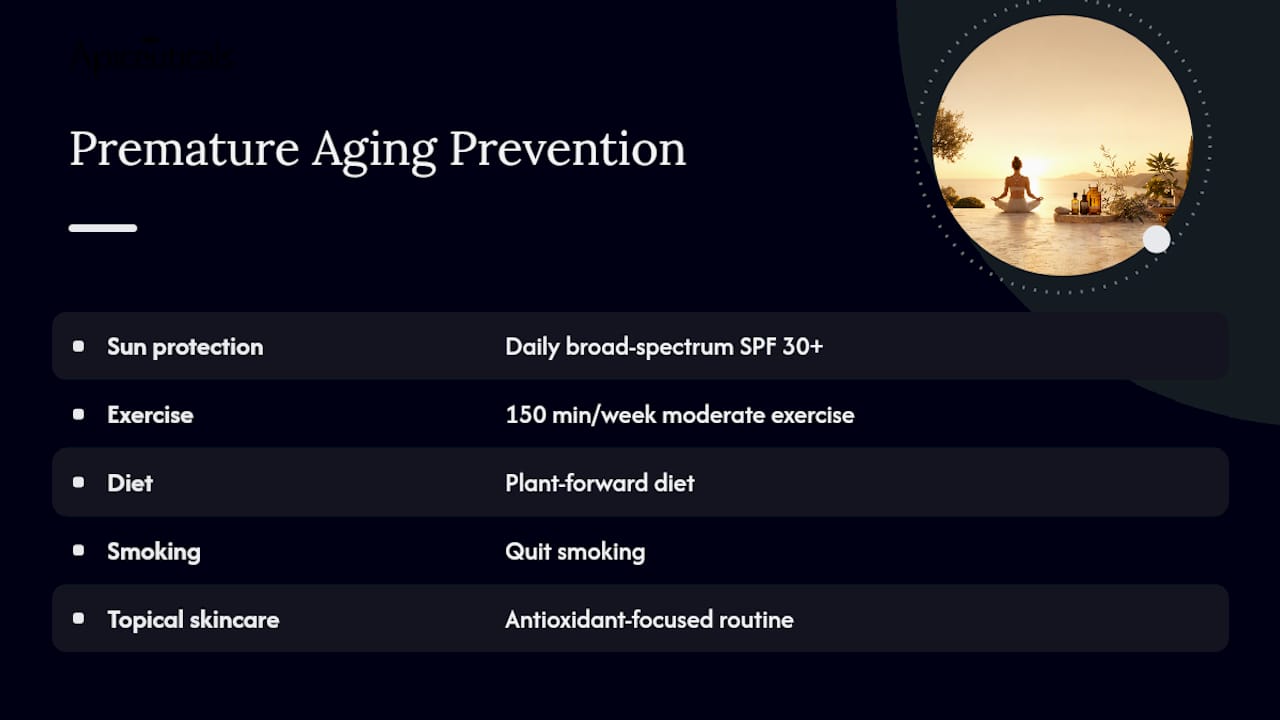
Combine daily broad-spectrum SPF 30+ with consistent lifestyle habits, including 150 minutes of weekly moderate exercise, a plant-forward diet, and quitting smoking, then layer an antioxidant-focused topical routine on top.
What Are Signs That Someone Is Aging Well?
Even, well-hydrated skin tone, elasticity that bounces back after gentle pinching, and the absence of abrupt pigmentation changes generally indicate skin is aging on a normal, healthy trajectory rather than a premature one.
Why Does Getting Older Feel So Hard on the Skin?
Collagen production naturally declines with age while cumulative sun, pollution, and oxidative damage keep accumulating, so the skin’s repair capacity shrinks just as the demands on it increase.
Why Is Gen Z Reporting Faster-Looking Skin Aging?
Increased screen time correlating with more squinting, higher reported stress and disrupted sleep, and growing sun exposure without consistent SPF habits are frequently cited factors, though this is an emerging pattern rather than one with a single confirmed cause.
Can Topical Antioxidants Really Slow Visible Aging?
Topical antioxidants neutralize free radicals generated by UV and pollution exposure before they degrade collagen and elastin; formulations offering continuous release, like PROPOWAX™ Living Honeycomb, extend that protective window across the day rather than in one burst.
When Should I See a Dermatologist Instead of Adjusting My Routine?
See a clinician promptly for any mole or lesion that changes rapidly, irregular pigmentation that spreads, or sudden loss of skin elasticity, since these signs fall outside what lifestyle or topical adjustments alone can address.
Recommended


Related posts

Explore how a trial lasting 24 weeks and Malassezia research link scalp oxidative stress to shedding, and where PROPOWAX™ fits continuous antioxidant care.

See when silicones smooth hair or build up, and how PROPOWAX™ holds a global patent for highest antioxidant activity, validated by Aristotle University.

Explore mountain honey benefits for skin and body, from floral polyphenols and antioxidant activity to evidence on cough relief, wound care, and safe use.

Propolis delivers stronger antioxidant and antimicrobial action. Royal jelly boosts hydration and repair. Learn which suits your skin or scalp and why...

Pick sulfate-free or sulfate shampoo by your scalp, porosity, and color needs. Read evidence-backed guidance, antioxidant options, and a 4-step switch...