
No products in the cart.
Return To Shop
Natural Hair Care Step by Step: Your Science-Backed Guide
TL;DR:
- Natural hair care success depends on proper technique, foundational steps, and balanced scalp health. Consistent routines with antioxidants like PROPOWAX™ promote long-term vitality and prevent damage from environmental stressors. Patience and understanding scalp biology are essential for visible improvements and healthy, resilient hair.
Natural hair care step by step is not just about buying the right products. Most people struggling with breakage, dryness, or stunted growth are skipping foundational steps or applying them out of order. The science is clear: moisture retention, scalp balance, and fiber integrity all depend on technique as much as formulation. This guide walks you through each phase of a clinically informed routine, from understanding your hair’s unique architecture to layering products with precision. Along the way, you will see how antioxidant-based approaches, including those anchored in PROPOWAX™ Living Honeycomb technology, contribute to long-term scalp and hair vitality.
Table of Contents
- Key Takeaways
- Understanding Your Natural Hair Care Step by Step Foundation
- Step 1: Gentle cleansing and scalp care
- Step 2 and 3: Conditioning, deep conditioning, and detangling
- Step 4: Moisturize and seal with LOC or LCO
- Step 5: Protective styling, night care, and environmental defense
- My perspective on patience, consistency, and scalp science
- Build your natural hair routine with Apiceuticals
- FAQ
Key Takeaways
| Point | Details |
|---|---|
| Know your hair first | Identifying your porosity and scalp condition shapes every product and method choice you make. |
| Scalp health is the foundation | Balanced microbiome cleansing outperforms any styling product for long-term hair health. |
| Layer products in the right order | The LOC or LCO method seals moisture effectively when applied after proper conditioning. |
| Protect hair physically and chemically | Silk accessories, protective styles, and antioxidants guard against mechanical and oxidative damage simultaneously. |
| Consistency beats complexity | Visible results take 2-4 weeks; a minimalist, repeatable routine outperforms frequent product switching every time. |
Understanding Your Natural Hair Care Step by Step Foundation
Before following any step by step hair care plan, you need an accurate picture of what you are working with. Curl pattern is the most visible variable, ranging from loose waves to tightly coiled textures, but it is arguably the least predictive of how your hair will respond to products. Porosity is the factor that truly governs absorption, hydration, and the behavior of every treatment you apply.
Hair porosity describes how easily the cuticle layer opens to receive and retain moisture. There are three categories worth knowing:
- Low porosity: The cuticle lies flat and resists product penetration. Water beads on the hair surface rather than absorbing. These strands need heat during conditioning to open the cuticle and benefit from lightweight, liquid-rich formulations.
- Medium porosity: The cuticle allows moderate absorption and holds moisture reasonably well. This is the most manageable category for building a stable routine.
- High porosity: The cuticle is raised, often due to chemical processing, heat, or environmental damage. These strands absorb moisture quickly but lose it just as fast. Product absorption dynamics vary significantly between porosity levels, and high porosity benefits most from protein-oil sealing layers.
A simple test: drop a clean strand into a glass of water. If it floats for several minutes, porosity is low. If it sinks slowly, porosity is medium. If it sinks immediately, porosity is high.
Scalp condition is the second pillar. Think of the scalp as a living ecosystem with its own microbiome, sebum production, and inflammatory responses. Excess sebum, product buildup, or pH imbalance disrupts this ecosystem, which in turn compromises hair follicle function. Examining your scalp under good light will tell you whether you are dealing with dryness, oiliness, flaking, or sensitivity. Each of these conditions calls for a different cleansing approach.
Step 1: Gentle cleansing and scalp care
Cleansing is not about stripping. It is about restoring balance to the scalp environment so that hair growth and moisture retention can proceed without interference. A pH-balanced shampoo keeps the cuticle in its naturally slightly acidic state (between 4.5 and 5.5), which reduces breakage and preserves protein structure throughout the hair fiber.
For most natural hair types, washing every one to two weeks is sufficient. Overwashing removes the sebum that naturally coats and protects the hair shaft. Underwashing allows product residue and dead skin cells to accumulate, blocking follicles. The sweet spot depends on your scalp type: oilier scalps benefit from weekly washing, while drier scalps can extend to every 10 to 14 days.
Pre-poo treatments are worth integrating before every wash. Applying a light oil, such as coconut or olive oil, to dry hair 30 minutes before shampooing creates a protective coating that reduces the swelling and friction caused when water penetrates the shaft rapidly. This single step measurably reduces breakage during washing, particularly for high porosity hair.
When shampooing, use your fingertips, not your nails, to massage the scalp for 60 to 90 seconds. This technique loosens buildup mechanically while stimulating circulation, rather than causing micro-abrasions that irritate the scalp microbiome. Focus the product at the roots and allow it to rinse through the lengths rather than scrubbing the ends directly.
Every three to four weeks, a clarifying wash removes silicone residue, mineral deposits, and deep product buildup that regular shampoo cannot address. Use clarifying shampoos sparingly, as they are intentionally more aggressive, and always follow with a thorough deep conditioning session.

Pro Tip: Apply a few drops of jojoba oil to your scalp before clarifying. This buffers the stripping effect while still allowing thorough buildup removal, and it mimics the chemical structure of sebum closely enough to maintain barrier function during the process.
The antioxidant content of a shampoo formula also matters more than most routines acknowledge. Free radicals generated by UV exposure, pollution, and oxidative stress behave like rust on metal: they degrade the lipid layer of the cuticle steadily over time. Antioxidant-rich formulations, such as those built around PROPOWAX™ Living Honeycomb technology, counteract this process at the scalp level, where follicle cells are most vulnerable to oxidative damage.
Step 2 and 3: Conditioning, deep conditioning, and detangling
These two steps are the most time-intensive in any organic hair care routine, and they are also the most commonly rushed. Regular conditioner smooths the cuticle after shampooing and provides a slip for detangling, but it does not penetrate the cortex. Deep conditioning masks do something categorically different: hair masks penetrate deeper than conditioner, delivering moisture and protein to the inner structure of the fiber to repair damage and rebuild elasticity.
Follow these steps for maximum conditioning benefit:
- After rinsing out your shampoo, apply conditioner from mid-length to ends, avoiding the scalp to prevent buildup around follicles.
- Detangle in sections using your fingers first, then a wide-tooth comb, always working from the ends upward toward the roots. Detangling from ends to roots can take 30 to 45 minutes but prevents the majority of mechanical breakage that most people attribute incorrectly to dryness.
- Rinse the regular conditioner thoroughly, then apply your deep conditioning mask in the same manner.
- Apply gentle heat using a warm towel or a heat cap for 20 to 45 minutes. For low porosity hair specifically, heat is not optional. It creates the thermal expansion needed to open the tightly sealed cuticle and allow the conditioning molecules to penetrate effectively.
- Rinse with cool water to close the cuticle and seal in the conditioning treatment.
Pro Tip: Alternate your deep conditioning sessions between moisture-focused masks and protein treatments. Moisture masks restore softness and flexibility; protein treatments rebuild structural strength. Using one type exclusively for several weeks often leads to one of two problems: hair that is mushy and over-conditioned, or hair that is stiff and prone to snapping.
Balancing protein and moisture is fundamental to preserving hair elasticity and preventing breakage. A strand that stretches slightly before returning to its original length is in good balance. A strand that stretches and does not spring back needs protein. A strand that snaps immediately with no stretch needs moisture. This simple manual test can guide your conditioning choices more reliably than any product label.
Step 4: Moisturize and seal with LOC or LCO
The LOC and LCO methods are the most evidence-supported approaches to moisture retention in a step by step haircare routine for natural hair. Both methods use three product types applied in a specific sequence to lock hydration into the hair shaft before it can evaporate.
| Method | Order | Best For |
|---|---|---|
| LOC | Liquid, then Oil, then Cream | High porosity hair; oil layer sits between cream and hair to slow moisture escape |
| LCO | Liquid, then Cream, then Oil | Low to medium porosity hair; cream penetrates better when not blocked by oil first |
The liquid step is a water-based leave-in conditioner applied to freshly washed, damp hair. This deposits the core moisture. The oil step, using lightweight options like jojoba or grapeseed, begins sealing the cuticle without blocking subsequent products from absorbing. The cream or butter step, applied last in the LOC sequence, provides the final barrier that slows water loss over the following days.
The most common mistake in this phase is applying too much of each product in pursuit of better results. More product does not improve retention. It creates buildup, attracts environmental debris, and makes the scalp prone to congestion. A pea-sized to dime-sized amount of each layer per section is sufficient for most hair types.
A minimalist approach to this phase pays dividends beyond moisture. Consistent, focused routines outperform complex product stacking because they allow you to observe what each individual product is doing and adjust accordingly. When you layer five or six products, you lose the ability to identify which one is causing buildup or dryness.
The antioxidant dimension of this step is underappreciated in most organic haircare step by step guides. Oxidative stress does not only damage the scalp: it degrades the lipid layer between cuticle cells, accelerating moisture loss through the hair shaft itself. Antioxidant delivery within a leave-in or finishing product, as seen in formulations using PROPOWAX™ Living Honeycomb technology, patent-validated for the highest antioxidant activity in cosmetics by the Aristotle University of Thessaloniki, addresses both moisture retention and structural preservation simultaneously.
Step 5: Protective styling, night care, and environmental defense
Protective styling and the choices you make after your routine is complete determine whether the moisture and structural work from the previous steps holds for days or disappears overnight. Treating natural hair like delicate fabric and minimizing all friction, heat, and tension is the operating principle.
Consider the following practices as non-negotiable components of a complete step by step hair repair and protection strategy:
- Silk or satin pillowcases and bonnets reduce the friction that cotton creates against the cuticle during sleep. Cotton is highly absorbent and draws moisture directly out of the hair shaft through the night.
- Loose protective styles such as pineappling (gathering hair loosely at the top of the head), two-strand twists, or loose braids keep ends tucked away from friction and clothing, reducing mechanical breakage between wash days.
- Heat use should be minimal and intentional. When heat styling is necessary, applying a heat protectant before any tool contact is not optional. Temperatures above 150 degrees Celsius cause irreversible changes to the hydrogen bonds in the hair cortex, and no conditioning treatment reverses structural protein denaturation.
- Scalp massage two to three times per week improves blood flow to the follicles. Scalp massage increases circulation and delivers nutrients to the follicle base, which directly supports new hair growth and follicle health.
Pro Tip: Refresh hair between wash days using a diluted leave-in conditioner in a spray bottle rather than water alone. Pure water can cause the cuticle to swell and contract repeatedly, which accumulates mechanical stress over time.
Environmental stressors, including UV radiation, pollution particulates, and hard water mineral deposits, generate free radical activity at the surface of the hair and scalp. This is where antioxidant-formulated products integrated into an organic hair care routine provide a meaningful layer of protection that purely mechanical approaches cannot replicate. The PROPOWAX™ Living Honeycomb structure, validated by the Aristotle University of Thessaloniki and recognized by British Vogue as arguably the global leader in antioxidant activity, continuously releases antioxidants onto the hair and scalp rather than depositing them in a single static dose.
My perspective on patience, consistency, and scalp science
I’ve watched countless people abandon well-constructed natural hair care step by step routines within the first two weeks because they expected visual transformation on a timeline that biology simply cannot accommodate. The reality is that visible improvements take 2 to 4 weeks at minimum, and genuine hair length retention and density changes reflect months of cumulative care.
What I’ve found consistently is that scalp biology is the variable people most underestimate. The scalp microbiome, like the gut microbiome, responds negatively to frequent disruption. Switching products every few weeks, alternating between harsh and gentle formulations, or experimenting with DIY natural hair treatments without understanding their pH impact creates chronic low-grade inflammation that silently undermines follicle performance.
My take is that the best natural hair care tips are not always the most exciting ones. Sleeping on silk. Keeping your scalp’s pH balanced. Deep conditioning on schedule, not when your hair feels bad. These are not dramatic interventions. They are the compound interest of healthy hair, and they work precisely because they are unspectacular and consistent. When antioxidant protection is added to that foundation through science-backed formulations like PROPOWAX™ Living Honeycomb, the routine addresses both the visible hair fiber and the follicular environment that generates it.
— Apiceuticals
Build your natural hair routine with Apiceuticals

Apiceuticals formulates every hair care product around PROPOWAX™ Living Honeycomb, a patented technology that holds a global patent for the highest antioxidant activity in cosmetics, independently validated by the Aristotle University of Thessaloniki. Unlike conventional conditioning and sealing products, these formulations continuously release antioxidants onto the scalp and hair fiber, working across every step of the routine you have just built. All formulations are free from SLS, SLES, parabens, silicones, and mineral oils, and are dermatologically tested with zero irritation on sensitive skin. Explore the hair care gift set for a curated starting point, or read the full science behind PROPOWAX™ technology to understand what antioxidant-level protection actually means for your hair.
FAQ
What is the correct order for natural hair care step by step?
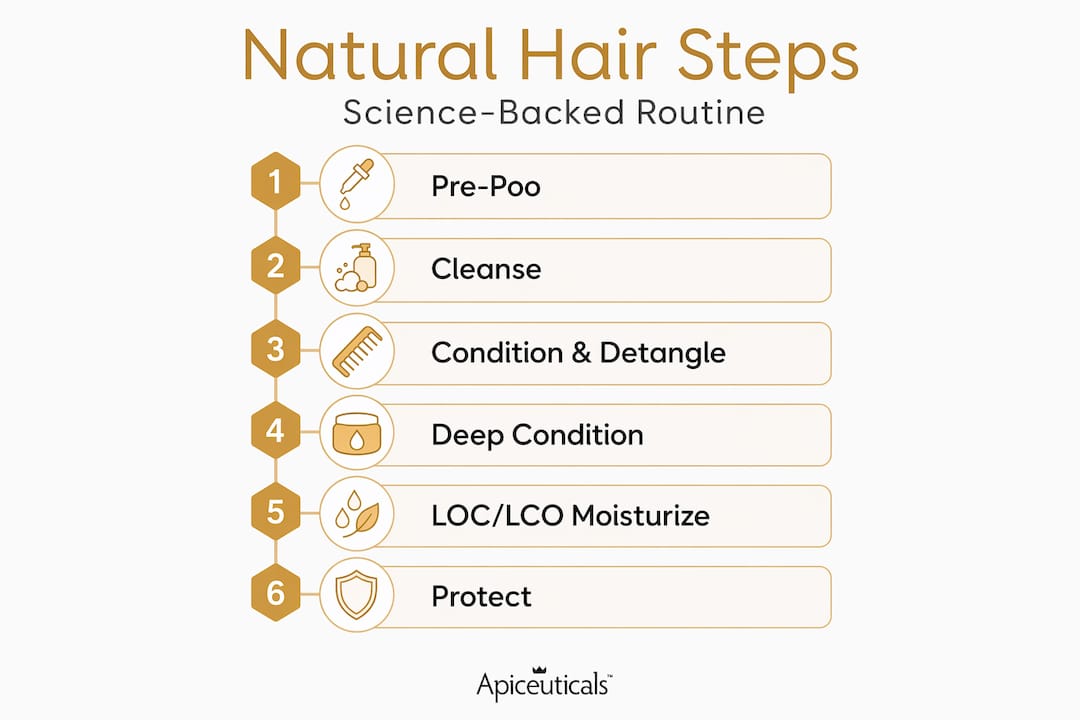
The correct sequence is: pre-poo, cleanse the scalp, condition and detangle, deep condition with heat, then apply the LOC or LCO method to seal moisture before styling or protective styling.
How often should natural hair be deep conditioned?
Deep conditioning once or twice weekly for 20 to 45 minutes is recommended, with treatments alternated between moisture-focused and protein-based formulas to maintain elasticity and prevent breakage.
What is the LOC method and which hair types should use it?
LOC stands for Liquid, Oil, Cream applied in that sequence to lock moisture into the hair shaft. High porosity hair benefits most from LOC, while low to medium porosity hair typically performs better with the LCO sequence, where cream precedes oil.
Why does scalp health matter so much in a natural hair routine?
Scalp microbiome balance directly affects follicle function, sebum quality, and the strength of new growth. Disrupting it through harsh cleansers or frequent product changes creates low-grade inflammation that undermines hair density over time.
How does antioxidant protection fit into a step by step hair care plan?
Free radicals from UV exposure and pollution degrade the lipid layer between hair cuticle cells, accelerating moisture loss and structural damage. Antioxidant-rich formulations, such as those built on PROPOWAX™ antioxidant technology, counteract this process continuously rather than offering a one-time topical deposit.
Recommended


Related posts

How bees and biodiversity sustain each other, what the science says about Greece and the Aegean, and how antioxidant beauty can start from a hive...

How organic propolis extraction works, from hive to extract: collection, solvents, EU organic rules, Greek propolis phenolics and what it means for skincare.

Build an anti pollution skincare routine that fits Greek city life: what pollution does to skin, the morning and evening steps, and the antioxidants with...

Honey moisture content explained: the EU and Greek limits, how to take a refractometer reading, what excess water does to honey, and why it matters...

How antioxidant activity measurement works: DPPH, ABTS, FRAP and ORAC explained, why results differ, and what a lab number can and cannot say about skin...















