
No products in the cart.
Return To Shop
The Role of Subscription Models in Skincare Growth
TL;DR:
- Subscription models in skincare boost customer lifetime value and lower acquisition costs when built as relationship architectures. They leverage predictable consumption cycles, personalization, and science-backed routines to foster long-term adherence and retention. A six-month pilot focusing on replenishment SKUs can determine profitability and scalability effectively.
Subscription models convert predictable product usage into predictable revenue, and the evidence across the US skincare market is clear: when built as a replenishment and relationship architecture rather than a simple discount toggle, they materially increase customer lifetime value and lower blended acquisition costs. The recommendation for most skincare founders is to pilot, not skip. Start with your top three replenishment SKUs, measure month-3 retention against a 60% threshold, and decide whether to scale at the six-month mark. The PROPOWAX™ Living Honeycomb delivery system, which continuously releases antioxidants onto skin and scalp, is exactly the kind of scientifically differentiated asset that gives a subscription program a retention narrative beyond price. Subscriber LTV can reach 3–5x that of one-time buyers when onboarding, bundles, and pre-churn interventions are layered in correctly.
Table of Contents
- How subscription models in skincare are reshaping the US market
- What subscription model type fits your skincare product line?
- How subscriptions change customer behavior and the consumer value proposition
- Pricing, unit economics, and the KPIs that decide whether a subscription is viable
- Operational requirements: inventory, packing, returns, and fulfillment
- How to acquire and retain subscribers cost-effectively
- A pragmatic feasibility checklist for US skincare brands
- What technology stack does a skincare subscription program actually need?
- Legal, regulatory, and consumer-protection issues in the United States
- How a subscription program can be structured for an antioxidant skincare brand
- Key Takeaways
- What subscription winners actually understand that most brands miss
- Apiceuticals and the science behind subscription-ready antioxidant skincare
- Authoritative sources and further reading
- FAQ
How subscription models in skincare are reshaping the US market
Skincare accounted for a large portion of beauty subscription box revenue in 2023, making it the leading subcategory within beauty subscription boxes. That share is not an accident. Skincare is a category built on routine, depletion cycles, and outcome dependency — three structural properties that make recurring delivery a natural fit. North America holds a large portion of the global beauty subscription box market, and analysts project strong mid-to-high teens CAGR through the late 2020s, driven by a consumer base that increasingly treats skincare as a health investment rather than a cosmetic indulgence.
Three consumer trends are accelerating this shift in the US. First, personalization expectations have risen sharply: shoppers want products matched to their skin type, climate, and concern, not generic retail assortments. Second, routine adherence has become a marketing language in itself — brands that frame their products as part of a system rather than a single purchase see higher repeat rates. Third, predictable consumption patterns in categories like moisturizers, serums, and body lotions make the replenishment case almost self-evident to a buyer who is already on their third bottle.
Structural tailwinds:
- Clean beauty and ingredient-conscious purchasing increase brand loyalty and reduce price-sensitivity, both favorable for subscription retention
- Direct-to-consumer infrastructure (Shopify, Recharge, Skio) has lowered the technical barrier to launching a subscription program
- Post-pandemic buying patterns normalized online replenishment across age cohorts previously resistant to it
- Antioxidant skincare, in particular, benefits from the “consistency compounds results” narrative, which maps naturally onto a subscription cadence
Structural headwinds:
- Paid social CAC has risen significantly, making subscriber acquisition expensive without a referral or organic component
- Subscription fatigue is real among consumers managing multiple recurring charges
- Churn spikes at month 3 and month 6 remain the most common failure points for brands that launch without a retention architecture
What subscription model type fits your skincare product line?
Not every skincare product belongs in the same subscription architecture. The model you choose should follow the SKU’s consumption predictability, margin profile, and the relationship depth your brand can credibly sustain.

| Model Type | Best-Fit Products | LTV Potential | CAC Sensitivity | Key Risk |
|---|---|---|---|---|
| Replenishment | Moisturizers, body lotions, cleansers | High | Low (organic-friendly) | Cadence mismatch causing pile-up |
| Discovery / Curated Box | Masks, serums, travel sizes, new launches | Moderate | High (paid social dependent) | High churn after novelty fades |
| Routine Bundle | Multi-step regimens (cleanser + serum + moisturizer) | Very High | Moderate | Complexity at checkout |
| Hybrid (Replenishment + Discovery) | Core SKUs + rotating seasonal additions | High | Moderate | Operational complexity |
| Service-Led / Concierge | Prescription adjustments, consultations, formulation tiers | Very High | Low (referral-driven) | Margin compression if consultation is underpriced |
The replenishment model is the lowest-risk entry point for most brands. Brands that match shipment cadence to actual usage cycles report 40–50% lower cancellation rates compared to those using generic 30/60/90-day defaults. That single operational decision, tagging each SKU by its realistic depletion window, separates brands that retain subscribers from those that train them to pause.
Discovery boxes carry higher CAC sensitivity because the novelty proposition requires constant curation investment. They work well for brands with deep SKU catalogs or seasonal launches, but they rarely produce the retention depth of a replenishment program. The hybrid model, which anchors on a replenishment core and adds a rotating discovery element, tends to produce the best of both: predictable revenue from the core SKU and engagement from the discovery layer. For brands with a scientifically differentiated product, like an antioxidant system built around a patented delivery mechanism, the routine-bundle model is particularly compelling because the science gives the bundle a coherent narrative.
A subscription beauty service guide can help you map these model types to your specific product mix before committing to a platform build.
How subscriptions change customer behavior and the consumer value proposition
The most underappreciated aspect of the impact of subscription services on skincare is behavioral, not financial. When a customer subscribes, they stop making a purchase decision every 30 or 60 days. That cognitive shift reduces experimentation with alternatives, increases product familiarity, and raises the perceived switching cost over time. A subscriber who has used a serum for four consecutive months and seen measurable results is not comparing prices on a competitor’s site. They are invested in the outcome.

Routine adherence is the mechanism. Skincare outcomes are time-dependent: antioxidant protection, wrinkle reduction, and barrier repair all require consistent application over weeks and months. A subscription cadence enforces that consistency in a way that one-time purchases cannot. Membership frameworks that include professional consultation value and structured cadence can deliver 15–30% savings versus retail pricing when measured as cost-per-outcome rather than cost-per-unit. That framing, cost-per-outcome rather than cost-per-bottle, is the most persuasive consumer value proposition available to a premium skincare brand.
The core consumer value props that drive subscription sign-up and retention are:
- Convenience: guaranteed availability without reorder friction
- Personalization: cadence and product selection matched to skin type and concern
- Cost-per-outcome framing: structured routines reduce wasted trial-and-error spend
- Education: onboarding sequences and in-dashboard content that build product literacy and adherence
Pro Tip: Sequence your subscriber education emails to mirror the biological timeline of your product’s mechanism. If your antioxidant serum requires 28 days to show measurable oxidative stress reduction, send a “what’s happening in your skin right now” email at day 21, before the subscriber has decided whether it’s working. Anticipating the question is more effective than answering it after they’ve already cancelled.
Understanding how to maximize skincare absorption is the kind of educational content that belongs in a subscriber onboarding sequence, not just on a product page.
Pricing, unit economics, and the KPIs that decide whether a subscription is viable
The financial case for subscription models in skincare rests on a single equation: subscriber LTV must exceed CAC by a margin wide enough to fund acquisition and still generate profit. Well-architected subscription programs can push subscriber LTV 3–5x higher than non-subscriber LTV when layered with onboarding, bundles, and pre-churn interventions. That multiplier is the ceiling; most brands start closer to 2x and build toward 3–4x as the architecture matures.
Sample unit-economics model (conservative assumptions):
- CAC (paid social + referral blended): $45
- First-order gross margin: 55%
- Monthly ARPU: $38
- Month-3 retention: 62%
- Month-12 retention: 38%
- 12-month LTV (ARPU × average subscriber months): approximately $190
- LTV:CAC ratio: approximately 4.2x
That ratio sits within the healthy range. Below 3x, the model is marginal. Above 5x, you have room to increase acquisition spend aggressively.
| KPI | Formula | Target Range (Healthy) |
|---|---|---|
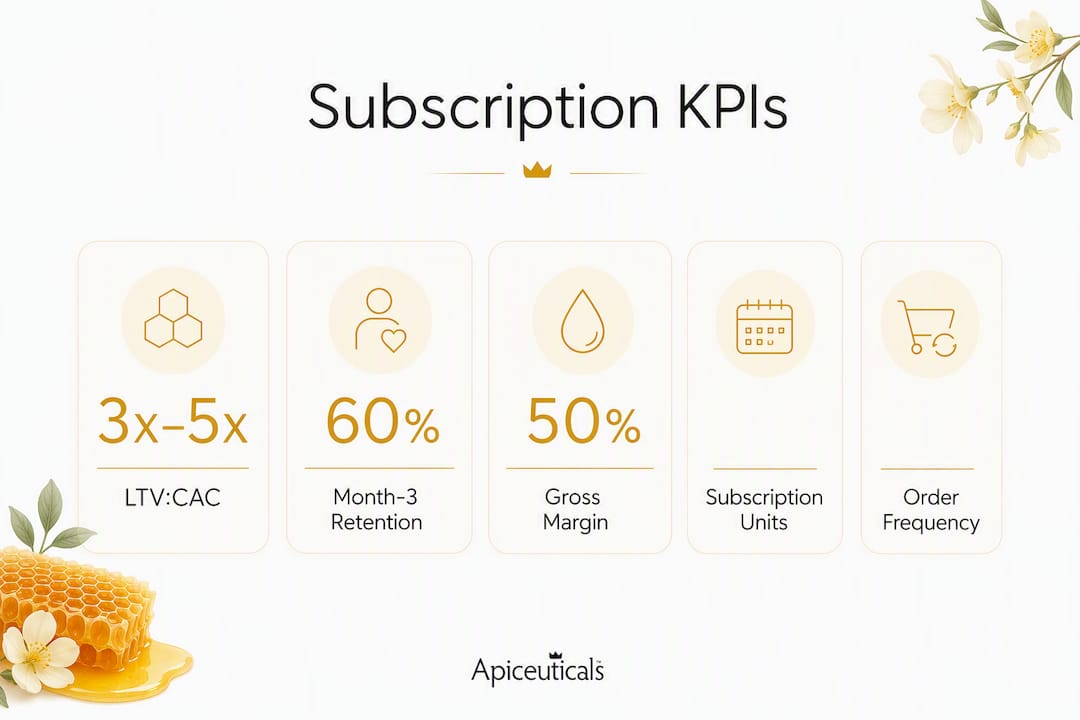
| LTV:CAC | 12-month LTV ÷ blended CAC | 3x–5x minimum |
| Month-3 Retention | Subscribers active at day 90 ÷ original cohort | ≥60% |
| Month-12 Retention | Subscribers active at day 365 ÷ original cohort | ≥35% |
| ARPU | Total subscription revenue ÷ active subscribers | Varies by tier; track trend |
| Gross Margin (subscription orders) | (Revenue – COGS – fulfillment) ÷ Revenue | ≥50% |
| CAC Payback Period | CAC ÷ (ARPU × gross margin %) | ≤4 months |
Well-run subscription programs also raise gross margin on subscription orders relative to one-time purchases, because predictable batching reduces fulfillment variability and bundle AOV is higher. That margin improvement compounds over time: better margins fund better acquisition, which funds better retention investment.
Gross margin below 50% on subscription orders is a warning sign. At that level, fulfillment costs and CAC leave almost no room for the retention investment that makes the model work. Brands with gross margins in the 60–70% range, typical for premium clean beauty with differentiated formulations, have the most favorable unit economics for subscription.
Operational requirements: inventory, packing, returns, and fulfillment
Subscription fulfillment is not simply one-time fulfillment on a schedule. The operational differences are material and affect margin, customer experience, and scalability in ways that catch underprepared brands off guard.
The most important structural decision is whether to pool subscription inventory with one-time inventory or segregate it. Pooling is simpler at low volume but creates fulfillment conflicts during promotional spikes when one-time demand surges. Segregating subscription inventory, even partially, protects subscriber experience during peak periods and allows more accurate depletion forecasting.
Pack-size and SKU tagging by consumption cycle is the operational equivalent of cadence matching. Every SKU in a subscription catalog should carry a realistic depletion window (30-day, 45-day, 60-day) based on actual usage data, not marketing copy. That tag drives the default cadence offered at checkout and the skip/swap logic in the subscriber portal. Brands that skip this step end up with product pile-up complaints, which are the single most common stated reason for cancellation in skincare subscriptions.
Returns in subscription programs require a distinct policy from one-time purchases. A subscriber who receives a damaged or incorrect shipment should have a frictionless replacement path that does not require cancellation. Quality-control checks for recurring shipments should include batch-level documentation, especially for products with active ingredients where stability over time matters.
Pro Tip: When evaluating a 3PL for subscription fulfillment, ask specifically about their kit-assembly throughput and their subscription management integration (Recharge, Skio, or equivalent). A 3PL that handles one-time DTC well but has no subscription-specific workflow will create fulfillment errors at cadence billing dates, which is exactly when subscriber trust is most fragile.
Per-shipment cost components to model: pick-and-pack labor, packaging materials, postage (weight and zone-dependent), and any insert or sample cost. For premium skincare brands, packaging quality is part of the product experience; cutting it to save $0.40 per shipment is rarely the right trade-off.
How to acquire and retain subscribers cost-effectively
Subscriber acquisition requires different creative and channel logic than one-time purchase acquisition. The goal is not to convert a browser; it is to convince someone to commit to a recurring charge. That requires more trust, more specificity about the value proposition, and a clear answer to “what do I get that I wouldn’t get buying once?”
Acquisition channel priorities:
- Referral programs embedded in the subscription funnel produce the lowest CAC and highest-quality subscribers; LTV/CAC ratios above 5x have been documented when referral mechanics are built into the subscription architecture
- Paid social (Meta, TikTok) works best with creative that shows the routine in use over time, not a single product shot; subscription-intent creative (before/after timelines, “my 90-day skin” formats) outperforms standard product ads for subscriber conversion
- Influencer seeding targeted at subscription intent means partnering with creators who document routines over weeks, not one-off unboxings
- Organic content (SEO, email nurture, educational video) builds the trust base that converts to subscription at lower CAC than paid
The 30/60/90-day engagement calendar is the retention architecture that prevents the month-3 churn spike. A well-designed sequence looks like this:
- Day 1: Welcome email with usage guide and what to expect in the first 30 days
- Day 14: “What’s happening in your skin” educational content tied to the product mechanism
- Day 28: First results check-in with a prompt to log observations
- Day 45: Introduce a complementary product or bundle upgrade
- Day 60: Loyalty tier progress update and referral prompt
- Day 80: Pre-churn intervention trigger if engagement signals are low (no portal login, no email opens)
Retention mechanics that materially move the needle: visible skip/swap UX (not buried in account settings), cycle-based default cadences, and progression-based loyalty tiers. Brands that make skip/swap visible and easy report 30–40% better retention than those that obscure the option. The counterintuitive truth is that making it easy to pause reduces cancellations, because subscribers who would have cancelled instead pause and often reactivate.
Loyalty tier structure (sample):
- Tier 1 (Months 1–3): Free shipping, early access to new products
- Tier 2 (Months 4–9): Tier 1 benefits + one free sample per shipment + priority customer service
- Tier 3 (Month 10+): Tier 2 benefits + annual gift, formulation consultation, and referral bonus
A pragmatic feasibility checklist for US skincare brands
A subscription pilot does not require a full platform rebuild or a new product line. The minimum viable pilot can run on your existing Shopify stack with a subscription billing layer added, and it should be designed to answer three questions within six months: Can you convert a meaningful percentage of existing buyers to subscribers? Can you retain them past month 3? Does the unit economics model hold at real CAC?
Pilot timetable (months 0–6):
- Month 0–1: Select top three replenishment SKUs by volume; tag each with a realistic depletion window; configure subscription billing (Recharge, Skio, or equivalent); set default cadences; write onboarding email sequence (5 emails, days 1–60).
- Month 1–2: Soft launch to existing customer email list; target 5–8% conversion of one-time buyers to subscribers; collect cancellation reason data from day one.
- Month 2–3: Analyze month-1 cohort retention; identify top three cancellation reasons; implement skip/swap UX if not already live; launch referral mechanic.
- Month 3–4: Evaluate month-3 retention against 60% threshold; if below 55%, pause paid acquisition and fix retention architecture first; if above 60%, begin modest paid acquisition test.
- Month 4–5: Introduce first bundle upgrade offer to active subscribers; measure ARPU lift and bundle attach rate.
- Month 5–6: Full unit-economics review: blended CAC, 6-month LTV, gross margin per subscription order, CAC payback period; make go/no-go decision on scaling.
Go/no-go criteria at month 6:
- Month-3 retention ≥60%: proceed to scale
- LTV:CAC ≥3x at current CAC: proceed to scale
- CAC payback ≤4 months: proceed to scale
- If two of three criteria are unmet: extend pilot, fix the weakest metric, retest at month 9
Minimum data to collect throughout: usage cohorts by SKU, cancellation reasons (categorized), fulfillment cost per subscriber shipment, and email engagement by onboarding sequence step.
What technology stack does a skincare subscription program actually need?
The technology requirement for a skincare subscription is more modest than most founders assume. The core stack has four components, and each has a clear selection criterion.
Subscription billing engine (Recharge, Skio, Ordergroove, or equivalent): This is the operational center of the program. Selection criteria include cadence flexibility (can it support 30/45/60-day cycles?), skip/swap UX quality, API access for CRM integration, and reporting granularity (cohort retention, churn reasons, ARPU by tier). Skio has gained traction for its migration tools and Shopify-native architecture; Recharge remains the most widely deployed for mid-market DTC brands.
CRM and email/SMS platform (Klaviyo is the de facto standard for DTC skincare): The CRM must support behavioral triggers (portal login, skip event, engagement drop) to power the 30/60/90-day engagement calendar and pre-churn intervention flows. Segment-level personalization, specifically messaging that differs by subscription tier and cohort age, is what separates a functional CRM from a retention engine.
ERP/fulfillment integration: The subscription billing engine must write orders to your fulfillment system in real time. If you use a 3PL, confirm that their WMS can receive subscription orders with cadence metadata and kit-assembly instructions. Gaps here cause the most operationally visible failures.
Analytics and churn-scoring: At minimum, you need cohort retention curves by acquisition channel and SKU, and a churn-risk score that triggers the pre-churn intervention flow before a subscriber cancels. Tools like Lifetimely (for Shopify LTV analytics) or a custom Looker Studio dashboard built on your subscription billing data are both viable.
Personalization layer: For antioxidant skincare brands, personalization means cadence adjustment based on skin concern and climate, not just name-field email tokens. A skin-type quiz at subscription sign-up that maps to a recommended cadence and product sequence is the minimum viable personalization layer. More sophisticated programs use in-dashboard skin logs and formulation adjustment consultations.
- Confirm API access between billing engine and CRM before committing to a platform
- Build the skip/swap UX before launch, not as a post-launch fix
- Instrument churn-reason capture at the cancellation step from day one
- Test cadence logic with a small internal cohort before opening to customers
- Ensure your 3PL can handle subscription-specific kit assembly and batch documentation
Legal, regulatory, and consumer-protection issues in the United States
The regulatory environment for skincare subscriptions in the US has tightened materially over the past three years, and the FTC’s updated Negative Option Rule (effective 2024) is the most consequential change for subscription operators.
Key compliance requirements:
- FTC Negative Option Rule: Requires clear and conspicuous disclosure of all subscription terms before purchase, simple cancellation mechanisms (no “save” flows that require multiple steps to complete a cancellation), and annual reminders of subscription terms for programs with free trials or introductory pricing
- State automatic-renewal laws: California, New York, and several other states have their own automatic-renewal statutes that impose additional disclosure and consent requirements; California’s law is the most stringent and effectively sets the national standard for any brand selling to US consumers
- FDA cosmetic labeling: The Modernization of Cosmetics Regulation Act of 2022 (MoCRA) introduced new requirements for adverse-event reporting, facility registration, and safety substantiation; subscription brands shipping recurring orders must maintain batch-level documentation to support any adverse-event investigation
- Ingredient claims: Claims like “clinically proven,” “dermatologically tested,” or “reduces wrinkles by X%” must be substantiated; subscription programs that use these claims in onboarding emails are subject to the same FTC substantiation standards as advertising
Pro Tip: Audit your cancellation flow against the FTC’s “click to cancel” standard before launch. The most common enforcement trigger is a cancellation path that requires a phone call, a chat session, or more than two clicks to complete. Build the cancellation path as carefully as you build the checkout.
Consumer-safety controls for recurring shipments should include: a documented adverse-event logging process (required under MoCRA for cosmetics), a quality-control checkpoint for each production batch that ships to subscribers, and a clear escalation path for complaints that distinguishes between product dissatisfaction (handled by customer service) and adverse skin reactions (escalated to a qualified safety officer).
How a subscription program can be structured for an antioxidant skincare brand
The following illustrates how a subscription architecture can be built around a scientifically differentiated antioxidant product line, using Apiceuticals as the reference case.
Apiceuticals’ PROPOWAX™ Living Honeycomb, validated by the Aristotle University of Thessaloniki for the highest antioxidant activity in cosmetics, is a replenishment-first asset. Antioxidant protection is cumulative and time-dependent: the mechanism requires consistent daily application to maintain the oxidative stress reduction that the science documents. That biological reality maps directly onto a subscription cadence.
A sample subscription architecture for Apiceuticals:
- Tier 1 (Replenishment Core): PROPOWAX™ Series body and haircare products on a 45-day cadence, matched to realistic depletion windows; entry price point designed to sit below the cost of two one-time purchases; free shipping included
- Tier 2 (Routine Bundle): PROPOWAX™ Series + HONEY BALM™ Series facial care on a 60-day cadence; the HONEY BALM™ Series’ clinically proven 26% wrinkle reduction gives the bundle a measurable outcome narrative that supports subscriber retention
- Tier 3 (Concierge): Tier 2 products + a formulation consultation and personalized regimen adjustment at month 3 and month 9; designed for subscribers who want to optimize their antioxidant regimen based on seasonal skin changes or specific concerns
Sample unit economics (conservative):
- Tier 1 ARPU: $42/month; estimated 12-month LTV at 40% retention: $200
- Tier 2 ARPU: $78/month; estimated 12-month LTV at 38% retention: $355
- Blended CAC target: $50–$65 (referral + organic + modest paid social)
- Blended LTV:CAC at Tier 2: approximately 5.5x
The PROPOWAX™ technology page provides the scientific foundation for subscriber education content, including the antioxidant delivery mechanism and the Aristotle University validation data. That content belongs in the day-14 and day-28 onboarding emails, where it reinforces the subscriber’s decision with evidence rather than marketing language.
Internal links to Apiceuticals’ antioxidant skincare and the Apisets Well-Beeing Packs are natural anchors for the routine-bundle tier, since the packaged sets already represent the multi-product regimen logic that a subscription bundle formalizes.
Key Takeaways
Subscription models are a viable growth engine for US skincare brands when built as a replenishment and relationship architecture, not a discount mechanism, with LTV:CAC above 3x and month-3 retention above 60% as the two non-negotiable thresholds.
| Point | Details |
|---|---|
| Skincare leads beauty subscriptions | Skincare accounted for approximately 42–43% of beauty subscription box revenue in 2023, making it the largest subcategory. |
| LTV multiplier is real but requires architecture | Subscriber LTV can reach 3–5x non-subscriber LTV when onboarding, bundles, and pre-churn interventions are layered in. |
| Cadence matching cuts cancellations | Matching shipment cadence to actual usage cycles reduces cancellation rates by 40–50% versus generic defaults. |
| Six-month pilot is the right test | A structured pilot with go/no-go criteria at month 6 (LTV:CAC ≥3x, month-3 retention ≥60%) is sufficient to decide whether to scale. |
| Apiceuticals as a subscription anchor | Apiceuticals’ PROPOWAX™ Living Honeycomb antioxidant science and multi-tier product lines provide a replenishment and routine-bundle architecture with strong retention narrative. |
What subscription winners actually understand that most brands miss
The conventional wisdom on skincare subscriptions is that they are primarily a revenue-smoothing tool: predictable cash flow, lower fulfillment variability, better inventory planning. Those benefits are real. But they are downstream of a more fundamental insight that separates the brands that build durable subscription programs from those that churn through subscribers every six months.
The brands that win treat subscription as a relationship stage, not a billing mechanism. The subscriber is not a customer who has agreed to pay monthly. They are a customer who has agreed to trust the brand with their skin, their routine, and their time. That trust is the asset. The subscription billing is just the accounting of it.
What this means operationally is that the growth team and the retention team cannot function as separate units. The creative that acquires a subscriber sets an expectation. If the onboarding sequence, the product experience, and the customer service model do not fulfill that expectation, the month-3 churn spike is not a retention problem. It is a brand-promise problem that the retention team cannot fix alone.
The other mistake that brands make consistently is launching a subscription program before the product-subscription fit is confirmed. Not every skincare SKU belongs in a subscription. A product with a 90-day depletion cycle, a $120 price point, and a complex application protocol is a harder subscription sell than a $38 body lotion that runs out in 45 days. Founders who launch subscription on their full catalog, rather than their top three replenishment SKUs, dilute the operational focus and make the unit economics harder to read. Start narrow, prove the model, then expand.
Apiceuticals and the science behind subscription-ready antioxidant skincare
Antioxidant skincare is one of the most scientifically compelling categories for a subscription model, precisely because the mechanism is time-dependent. Oxidative stress accumulates continuously, and the protection that a well-formulated antioxidant product provides requires consistent, daily application to remain effective. That biological reality is the most honest retention argument a brand can make.

Apiceuticals holds a global patent for the highest antioxidant activity in cosmetics, validated by the Aristotle University of Thessaloniki, delivered through the PROPOWAX™ Living Honeycomb system. The PROPOWAX™ technology continuously releases antioxidants onto skin, scalp, and hair, making it a natural fit for a replenishment subscription architecture where the science itself argues for consistency. The HONEY BALM™ Series’ clinically proven 26% wrinkle reduction and the PROPOWAX™ Series’ antioxidant haircare and bodycare lines provide the multi-tier product depth that a routine-bundle subscription requires. For founders evaluating subscription-capable antioxidant skincare for their own pilot or partnership, the Apiceuticals antioxidant skincare range is the reference point for what product-subscription fit looks like when the science and the cadence are aligned.
Authoritative sources and further reading
The following sources underpin the analysis in this guide and are recommended for founders building a subscription pilot plan.
- Beauty Subscription Box Market Size & Share Report, 2030 (Grand View Research): The primary market-sizing source for beauty subscription box CAGR and North America share data cited in this article.
- Beauty Subscription Market Size & Trends 2025–2035 (Future Market Insights): A complementary forecast source with extended projections through 2035; useful for long-range scenario modeling.
- The Rise of Beauty and Skincare Subscription Models (Supply Chain Outlook): Operational and supply-chain perspective on beauty subscription growth; relevant for fulfillment planning.
- Dermalogica’s Playbook for Growing Subscribers Without Discounts (Recharge): Dermalogica grew active subscribers 26% and cut churn 20.4% without discounting, using value visibility and personalized messaging. The most practically useful case study for premium skincare brands that want to avoid margin erosion.
- Skincare Subscription Models: Building LTV with Replenishment Flows in 2026 (Veilup): The source for cadence-matching data, skip/swap retention improvements, and the staged build roadmap cited throughout this guide.
- Why Consistency Matters in Skincare: The Membership Advantage (Exploration Junkie): Consumer-side analysis of cost-per-outcome framing and the 15–30% savings argument for membership models.
- FTC Negative Option Rule (Federal Trade Commission): The primary regulatory reference for subscription disclosure, cancellation UX, and compliance requirements in the US.
- MoCRA Guidance (FDA): FDA’s guidance on the Modernization of Cosmetics Regulation Act; required reading for any skincare brand operating a subscription program with recurring shipments.
FAQ
What is the role of subscription models in skincare businesses?
Subscription models convert predictable product usage into predictable revenue, increase customer lifetime value through routine adherence, and lower blended CAC when referral and retention mechanics are embedded in the architecture.
What LTV:CAC ratio should a skincare subscription target?
A healthy skincare subscription program targets a LTV:CAC ratio of 3x–5x; below 3x the model is marginal, and above 5x there is room to increase acquisition spend.
How do subscription models change skincare customer behavior?
Subscriptions reduce purchase-decision frequency, increase product familiarity, raise switching costs, and enforce the routine adherence that produces measurable skincare outcomes over time.
What are the advantages of skincare subscriptions for brand operators?
The primary advantages are higher subscriber LTV (up to 3–5x non-subscriber LTV), improved gross margin from predictable fulfillment batching, and lower CAC when referral mechanics are embedded in the subscription funnel.
What month-3 retention rate should a pilot target?
A month-3 retention rate of 60% or above is the threshold for proceeding to scale; below 55%, the retention architecture should be fixed before increasing acquisition spend.
Why choose a skincare subscription over one-time purchases for antioxidant products?
Antioxidant protection is cumulative and requires consistent daily application to remain effective, making subscription cadence the most scientifically coherent delivery model for antioxidant skincare products like those built on PROPOWAX™ Living Honeycomb technology.
Recommended


Related posts

How bees and biodiversity sustain each other, what the science says about Greece and the Aegean, and how antioxidant beauty can start from a hive...

How organic propolis extraction works, from hive to extract: collection, solvents, EU organic rules, Greek propolis phenolics and what it means for skincare.

Build an anti pollution skincare routine that fits Greek city life: what pollution does to skin, the morning and evening steps, and the antioxidants with...

Honey moisture content explained: the EU and Greek limits, how to take a refractometer reading, what excess water does to honey, and why it matters...

How antioxidant activity measurement works: DPPH, ABTS, FRAP and ORAC explained, why results differ, and what a lab number can and cannot say about skin...















