No products in the cart.
Return To Shop
Shampoo Ingredients to Avoid for Healthier Hair and Scalp
The shampoo ingredients to avoid fall into a short, memorable list: sulfates like SLS and SLES, parabens, undisclosed fragrance and its hidden phthalates, cocamide DEA and other formaldehyde-releasers, silicones, PEGs and ethoxylated compounds, drying alcohols, synthetic dyes, and the triclosan and PFAS family sometimes called “forever chemicals.” Each earns its place on the list for a distinct reason: some strip the scalp’s lipid barrier, some carry documented sensitization or endocrine concerns, and others persist in waterways long after they leave your shower drain.
The action to take before you read another paragraph is simple. Flip the bottle over and scan for these specific cues:
- “Sodium lauryl sulfate” or “sodium laureth sulfate” near the top of the list
- The word “fragrance” or “parfum” with no breakdown of what it contains
- “Cocamide DEA,” “TEA,” or “DMDM hydantoin”
- Any ingredient ending in “-cone,” “-siloxane,” “-eth,” or starting with “PEG”
- “FD&C” followed by a number, or “triclosan”
If your scalp reacts to products, choose fragrance-free formulations first. A patch test on the inner forearm, left for 24 hours, catches most sensitivities before they reach your hairline.
Key Takeaways
Shampoo ingredients to avoid share three common risks: scalp irritation, endocrine or sensitization concern, and environmental persistence, and label literacy is the single most reliable defense against all three.
| Point | Details |
|---|---|
| Fragrance is the top offender | Undisclosed “fragrance” most often hides phthalates and other unlisted compounds. |
| Watch for suffix patterns | “-eth,” “PEG,” “-cone,” and “quaternium” flag ethoxylation, silicones, and quats at a glance. |
| Hair loss claims are overstated | Evidence points to irritation and breakage risk, not permanent follicle damage, from harsh chemicals. |
| Free-from claims need verification | Check the full ingredient list, not just the front-of-bottle badge, before trusting a claim. |
| Apiceuticals excludes core offenders | Its Antioxidant Shampoo omits SLS, SLES, parabens, silicones, and mineral oils, relying on PROPOWAX™ for antioxidant delivery. |
Table of Contents
- Which Harmful Shampoo Chemicals Show Up Most Often, and Why
- How to Decode a Label and Choose Safer Swaps
- The Science Behind Apiceuticals’ Ingredient Standards
- Sources
- FAQ
Which Harmful Shampoo Chemicals Show Up Most Often, and Why
Reading a shampoo label well means understanding what each flagged ingredient actually does, not just memorizing a blacklist. Below is the evidence behind each entry, organized so you can check your own bathroom shelf against it.
Sulfates (SLS and SLES). These detergents create the foam most people associate with a “working” shampoo, but foam has nothing to do with cleansing power. Sodium lauryl sulfate is the harsher of the two variants; sodium laureth sulfate is milder because it has been ethoxylated, a process that introduces its own concern (more on that below). People with eczema, psoriasis, color-treated hair, or curly and textured hair tend to feel sulfates most acutely, since these surfactants strip sebum faster than the scalp can replenish it. Sulfate-free matters most for anyone managing a compromised barrier or chemically processed strands; it matters less for someone with resilient, oily-leaning hair who showers daily.
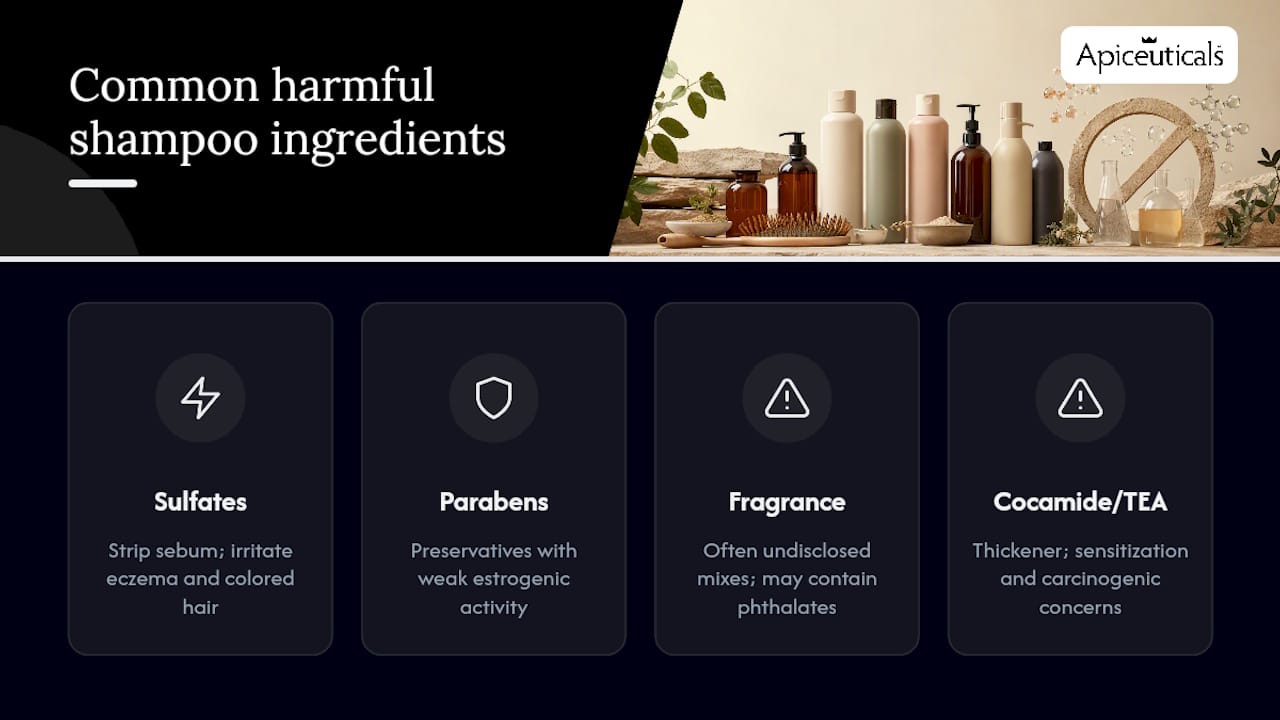
Parabens. Methylparaben, propylparaben, butylparaben, and ethylparaben preserve shampoo against mold and bacterial growth, which is a legitimate job. The concern is their weak estrogenic activity, which has kept them under ongoing toxicological review even as regulators have not banned most forms outright. Anyone with a personal or family history of hormone-sensitive conditions often chooses to avoid them as a precaution, even where the evidence remains inconclusive for topical, rinse-off exposure.
Undisclosed fragrance and phthalates. This is arguably the single most consequential entry on the list. The Environmental Working Group flags “fragrance” as the most common problematic ingredient in shampoo, because manufacturers can bundle dozens of unlisted compounds under that one word to protect proprietary formulas. Diethyl phthalate is a frequent passenger, added to help scent molecules linger, and federal health researchers link certain phthalates to endocrine and reproductive effects with repeated exposure. If your scalp flares with new products or you simply want to know what you are applying, a fragrance-free formulation removes the guesswork entirely.
Cocamide DEA, TEA, and formaldehyde-releasers. Cocamide DEA thickens shampoo and boosts foam, but regulatory reviews document sensitization concerns strong enough that the European Union caps its concentration in cosmetic formulas. Triethanolamine (TEA) and diethanolamine (DEA) carry similar dermal absorption questions, and the same review cites evidence linking alkanolamines to possible carcinogenic signals in animal studies, a finding that underlies the EU’s cautious stance. Formaldehyde-releasing preservatives, most commonly DMDM hydantoin and quaternium-15, slowly release small amounts of formaldehyde to control microbial growth. Anyone with contact dermatitis or a known formaldehyde sensitivity should treat these names as a hard stop.
Silicones. Dimethicone and its relatives coat the hair shaft to create the instant slip and shine that makes a shampoo “feel” luxurious in the shower. The trade-off isn’t primarily about scalp health. It’s environmental: silicones resist biodegradation and accumulate in wastewater systems, so the decision to avoid them often comes down to personal sustainability priorities rather than a direct safety concern. Watch for any ingredient ending in “-cone” or “-siloxane.”
Ethoxylated ingredients, PEGs, and 1,4-dioxane. Ethoxylation is a manufacturing shortcut that makes harsh surfactants gentler, but it can leave behind 1,4-dioxane, a by-product NCBI toxicology reviews associate with carcinogenicity signals in long-term animal exposure studies. You won’t find 1,4-dioxane itself listed, since it’s a contaminant rather than an added ingredient. Instead, Consumer Reports recommends scanning for the telltale signatures of the process: any name ending in “-eth” (like laureth or ceteareth) or beginning with “PEG.”
Drying alcohols. Short-chain alcohols such as SD alcohol, denatured alcohol, and isopropyl alcohol evaporate quickly and can pull moisture from both hair fiber and scalp. They differ from fatty alcohols like cetyl or stearyl alcohol, which condition rather than dry. Anyone with fine, chemically treated, or naturally dry hair notices the difference fastest.
Dyes and colorants. FD&C-labeled synthetic dyes exist purely for shelf appeal, since they do nothing for cleansing or conditioning. Trihydroxybenzene-based colorants have drawn particular scrutiny for triggering contact irritation on sensitive scalps, and anyone managing dermatitis or psoriasis gains nothing from a dye’s cosmetic tint.
Triclosan, PFAS, and mineral oil. Triclosan, an antimicrobial once common in “anti-dandruff” formulas, has faced tightening restrictions over resistance and hormone-disruption concerns. PFAS, sometimes added for a silky slip, persist in the environment for decades, earning the “forever chemical” label. Mineral oil, a petroleum derivative, simply sits on the hair shaft rather than nourishing it, offering shine without any functional benefit to the scalp barrier.
Statistic Callout: A Consumer Reports analysis of nearly 100 shampoos found that fragrance, ethoxylated compounds, dyes, silicones, and parabens appear across the large majority of mainstream formulas, not a fringe minority.
Pro Tip: Keep your phone’s camera roll handy for ingredient lists. Photograph the back of any shampoo you’re considering before you buy it, then compare it against this list at home rather than trying to memorize suffixes in a crowded aisle.
One clarification worth holding onto: current evidence does not support the idea that shampoo chemicals cause permanent hair loss. Medical reviews note the more accurate concern is irritation, barrier disruption, and breakage from harsh surfactants and dyes, not follicle death. That distinction matters when you’re deciding how urgently to overhaul your routine versus simply making smarter swaps over time.
How to Decode a Label and Choose Safer Swaps
Label literacy is a skill, and it follows a predictable pattern once you know what to look for.
- Scan for suffixes before ingredient names. “-eth” and “PEG” signal ethoxylation and a possible 1,4-dioxane pathway. “Quaternium” or “polyquaternium” marks a quat, which environmental toxicology research flags for poor biodegradability and aquatic toxicity. “FD&C” plus a number means synthetic dye, and any text containing “paraben” as a substring belongs to that preservative family.
- Treat “fragrance” as a red flag by default, not an afterthought, unless the label separately discloses its components.
- Verify “free-from” claims against the full list, not just the front-of-bottle badge. A shampoo can be marketed as “sulfate-free” while still containing cocamide DEA or a PEG compound; the claim is accurate but incomplete.
- Favor biodegradable, plant-derived surfactants (decyl glucoside and coco-glucoside are common examples) and mild amphoteric cleansers over harsher sulfates, especially if you have a reactive or eczema-prone scalp.
- Cross-check unfamiliar names against a public database like EWG’s Skin Deep before committing to a new product, especially one making bold marketing claims.
Pro Tip: Simplify before you optimize. If your scalp reacts to everything, strip your routine down to one fragrance-free, sulfate-free shampoo for two weeks before reintroducing anything else, so you can actually identify what triggers the irritation.
The Science Behind Apiceuticals’ Ingredient Standards
Apiceuticals built its exclusion policy around the same evidence this guide walks through, informed by a family beekeeping practice the Roumeliotis family has run in Arcadia since 1981. That heritage shaped a stricter question than “does this ingredient meet the legal minimum”: does it belong on skin and scalp at all.
Apiceuticals holds a global patent for and the highest antioxidant activity in cosmetics, achieved through its PROPOWAX™ Living Honeycomb technology, a delivery system independently validated by the Aristotle University of Thessaloniki. The formulation continuously releases antioxidant compounds onto the scalp and hair fiber, addressing oxidative stress, the same free-radical process that corrodes metal into rust, only here it degrades the scalp barrier and accelerates visible hair aging.
The brand’s exclusion list maps directly onto the ingredients covered above:
- No SLS or SLES, avoiding the harsh sulfate stripping described earlier
- No parabens, sidestepping the preservative family under endocrine review
- No silicones, eliminating the environmental persistence trade-off
- No mineral oils, removing the petroleum-derived filler with no functional scalp benefit
Details on the PROPOWAX™ technology and its documented effects on the scalp appear in Apiceuticals’ antioxidant shampoo overview.
A Shopping Checklist Worth Keeping
Ingredient safety comes down to transparency over marketing language, every time. A “botanical” claim on the front of a bottle means nothing if the back lists cocamide DEA and an undisclosed fragrance blend.
Before you buy, run through four checks: skip anything with undisclosed fragrance if your scalp is reactive; favor products with genuine clean certification rather than a self-assigned “natural” label; patch-test new formulas for 24 hours on your forearm; and reach for mild, biodegradable surfactants rather than reaching for a clarifying shampoo out of habit when your scalp doesn’t actually need it. If irritation, flaking, or shedding persists beyond a few weeks of these changes, see a dermatologist. Ingredient swaps solve a lot, but they aren’t a substitute for a clinical diagnosis.
Where Apiceuticals Fits Into This Routine
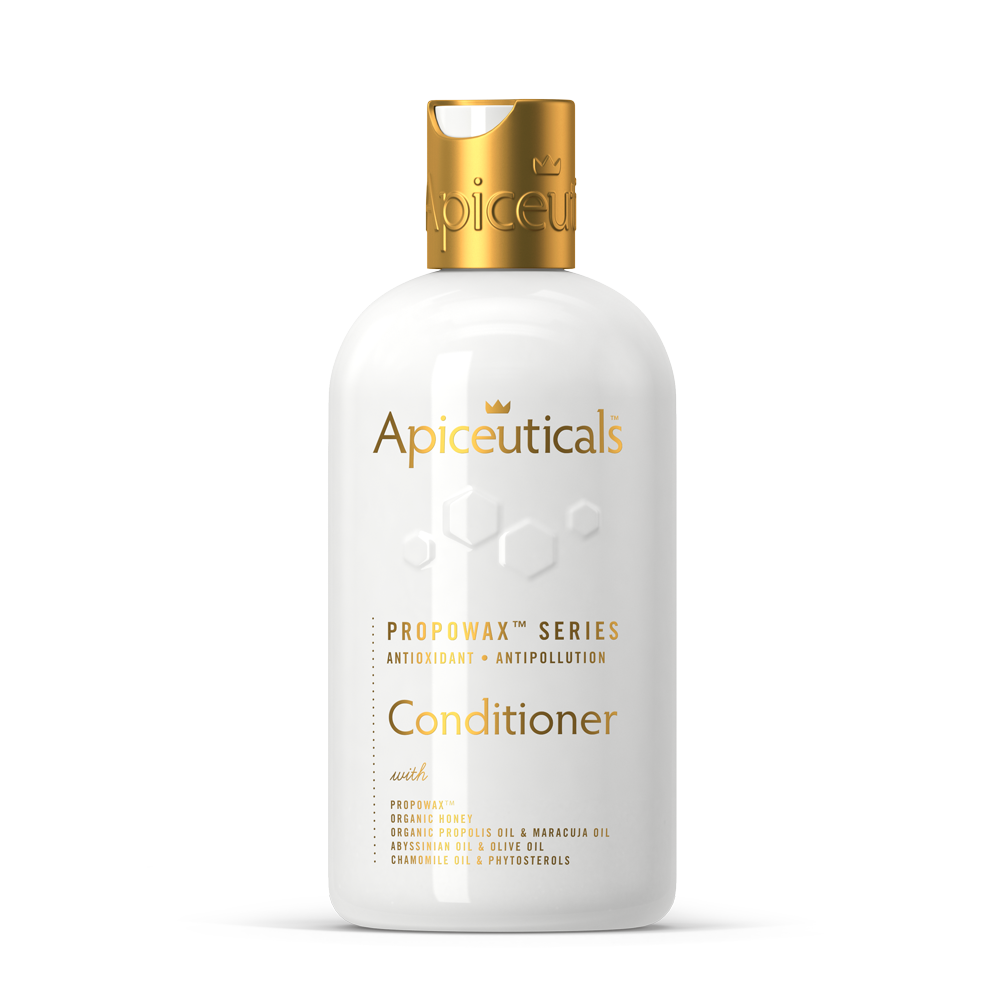
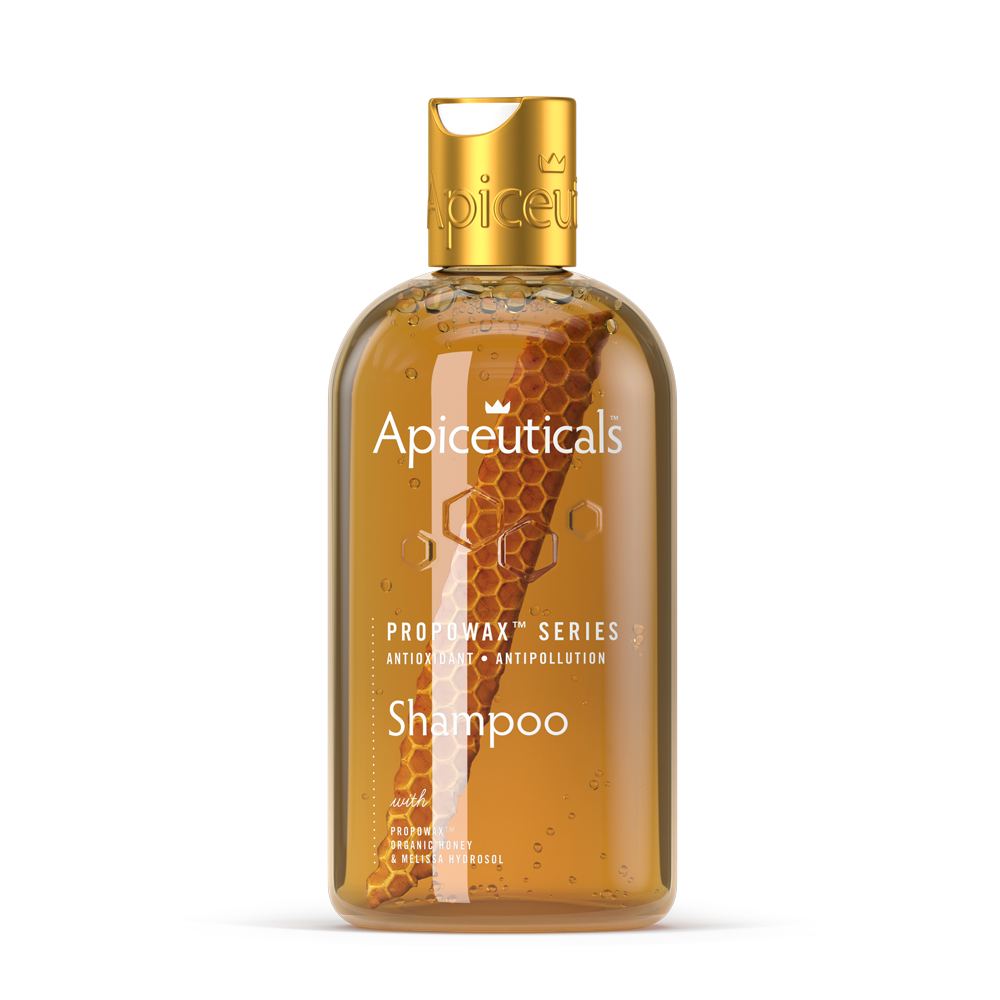
If you’ve read this far checking labels against your own shelf, Apiceuticals’ Antioxidant Shampoo was formulated to pass that exact test. It excludes sulfates, parabens, silicones, and mineral oils, the same categories detailed throughout this guide, while relying on the patented PROPOWAX™ Living Honeycomb to deliver antioxidant compounds to the scalp continuously rather than through a single rinse-off application.

The formulation doesn’t rely on synthetic fragrance carriers or ethoxylated thickeners to achieve its texture and slip. For readers who want to see how the technology behind that antioxidant delivery actually works, the PROPOWAX™ technology page breaks down the mechanism in detail, and the full antioxidant haircare range is available to browse directly. If you’re ready to replace a shampoo you no longer trust, start there and compare the ingredient panel yourself.
Sources
- A Review on Synthetic Shampoo Ingredients and Their Adverse Health Effects
- Safer shampoo: Steer clear of these problematic ingredients
- How to Choose a Shampoo With Fewer Harmful Chemicals – Consumer Reports
- NCBI review on cosmetic chemical safety
FAQ
What Is the Healthiest Shampoo to Use?
The healthiest shampoo avoids sulfates, parabens, undisclosed fragrance, and silicones while using mild, biodegradable surfactants suited to your specific scalp condition; no single formula fits every hair type.
Which Ingredients Are Not Good for Hair in Shampoo?
Sulfates (SLS/SLES), parabens, cocamide DEA, formaldehyde-releasers like DMDM hydantoin, PEGs, drying alcohols, synthetic dyes, triclosan, and PFAS top the list of ingredients to avoid for scalp and hair health.
What Shampoos Have No Harmful Ingredients?
No shampoo can claim zero risk for every user, but formulas that exclude sulfates, parabens, silicones, and mineral oils, such as Apiceuticals’ Antioxidant Shampoo, remove the categories most frequently linked to irritation and regulatory concern.
What Shampoos Have Bad Ingredients?
Most mainstream shampoos contain at least one flagged ingredient; A Consumer Reports review found that fragrance, ethoxylated compounds, dyes, silicones, and parabens are present across the majority of mainstream shampoo products tested.
Do Sulfates in Shampoo Actually Damage Hair?
Sulfates don’t damage the hair shaft directly, but they strip natural sebum faster than the scalp can replace it, which can worsen dryness for color-treated, curly, or eczema-prone scalps.
Are Paraben-Free Shampoos Worth Choosing?
Paraben-free shampoos are a reasonable precaution given ongoing endocrine-disruption research, though current evidence on rinse-off, topical paraben exposure remains inconclusive rather than definitively harmful.
Recommended


Related posts

How bees and biodiversity sustain each other, what the science says about Greece and the Aegean, and how antioxidant beauty can start from a hive...

How organic propolis extraction works, from hive to extract: collection, solvents, EU organic rules, Greek propolis phenolics and what it means for skincare.

Build an anti pollution skincare routine that fits Greek city life: what pollution does to skin, the morning and evening steps, and the antioxidants with...

Honey moisture content explained: the EU and Greek limits, how to take a refractometer reading, what excess water does to honey, and why it matters...

How antioxidant activity measurement works: DPPH, ABTS, FRAP and ORAC explained, why results differ, and what a lab number can and cannot say about skin...