No products in the cart.
Return To Shop
SLS vs SLES: What Differs and Which Suits Your Scalp
SLS and SLES are two different cleansing agents, not two spellings of one ingredient. Sodium lauryl sulfate (SLS) is the more irritating of the pair in controlled skin testing, while sodium laureth sulfate (SLES) is an ethoxylated relative that is generally gentler but not irritation-proof. For most people the useful question is not which acronym is virtuous, but how a complete shampoo formula behaves on your particular scalp. This guide sets out what separates the two molecules, what the research shows, and how to read a label sensibly, within the antioxidant approach to hair and scalp care that guides our work at Apiceuticals.
TL;DR
- SLS and SLES are different surfactants: SLES is made by ethoxylating the lauryl structure, which generally lowers irritation while keeping foam and cleansing power.
- In matched patch tests SLS produced a pronounced reaction and SLES a far milder one, but concentration, contact time and the rest of the formula change the outcome.
- The claim that every SLES product carries dangerous 1,4-dioxane is inaccurate: EU scientific advisers consider 10 ppm or less in a finished cosmetic safe.
- A dry, reactive or color-treated scalp is a reasonable reason to choose a sulfate-free formula; a healthy scalp may tolerate either.
Table of Contents
- What SLS and SLES actually are
- SLS vs SLES: how they compare in practice
- What the patch-test evidence shows
- The skin barrier and why your scalp may react differently
- The 1,4-dioxane question
- What EU rules mean for shoppers in Greece
- Choosing a shampoo: a conditional decision
- Our perspective: cleansing is only half the story
- Where PROPOWAX™ fits into a sulfate-conscious routine
- Common misconceptions worth retiring
- FAQ
- Sources
What SLS and SLES actually are
Both ingredients belong to the family of anionic surfactants, molecules with a water-loving head and an oil-loving tail. The tail grips sebum, styling residue and environmental grime; the head lets water carry it away. That simple mechanism is why a shampoo foams and why an overly efficient surfactant can also remove the lipids your scalp needs.
SLS, also listed as sodium dodecyl sulfate, is built on a twelve-carbon fatty alcohol that has been sulfated. SLES starts from the same fatty alcohol, but before sulfation it is ethoxylated, meaning a short chain of ethylene oxide units is attached. According to a comparative washing study in Food and Chemical Toxicology, this modification generally reduces irritation while the molecule keeps its cleansing and foaming functions. The extra chain makes the head larger and more hydrated, so the molecule interacts less aggressively with the skin’s own lipids and proteins.

The naming causes most of the confusion. On a label you may see Sodium Lauryl Sulfate, Sodium Dodecyl Sulfate, Sodium Laureth Sulfate or Sodium Lauryl Ether Sulfate. The first two are the same substance; the last two are the same substance as each other. The two groups are not interchangeable. The European Commission’s CosIng database entry for SLES records its cleansing, foaming and emulsifying roles, which also tells you why it appears so often: it is an inexpensive, reliable workhorse.
SLS vs SLES: how they compare in practice
The table below summarizes the practical differences. Read it as a tendency, not a verdict, because finished products are blends.
| Feature | SLS | SLES |
|---|---|---|
| Chemical difference | Sulfated lauryl alcohol | Ethoxylated first, then sulfated |
| Typical irritation in patch tests | Pronounced | Far milder |
| Foam character | Quick, sharp lather | Denser, more cushioned lather |
| Cleansing strength | Stronger, more stripping | Effective, usually gentler |
| Manufacturing by-product concern | None specific to ethoxylation | Trace 1,4-dioxane, controlled by purification |
| Typical concern | Barrier disruption, dryness | Variable by formula and concentration |
This is the pattern repeated across the search results readers see for this topic, and it is broadly consistent with the primary literature. What the summaries often leave out is the conditional language, which matters more than the headline.
What the patch-test evidence shows
The most instructive paper for anyone weighing SLS vs SLES is a profile of irritant patch testing with detergents published in Contact Dermatitis. Researchers applied solutions of SLS, SLES and an alkyl polyglucoside at 0.125%, 0.25%, 0.5%, 1.0% and 2.0% for 6, 12 or 24 hours. They then measured transepidermal water loss, a proxy for how leaky the skin barrier has become, and blood flow with laser Doppler flowmetry, followed by checks on days 7 and 10.
SLS produced a pronounced reaction. SLES produced a far milder one. Barrier changes after SLS remained detectable through day 10, whereas SLES irritation was convincingly detectable only through day 7. In other words, the ethoxylated molecule irritated less and recovered sooner.
The design deserves honest reading, though. A patch held against the skin for many hours is not a shampoo that sits on the scalp for two minutes and is rinsed away. SLS is so reliably irritating under occlusion that dermatology uses it as a reference irritant, which is exactly why it appears in such experiments. The lesson is comparative: SLES performed better than SLS under controlled conditions, and that is not the same as saying SLES is harmless in every routine.
Why a finished shampoo behaves differently
A second study, an evaluation of surfactant mixtures in 13 human subjects, tested SLES alone and in combination with lauryl glucoside, polysorbate 20 and cocamidopropyl betaine. The authors concluded that irritation depended on total surfactant concentration, mode of application, molecular activity and chemical structure. In the data we reviewed, 10 of 13 subjects showed no reaction at the lower dose, while at the higher dose 11 showed a broad range of irritation.
This explains a common experience: two shampoos that both list SLES can feel completely different on the same scalp. One may contain a co-surfactant system that buffers the SLES; another may rely on it at a high concentration with a strong fragrance load. The acronym is a single line in an ingredient list, not a performance guarantee.
The skin barrier and why your scalp may react differently
Irritation is not a fixed property of the ingredient. It is an interaction between the ingredient and the state of your barrier on the day you use it. A human study on the alkaline pH-adapted skin barrier is a good illustration: healthy skin sits at a pH of around 5.5, maintained by several regulatory mechanisms, and the study found that skin adapted to alkaline products was disrupted more severely by an SLS challenge. Twenty healthy subjects were followed for five weeks before the challenge was applied.
The practical meaning is that repeated exposure to alkaline or stripping cleansers can leave the barrier primed to overreact. We think of the scalp as a living ecosystem, with its own lipids, microbial community and acid mantle. A cleanser that removes too much of that film leaves the scalp tight, itchy or flaky, and the hair beneath it more exposed to oxidative stress, the chemical equivalent of rust slowly corroding metal.
This is also why the evidence does not support the stronger claims you may read online. The reasonable concern about SLS is irritation and barrier disruption, particularly for sensitive, dry, eczema-prone or already compromised skin. It is not proof that SLS causes hair loss or that it is universally toxic. Our own deeper discussion of when SLS actually damages hair takes the same measured view.
When to seek medical advice rather than switch shampoo
If your scalp is persistently red, scaly, weeping or painful, changing shampoo is not a substitute for a diagnosis. Conditions such as seborrheic dermatitis, psoriasis and eczema need assessment by a dermatologist or your GP, and a product swap can delay that. If you cannot easily reach a clinic, an online dermatology and eczema consultation is one option; note that this particular service is based in Ireland and offers video consultations with licensed doctors there, so check what is available to you in Greece. Seek urgent care for swelling of the face, spreading infection or a reaction that appears within minutes of using any product.
The 1,4-dioxane question
The most persistent argument against SLES is that it contains a carcinogen. The truth is more precise. 1,4-dioxane is not an ingredient; it is an impurity that can form as a by-product when ethoxylated substances are manufactured. The scientific opinion of the SCCS, the European Commission’s consumer safety committee, describes it exactly that way: an impurity that may be present in trace amounts in some cosmetics and is not used as an ingredient.
The same committee, in its conclusion on acceptable trace levels, considers a trace level of 1,4-dioxane of 10 ppm or below in cosmetic products safe for the consumer. The control, therefore, is purification at the supplier and analytical quality assurance on the finished product. A properly purified SLES formula is not equivalent to a contaminated one, and the presence of the word Laureth on a label does not tell you which of the two you hold.
This cuts both ways, and fairness requires saying so. SLS has no ethoxylation by-product to worry about, but it has the stronger evidence for irritation. Neither ingredient is categorically safer in every respect. That is why a single-ingredient rule such as avoid everything with an E in it is a poor substitute for looking at the whole formula.
What EU rules mean for shoppers in Greece
Greece applies the European cosmetics framework, so shampoos sold here are governed by Regulation (EC) No 1223/2009, which requires a safety assessment of each finished product. A label showing SLS or SLES therefore does not by itself mean a product is illegal or unsafe; the assessment concerns the complete formulation, the intended rinse-off or leave-on use and the exposure. CosIng is an information database, not an endorsement of every concentration or finished product.
The same logic applies in reverse. Sulfate-free on the front of a bottle is a marketing statement, not a safety guarantee. Turn the bottle over and read the full INCI list, because a sulfate-free formula can still contain a high load of fragrance, or other irritants, and a sulfate-containing one can be thoughtfully balanced. Our guide to shampoo ingredients to avoid walks through the label line by line.
Choosing a shampoo: a conditional decision
Because irritation is dose-, formula- and barrier-dependent, the most defensible advice is conditional rather than absolute. Consider the following situations.
If your scalp is dry, reactive or prone to flaking, starting with an SLS-free, and ideally also SLES-free, formula is a reasonable first step, since you remove the stronger irritant and the ethoxylated alternative from the equation while you observe what changes. If your hair is color-treated, a gentler cleansing system helps because aggressive surfactants and high-pH cleansing accelerate dye loss; we compare the two approaches in our piece on sulfate-free versus sulfate shampoo.
If your scalp is healthy and oily, or you use heavy styling products that need removing, a well-formulated SLES shampoo may clean more thoroughly with a lower irritation profile than an SLS one, and many people tolerate it perfectly. What matters then is washing frequency, water temperature and thorough rinsing as much as the surfactant itself.
If you are unsure, run a simple test. Change one product at a time, use it consistently for two weeks, and note itching, tightness, flaking and how quickly hair feels coated. Changing several variables at once, such as shampoo, conditioner and styling product, makes the result impossible to read. Our write-up of a two-week sulfate-free shampoo trial shows how we structure that kind of observation, and our practical haircare tips with antioxidants cover the routine around the wash.
Fragrance deserves a mention here because it is a frequent hidden variable. If a sulfate-free shampoo still stings, the culprit may be the perfume rather than the cleanser, which is why we also describe the case for fragrance-free formulas for reactive scalps. Likewise, many gentle cleansing systems use cocamidopropyl betaine, and most reactions attributed to it trace back to impurities rather than true allergy, as we explain in our note on cocamidopropyl betaine reactions.

Our perspective: cleansing is only half the story
At Apiceuticals we approach the SLS vs SLES debate from a slightly different angle. Choosing a gentler surfactant answers the question of what you take away from the scalp. It does not answer what you give back. Hair and scalp meet ultraviolet light, pollution, heat styling and the oxidation that follows each of them, and a rinse-off product that merely avoids harm leaves that second question open.
That is the reason our formulas are built around PROPOWAX™, a patented Living Honeycomb that sits inside every product and continuously releases antioxidants onto skin, scalp and hair. The technology holds a global patent for the highest antioxidant activity in cosmetics, and its activity was independently validated by the Aristotle University of Thessaloniki. We treat it as a scientific reference point rather than a slogan: it is how we measure what a formula contributes, not only what it avoids. You can read how it works on our PROPOWAX™ technology page, and why different antioxidant families matter in our overview of antioxidants for hair.
Our position on ingredients follows from that. Our products exclude SLS and SLES, as well as parabens, silicones and mineral oils, and the brand excludes more than 2,000 potentially harmful ingredients. We are also candid that exclusion lists are a starting point. The better test of any shampoo is the dermatological one: how does it behave on a sensitive scalp over weeks, and does the formula support the scalp afterwards? Our products are dermatologically tested on sensitive skin with 0% irritation. We would rather you judge a formula by evidence and by your own scalp than by a single acronym, ours included.
— Apiceuticals
Where PROPOWAX™ fits into a sulfate-conscious routine
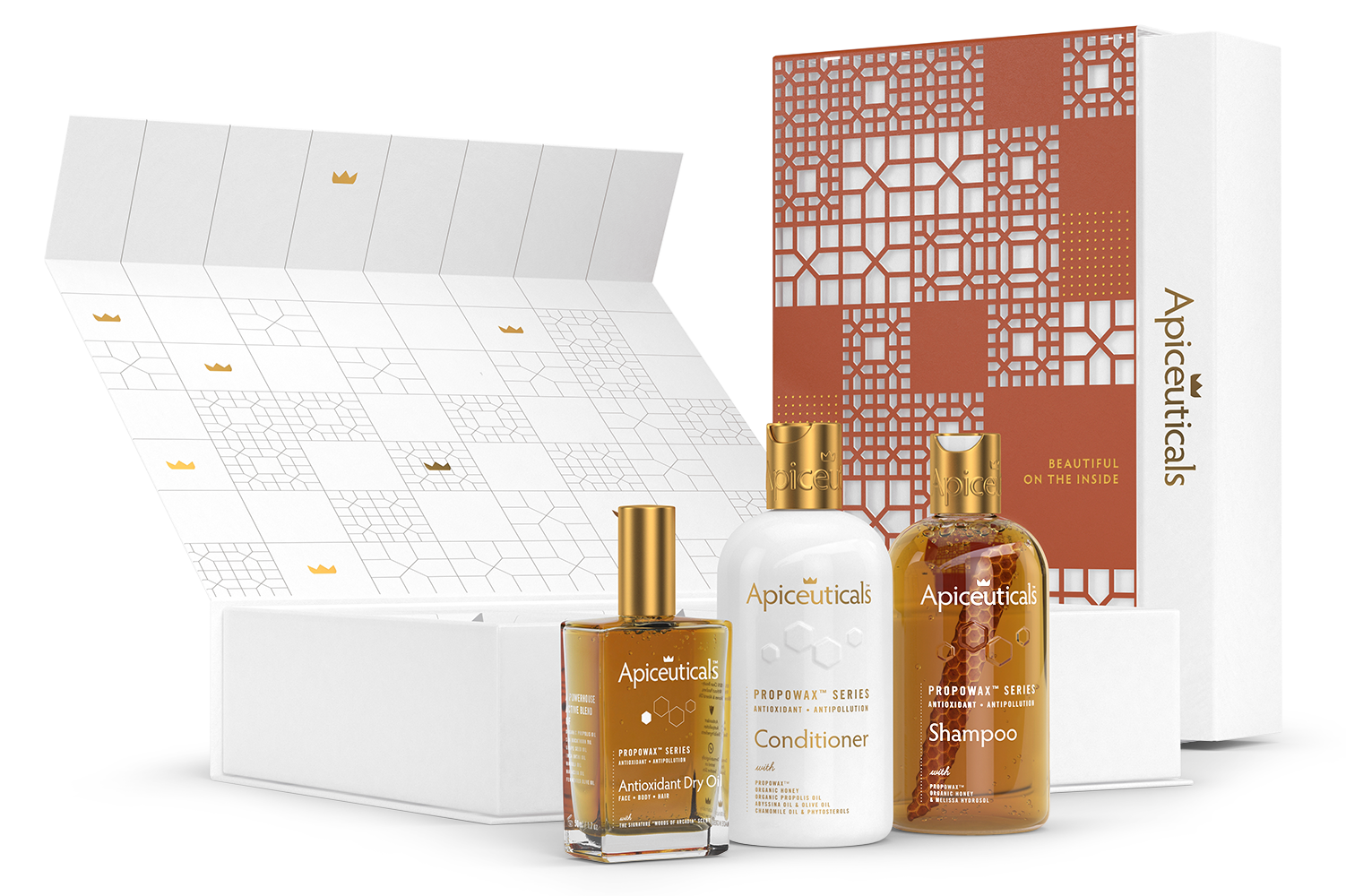
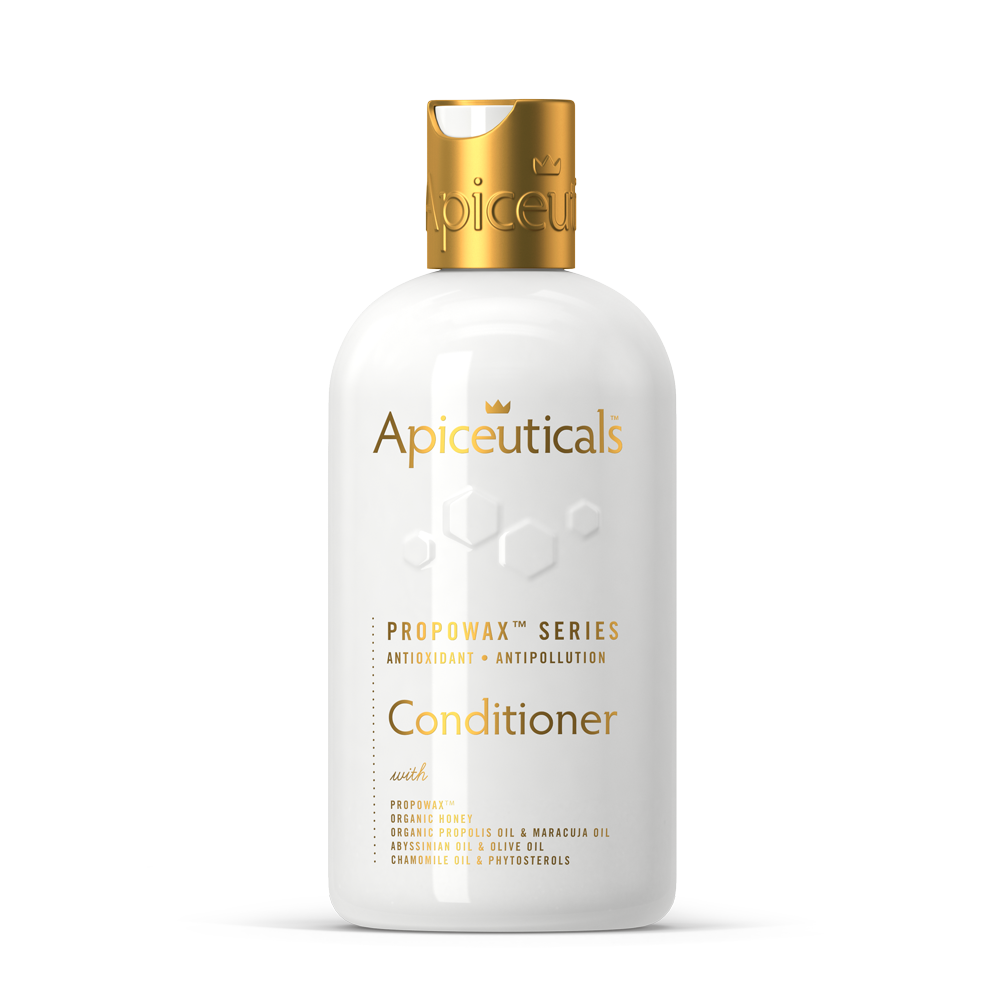
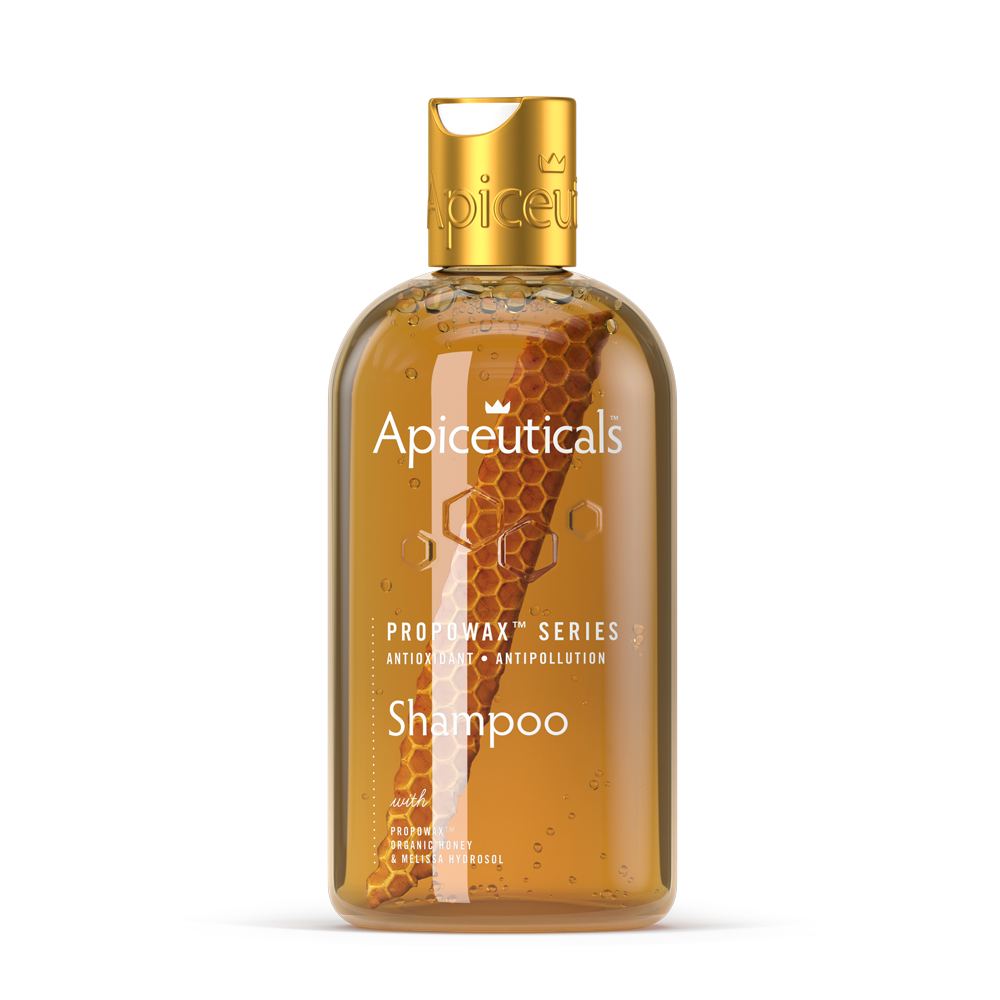
If you have decided to step away from both sulfates, the next consideration is what the replacement routine should do. A gentle cleanser clears the scalp; an antioxidant-active formula then supports it against the oxidative stress that accumulates between washes. The PROPOWAX™ Series pairs a clean surfactant-conscious base with the Living Honeycomb, so the antioxidant delivery is continuous rather than a single event at the point of application. The same antioxidant logic extends to facial care through our waterless HONEY BALM™ Series, for readers who want a coherent approach from scalp to skin.
A caution belongs here too. No shampoo, ours included, treats a scalp condition, and a switch is best judged over several washes rather than one. If a new product causes burning or a rash, stop using it and consult a dermatologist.
Common misconceptions worth retiring
Several beliefs travel with this topic, and most do not survive contact with the research. The first is that SLS and SLES are the same ingredient with a longer name. They are related but behave differently, and the patch-test data show it. The second is that sulfates cause hair loss. The evidence supports irritation and barrier disruption in susceptible skin, not a direct effect on hair follicles. The third is that sulfate-free means gentle. A shampoo is gentle when its whole system is balanced, and a poorly built sulfate-free formula can disappoint.
The fourth is that foam equals cleaning. Lather is largely a sensory cue created by the surfactant system; a shampoo can clean well with modest foam, and a very foamy one can be harsh. The fifth is that natural ingredients cannot irritate. Plant extracts and essential oils are among the more common triggers of contact reactions, which is another reason to read the full list rather than a headline claim. Finally, many readers assume that if something is permitted in the EU it is automatically right for them. Regulation sets a floor for safety across a population; your own scalp may still prefer something milder.
FAQ
Is SLES the same as SLS?
No. Both are anionic surfactants derived from the same type of fatty alcohol, but SLES is ethoxylated before sulfation, which changes how it interacts with skin. That structural step generally reduces irritation while preserving foaming and cleansing.
Is SLS worse than SLES?
For irritation potential, generally yes. In a controlled patch study, SLS caused a pronounced reaction and SLES a far milder one. That does not make SLES irritation-proof, because concentration, contact time and the other ingredients in the formula still matter.
Is SLS safer than SLES?
Neither is safer in every respect. SLS has the stronger evidence for irritation, while SLES can carry trace 1,4-dioxane from manufacturing. The SCCS considers levels of 10 ppm or below in a finished cosmetic safe, so a purified and quality-controlled SLES formula is not the same as a contaminated one.
Why should you avoid SLS?
The best-supported reason is possible barrier disruption and irritation, especially on sensitive, dry, eczema-prone or already compromised skin and scalp. There is no solid evidence that it causes hair loss or is toxic for everyone. If you have a healthy scalp and tolerate it, it is a preference rather than a necessity.
Which is better in a shampoo, SLS or SLES?
It depends on your scalp. SLS-free is a sensible starting point for a dry, reactive or color-treated scalp, while SLES may offer stronger cleansing with a lower irritation profile than SLS on a robust scalp. The complete surfactant blend, fragrance, pH and how thoroughly you rinse often decide the result.
Sources
- Subclinical, non-erythematous irritation with an open assay model: SLS versus SLES
- Profile of irritant patch testing with detergents: SLS, SLES and alkyl polyglucoside
- Evaluation of irritation potential of surfactant mixtures
- The alkaline pH-adapted skin barrier is disrupted severely by SLS-induced irritation
- SCCS opinion on 1,4-dioxane as an impurity in cosmetics
- European Commission: acceptable trace level of 1,4-dioxane in cosmetic products
- CosIng entry for sodium laureth sulfate
Recommended


Related posts

How bees and biodiversity sustain each other, what the science says about Greece and the Aegean, and how antioxidant beauty can start from a hive...

How organic propolis extraction works, from hive to extract: collection, solvents, EU organic rules, Greek propolis phenolics and what it means for skincare.

Build an anti pollution skincare routine that fits Greek city life: what pollution does to skin, the morning and evening steps, and the antioxidants with...

Honey moisture content explained: the EU and Greek limits, how to take a refractometer reading, what excess water does to honey, and why it matters...

How antioxidant activity measurement works: DPPH, ABTS, FRAP and ORAC explained, why results differ, and what a lab number can and cannot say about skin...