
No products in the cart.
Return To Shop
The Role of Antioxidants in Anti-Aging Skin Health
TL;DR:
- Antioxidants protect skin from oxidative stress by neutralizing free radicals that cause aging. Combining topical and dietary antioxidants offers better skin health results than using either alone. PROPOWAX™ Living Honeycomb provides a patented, continuous-release delivery of antioxidants, setting a new standard in cosmetic efficacy.
Antioxidants are defined as molecules that neutralize reactive oxygen species (ROS), the unstable compounds that drive oxidative stress and accelerate skin aging at the cellular level. The role of antioxidants in anti-aging is not cosmetic in the superficial sense. It is biochemical: antioxidants protect collagen, elastin, and cellular DNA from the degradation that produces wrinkles, pigment changes, and loss of skin resilience. Vitamins C and E are the most studied topical antioxidants, each with distinct mechanisms for preserving skin barrier integrity. Apiceuticals’ PROPOWAX™ Living Honeycomb holds a global patent for the highest antioxidant activity in cosmetics, independently validated by the Aristotle University of Thessaloniki, setting a measurable benchmark for what antioxidant delivery in skincare can achieve.
How do free radicals cause skin aging?
Oxidative stress is the central mechanism of skin aging. Free radicals, specifically ROS, are generated when skin encounters UV radiation, air pollution, cigarette smoke, and even metabolic byproducts of normal cellular activity. Think of ROS acting on skin tissue the way rust acts on metal: a slow, relentless degradation of structural integrity that compounds over time.
The damage follows a precise biochemical cascade. ROS attack collagen and elastin fibers directly, breaking the peptide bonds that give skin its firmness and elasticity. They also oxidize membrane lipids, compromising the skin barrier and allowing moisture to escape. Perhaps most critically, ROS activate matrix metalloproteinases (MMPs), enzymes that further degrade the extracellular matrix and accelerate the visible signs of aging.
The role of free radicals in aging extends beyond structural damage. Oxidative stress triggers inflammatory signaling pathways that create a chronic, low-grade inflammatory state in the dermis. This state, sometimes called “inflammaging,” suppresses cellular repair mechanisms and compounds the structural losses caused by direct ROS attack.
Key sources of skin oxidative stress include:
- UV radiation (UVA and UVB): The primary environmental driver of photoaging, generating singlet oxygen and hydroxyl radicals in the dermis.
- Particulate matter and ozone: Urban air pollutants that penetrate the stratum corneum and generate ROS independently of sun exposure.
- Glycation: Excess dietary sugar binds to collagen proteins, stiffening fibers and making them more vulnerable to oxidative cleavage.
- Lifestyle factors: Poor sleep, chronic psychological stress, and alcohol consumption all elevate systemic oxidative markers.
Understanding oxidative stress in skin is the first step toward building a defense that actually works.
The role of antioxidants in anti-aging: topical versus dietary strategies
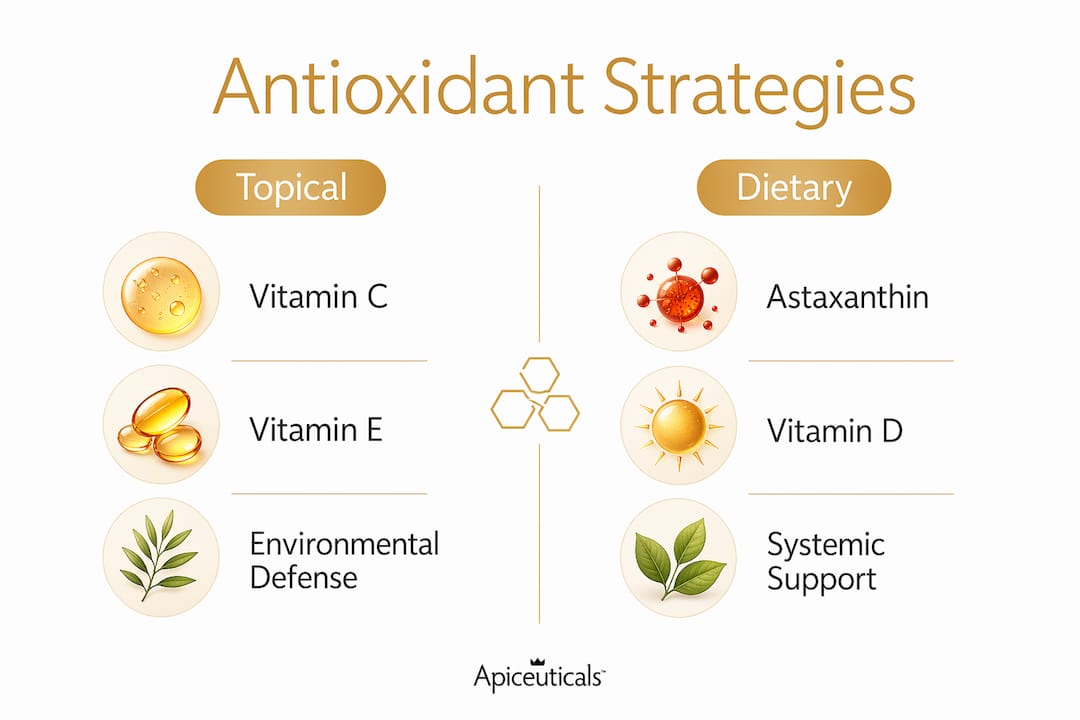
The anti-aging benefits of antioxidants operate through two distinct but complementary routes: topical application and dietary intake. Neither route alone provides complete protection. Together, they address both the external assault of environmental ROS and the internal depletion of cellular redox reserves.
Topical antioxidants: direct environmental defense
Topical antioxidants like vitamin C and vitamin E work at the skin surface and within the upper dermis to intercept ROS before they reach structural proteins. Vitamin C stimulates collagen production and reduces hyperpigmentation by inhibiting tyrosinase activity, while vitamin E protects the lipid bilayer of cell membranes from peroxidation. Polyphenols, including resveratrol and ferulic acid, add a further layer of photoprotection by absorbing UV energy and quenching singlet oxygen.
The clinical evidence for topical antioxidants is well established. Studies show that topical vitamin C applied consistently reduces the appearance of fine lines, improves skin tone, and measurably increases dermal collagen density. Vitamin E applied alongside vitamin C produces a synergistic effect, with each molecule regenerating the other after electron donation.
Dietary antioxidants: systemic redox support
Dietary antioxidants work differently. Rather than targeting a specific skin zone, they replenish the body’s systemic antioxidant reserves and support redox homeostasis throughout all tissues. The Mediterranean diet, rich in polyphenols, carotenoids, and omega-3 fatty acids, is linked to measurably lower oxidative markers including F2-isoprostanes and 8-OHdG, two biomarkers of systemic oxidative damage.
Clinical studies show that dietary antioxidants like astaxanthin and vitamin D improve skin hydration and photoprotection from within. Astaxanthin, a carotenoid found in marine algae, crosses the blood-skin barrier and deposits in the dermis, where it quenches singlet oxygen with exceptional efficiency.
Synergistic integration
| Approach | Primary Target | Key Compounds | Measured Benefit |
|---|---|---|---|
| Topical | Environmental ROS at skin surface | Vitamin C, Vitamin E, Polyphenols | Collagen synthesis, barrier repair, pigment reduction |
| Dietary | Systemic oxidative stress | Astaxanthin, Vitamin D, Polyphenols | Hydration, photoprotection, reduced oxidative markers |
| Combined | Both internal and external oxidative load | Full-spectrum antioxidant regimen | Improved elasticity, wrinkle reduction, barrier function |
Integrated antioxidant regimens that combine topical and oral strategies produce measurably better outcomes for skin elasticity, hydration, and wrinkle appearance than either approach alone.
Pro Tip: Pair a topical vitamin C serum in the morning with a dietary astaxanthin supplement taken with a fat-containing meal. The fat improves astaxanthin absorption, and the morning application of vitamin C maximizes photoprotection during peak UV hours.
Does formulation matter more than the antioxidant itself?
Formulation science is where most antioxidant skincare fails. The identity of the antioxidant matters less than whether it reaches its target in an active form.
Vitamin C illustrates this problem precisely. Oxidized ascorbic acid is biologically inactive. For vitamin C to penetrate the stratum corneum and stimulate collagen synthesis, the formulation must maintain a pH below 3.5 and use a stable delivery vehicle that prevents oxidation on contact with air. Most mass-market vitamin C products fail this requirement within weeks of opening.
The dose question is equally important, and the answer is counterintuitive. Higher antioxidant doses do not always produce better outcomes. Excessive antioxidant supplementation can trigger pro-oxidant effects, a phenomenon called the “antioxidant paradox,” where oversaturation of the redox system actually accelerates oxidative damage rather than preventing it. This is particularly relevant for isolated high-dose supplements rather than food-derived or well-formulated topical sources.
The distinction between direct and indirect antioxidants adds another layer of complexity:
- Direct antioxidants donate electrons to neutralize free radicals immediately. Vitamins C and E operate this way. They are consumed in the process and must be continuously replenished.
- Indirect antioxidants activate cellular defense pathways rather than scavenging radicals directly. Compounds that trigger Nrf2 activation cause the cell to produce its own protective enzymes, including superoxide dismutase and catalase, providing sustained protection that outlasts the compound itself.
Indirect antioxidants represent the more sophisticated long-term strategy. A single Nrf2-activating compound can trigger a cascade of endogenous protection that no amount of topical vitamin C can replicate.
Pro Tip: When evaluating an antioxidant serum, check whether the brand publishes stability data. A product with no stability testing has likely not solved the oxidation problem, regardless of the concentration on the label.
The best antioxidants for skin are those formulated for bioavailability, not just ingredient concentration. Personalized antioxidant approaches consistently outperform generic supplementation because they account for individual oxidative load, skin type, and lifestyle factors.
What makes PROPOWAX™ Living Honeycomb different from standard antioxidants?
The most compelling developments in antioxidant skincare move beyond isolated vitamins toward complex, multi-compound sources with validated activity. Polyphenols, flavonoids, carotenoids, and propolis-derived compounds each contribute distinct mechanisms that vitamins C and E cannot replicate alone.
PROPOWAX™ Living Honeycomb, the patented technology at the core of Apiceuticals’ formulations, represents this next generation of antioxidant delivery. The technology embeds a living honeycomb matrix inside each product that continuously releases antioxidants onto skin, scalp, and hair over time. This sustained-release mechanism addresses one of the core failures of conventional antioxidant skincare: the rapid depletion of active compounds after application.
The global patent for highest antioxidant activity held by Apiceuticals was validated by the Aristotle University of Thessaloniki, one of Greece’s leading research institutions. British Vogue recognized Apiceuticals as “arguably the global leader in antioxidant activity.” These are not marketing claims. They are independently verified scientific findings.
| Antioxidant Source | Delivery Mechanism | Stability | Validated Activity |
|---|---|---|---|
| Vitamin C (L-ascorbic acid) | Single-dose topical | Low (oxidizes rapidly) | Collagen synthesis, pigment reduction |
| Vitamin E (tocopherol) | Single-dose topical | Moderate | Lipid barrier protection |
| Polyphenol complex | Varies by formulation | Moderate to high | Anti-inflammatory, photoprotection |
| PROPOWAX™ Living Honeycomb | Continuous-release matrix | High (patented stabilization) | Highest validated antioxidant activity in cosmetics |
The propolis and beeswax compounds within PROPOWAX™ contain a spectrum of polyphenols and flavonoids that support dermal resilience, barrier repair, and photoprotection simultaneously. Apiceuticals’ HONEY BALM™ Series, which uses this technology in waterless facial formulations, has demonstrated clinically proven 26% wrinkle reduction. That figure reflects what happens when antioxidant delivery is solved at the formulation level, not just the ingredient level.
For those building a complete antioxidant regimen, understanding how to prevent skin oxidation requires looking beyond ingredient lists to the science of how those ingredients are stabilized and delivered. The role of antioxidants in skin health is well documented across dermatology literature, and the consensus is clear: delivery and stability determine efficacy, not concentration alone.
Key Takeaways
The role of antioxidants in anti-aging is defined by their ability to neutralize ROS, activate cellular defense pathways, and preserve the structural proteins that keep skin firm, even, and resilient over time.
| Point | Details |
|---|---|
| Free radicals drive skin aging | ROS degrade collagen, elastin, and DNA, triggering inflammation and MMP activation. |
| Topical and dietary antioxidants complement each other | Combined regimens produce better outcomes for elasticity, hydration, and wrinkle reduction than either alone. |
| Formulation determines efficacy | Vitamin C requires pH below 3.5 and stable delivery; oxidized forms are biologically inactive. |
| Indirect antioxidants offer sustained protection | Nrf2-activating compounds trigger endogenous enzyme production, providing longer-lasting defense than direct scavenging. |
| PROPOWAX™ sets a validated benchmark | Apiceuticals’ patented continuous-release technology holds the global record for highest antioxidant activity in cosmetics, validated by the Aristotle University of Thessaloniki. |
Apiceuticals’ perspective on antioxidants and long-term skin health
The most common mistake in antioxidant skincare is treating it as an ingredient problem rather than a systems problem. Skin aging is not caused by a deficiency of vitamin C. It is caused by a sustained imbalance between oxidative damage and the skin’s capacity to repair itself. Correcting that imbalance requires a strategy, not a single product.
At Apiceuticals, the approach begins with the recognition that antioxidant efficacy is dose-dependent and highly individual. Two people with identical sun exposure histories can have dramatically different oxidative loads based on diet, sleep quality, and genetic antioxidant enzyme activity. Generic supplementation ignores this reality.
The science also shows that antioxidants reduce markers of oxidative stress and delay the onset of visible aging, but the most durable outcomes come from building systemic resilience rather than chasing individual biomarkers. PROPOWAX™ Living Honeycomb was developed with this systems-level thinking in mind. Its continuous-release mechanism ensures that antioxidant activity is not a single event at the moment of application. It is an ongoing process that mirrors how the skin’s own defense systems work.
The future of skin anti-aging, as dermatology increasingly recognizes, integrates topical antioxidants with internal nutrition for a complete defense. That integration is not a trend. It is the logical conclusion of the science.
— Apiceuticals
Apiceuticals’ antioxidant skincare, powered by PROPOWAX™
Apiceuticals builds every formulation around PROPOWAX™ Living Honeycomb, the only cosmetic technology in the world to hold a global patent for highest antioxidant activity. The science behind it is validated, the results are clinically measured, and the clean beauty standards are uncompromising: no SLS, SLES, parabens, silicones, or mineral oils, and dermatologically tested with 0% irritation on sensitive skin.

For those serious about the anti-aging benefits of antioxidants, Apiceuticals offers a complete range of antioxidant skin care products formulated for real bioavailability. The HONEY BALM™ Series delivers clinically proven 26% wrinkle reduction through waterless facial formulations. The PROPOWAX™ Series extends that same antioxidant science to haircare and bodycare. Every product is rooted in bee science developed across four decades of organic beekeeping in Arcadia, Greece, and every formulation is built to deliver what the label promises.
FAQ
What is the role of antioxidants in anti-aging?
Antioxidants neutralize reactive oxygen species (ROS) that degrade collagen, elastin, and cellular DNA, the primary drivers of visible skin aging. By interrupting oxidative damage, they preserve skin structure and support cellular repair.
How do antioxidants prevent skin aging at the cellular level?
Antioxidants work through two mechanisms: direct scavenging of free radicals and indirect activation of cellular defense pathways like Nrf2, which triggers the production of protective enzymes including superoxide dismutase.
Can antioxidants reverse existing signs of aging?
Antioxidants reduce oxidative markers and support collagen synthesis, which can improve the appearance of fine lines and uneven tone. Clinical evidence shows measurable wrinkle reduction with consistent use, though complete reversal of structural aging is not supported by current research.
Why does antioxidant formulation matter so much?
An antioxidant that oxidizes before reaching its target is biologically inactive. Vitamin C, for example, requires a pH below 3.5 and a stable delivery vehicle to remain effective. Formulation quality determines whether the active compound actually reaches the dermis.
What makes PROPOWAX™ Living Honeycomb effective for anti-aging?
PROPOWAX™ uses a patented continuous-release matrix that delivers antioxidants to skin over time rather than in a single application event. Its antioxidant activity is the highest validated in cosmetics, independently confirmed by the Aristotle University of Thessaloniki.
Recommended


Related posts

How bees and biodiversity sustain each other, what the science says about Greece and the Aegean, and how antioxidant beauty can start from a hive...

How organic propolis extraction works, from hive to extract: collection, solvents, EU organic rules, Greek propolis phenolics and what it means for skincare.

Build an anti pollution skincare routine that fits Greek city life: what pollution does to skin, the morning and evening steps, and the antioxidants with...

Honey moisture content explained: the EU and Greek limits, how to take a refractometer reading, what excess water does to honey, and why it matters...

How antioxidant activity measurement works: DPPH, ABTS, FRAP and ORAC explained, why results differ, and what a lab number can and cannot say about skin...















