
No products in the cart.
Return To Shop
The Role of Clinical Testing in Skincare Explained
TL;DR:
- Clinical testing in skincare involves scientifically controlled studies that verify a product’s safety and efficacy before market release. It distinguishes between objective, instrument-measured outcomes and subjective consumer perception, with validated finished formulations providing the most credible evidence; regulatory standards now demand thorough, product-specific, and independently validated data to substantiate claims.
Clinical testing in skincare refers to scientifically controlled studies designed to verify a product’s safety and effectiveness before it reaches consumers. The role of clinical testing in skincare extends far beyond regulatory compliance. It is the mechanism by which a brand earns the right to make a claim, and by which a consumer earns the right to trust one. In 2026, with the Modernization of Cosmetics Regulation Act (MoCRA) reshaping FDA oversight and the Federal Trade Commission (FTC) enforcing stricter claim substantiation standards, understanding what clinical testing actually involves has never been more relevant. Apiceuticals, whose PROPOWAX™ Living Honeycomb technology was independently validated by the Aristotle University of Thessaloniki, treats clinical testing not as a checkbox but as the scientific foundation of every product claim it makes.
What does the role of clinical testing in skincare actually involve?
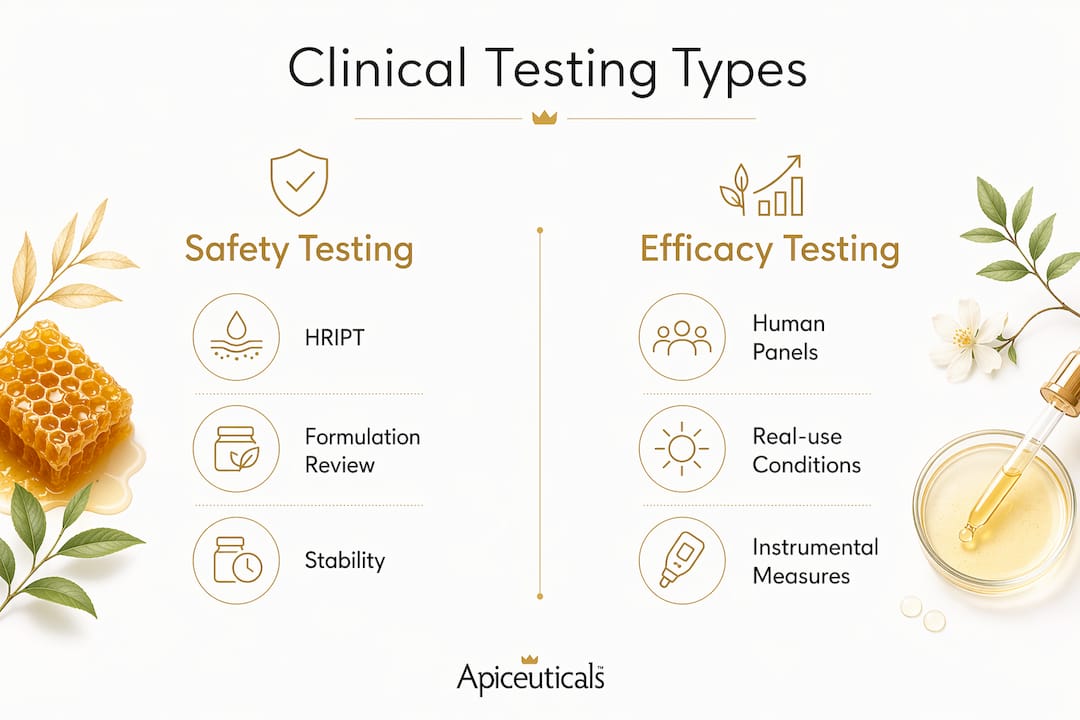
Clinical testing in cosmetics encompasses two distinct but complementary categories: safety testing and efficacy testing. Safety testing determines whether a product causes harm. Efficacy testing determines whether a product delivers its promised benefit. Both are required to build a credible, defensible product dossier, and neither can substitute for the other.
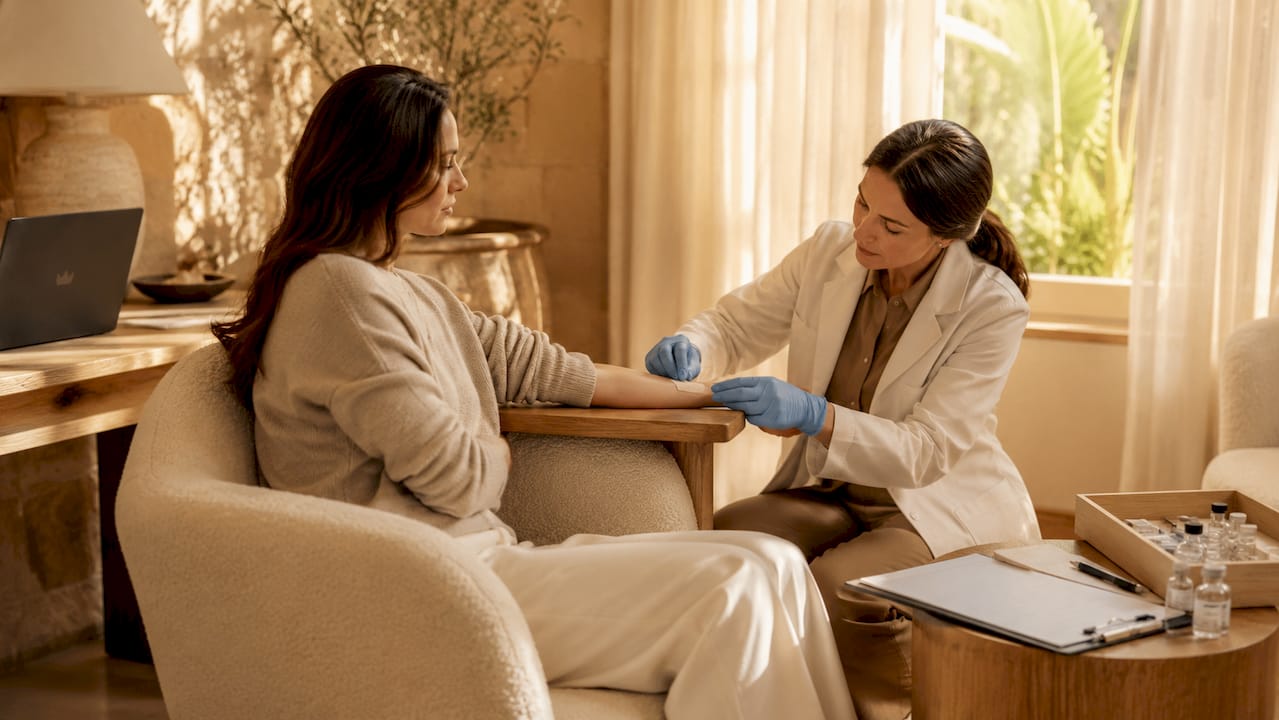
Safety testing for leave-on skincare products typically centers on the Human Repeat Insult Patch Test (HRIPT). This protocol involves repeated patch applications over a three-week induction period, followed by a rest interval and a final challenge phase. The design is deliberate: it mirrors real-world use, where a consumer applies a product daily for months, not once. Sensitization risks can develop only after repeated exposures, which is why a single-contact irritation test is insufficient for leave-on formulations. The HRIPT is the gold standard precisely because it accounts for cumulative exposure.
Efficacy testing follows a different logic. Clinical efficacy studies typically involve panels of 20 to 50 subjects, using instrumental measurements such as corneometry for hydration, cutometry for elasticity, and expert grader assessments to evaluate visible outcomes. Studies are conducted over controlled regimens, with specific endpoints chosen to match the product’s intended claims. A moisturizer claiming 72-hour hydration requires a different endpoint design than a serum claiming wrinkle reduction.
One detail that separates credible testing from superficial testing is the use of the finished formulation at real-use concentrations. Testing the exact product as marketed, rather than an isolated ingredient or a higher concentration, is what makes clinical data legally and scientifically defensible. A study conducted on a raw ingredient at 10 times the formulated concentration tells you very little about what the product will do on a consumer’s skin.
Pro Tip: When evaluating a brand’s clinical claims, ask whether the study tested the finished product or just an active ingredient in isolation. Only finished-product data at real-use concentrations can substantiate a claim under FTC standards.
Safety testing frameworks also incorporate multiple evidence streams beyond clinical data alone. Formulation review, stability testing, microbiology, and clinical results are assembled into a cohesive substantiation dossier that must withstand regulatory inspection. No single test is sufficient on its own. The dossier is the argument, and clinical data is its strongest evidence.
How do MoCRA and FTC standards shape clinical testing requirements?
The regulatory environment governing skincare in the United States shifted significantly with MoCRA, which came into full effect and began reshaping FDA oversight through 2025 and 2026. Understanding these frameworks helps consumers interpret what brands are legally required to prove, and what they are not.
Safety substantiation is mandatory. Under MoCRA, a responsible person, typically the brand or manufacturer, must maintain safety records demonstrating adequate substantiation evaluated by qualified experts. This is not optional documentation. It is a legal requirement tied to every product on the market.
FDA can access records without prior notice. MoCRA extends FDA authority to access safety and manufacturing records when investigating products that may cause serious adverse health consequences or death. This enforcement power gives the safety dossier real legal weight.
Recall authority is now mandatory, not voluntary. If FDA determines a reasonable probability that a cosmetic is adulterated or misbranded and could cause significant disfigurement or require medical intervention, mandatory recall authority applies. Brands without documented substantiation face the highest exposure.
FTC requires “competent and reliable scientific evidence.” For any health or safety claim in advertising, the FTC standard demands human clinical evidence designed and reviewed by qualified experts. The strength of that evidence must match the strength of the claim. “Clinically proven to reduce wrinkles by 26%” requires more rigorous substantiation than “helps improve skin texture.”
Substantiation must be product-specific. Adequate safety substantiation must be product-relevant and sufficient to provide reasonable certainty of safety. Generic literature about an ingredient class does not satisfy this standard for a specific finished formulation.
“The strength of scientific evidence backing claims like ‘clinically proven’ matters; marketers must align advertising with actual clinical data quality and scope.” — FTC substantiation guidance, as interpreted by advertising law practitioners.
For consumers, this regulatory context is practically useful. A brand that publishes its clinical methodology, panel size, and endpoint data is operating transparently within a framework that has real legal consequences for misrepresentation. A brand that uses the phrase “clinically tested” without specifying what was tested, on whom, and with what result is exploiting the gap between regulatory language and consumer understanding. The science behind beauty products is only as trustworthy as the testing that produced it.
Clinical testing vs. consumer testing: what’s the difference?
These two categories of evidence are frequently conflated in marketing, but they measure entirely different things. Understanding the distinction is one of the most useful tools a skincare consumer can have.
| Feature | Clinical testing | Consumer testing |
|---|---|---|
| Who conducts it | Trained clinicians, dermatologists, or instrument operators | Recruited consumer panels, often self-reporting |
| What it measures | Objective biological or physical endpoints (hydration, elasticity, wrinkle depth) | Subjective perception (feel, satisfaction, preference) |
| Scientific rigor | Controlled study design with statistical analysis | Qualitative or semi-quantitative survey data |
| Regulatory weight | Accepted by FDA and FTC as substantiation | Not accepted as standalone scientific evidence |
| Typical claim language | “Clinically proven to reduce wrinkle depth by X%” | “9 out of 10 users said skin felt smoother” |
Clinical testing produces objective data. A cutometer measures skin elasticity in millimeters. A spectrophotometer quantifies pigmentation change. These instruments do not have opinions, and their outputs can be audited. Consumer testing produces perception data. It tells you how people feel about a product, which is commercially valuable but scientifically limited. A consumer who believes a product is working may report improvement regardless of whether any measurable change has occurred. This is not a flaw in consumer testing. It is simply a different type of information.
The problem arises when consumer perception data is presented with the authority of clinical evidence. Phrases like “proven by consumers” or “users agree” are marketing constructs, not scientific claims. If you want to understand what clinically tested skincare actually means, the distinction between these two evidence types is the place to start.
How clinical testing validates antioxidant skincare like PROPOWAX™
Antioxidant skincare occupies a category where clinical validation is particularly demanding. Antioxidants neutralize free radicals, the unstable molecules that accelerate oxidative stress in skin cells. Think of oxidative stress as rust forming on metal. Free radicals are the corrosive agents, and antioxidants are the protective coating that slows the process. But measuring antioxidant activity in a living skin system requires more than a laboratory assay. It requires validated methodology applied to the finished product.
This is where independent academic validation becomes the benchmark. Apiceuticals’ PROPOWAX™ Living Honeycomb holds a global patent for antioxidant activity, validated by the Aristotle University of Thessaloniki, one of Greece’s leading research institutions. This validation is not a marketing endorsement. It is a scientific finding produced by an independent institution using reproducible methodology. British Vogue described PROPOWAX™ as “arguably the global leader in antioxidant activity,” a characterization grounded in that independent research.
Validated endpoints in antioxidant skincare studies typically include:
- DPPH radical scavenging activity, which measures how effectively a formulation neutralizes a standardized free radical in vitro.
- ORAC (Oxygen Radical Absorbance Capacity) values, which quantify total antioxidant capacity against multiple oxidant types.
- Skin biomarker assessments, including measurements of oxidative stress markers in skin tissue before and after product application.
- Dermatological safety evaluation, confirming that antioxidant actives do not cause irritation or sensitization at formulated concentrations.
Apiceuticals’ HONEY BALM™ Series, the brand’s waterless facial care line, carries a clinically proven 26% wrinkle reduction claim. That figure exists because a controlled study measured it using validated instrumentation on the finished product. It is not an estimate, a projection, or a consumer survey result. The importance of clinical testing in this context is that it converts a biological mechanism into a measurable, defensible consumer benefit. Antioxidant activity that cannot be measured cannot be claimed.
Key takeaways
Clinical testing is the only mechanism that converts a skincare ingredient’s theoretical benefit into a legally defensible, scientifically verified consumer claim.
| Point | Details |
|---|---|
| Safety testing requires repeated exposure | HRIPT protocols simulate long-term use to detect sensitization that single-contact tests cannot reveal. |
| MoCRA mandates documented substantiation | Brands must maintain safety records evaluated by qualified experts, or face FDA enforcement and mandatory recall. |
| FTC demands product-specific clinical data | Generic ingredient literature does not satisfy the “competent and reliable scientific evidence” standard for advertising claims. |
| Clinical and consumer testing serve different purposes | Objective instrumental data substantiates claims; consumer perception data measures satisfaction but carries no regulatory weight. |
| Independent validation sets the credibility standard | Third-party academic validation, as with PROPOWAX™ at the Aristotle University of Thessaloniki, is the strongest form of antioxidant efficacy evidence. |
Why clinical evidence should change how you choose skincare
At Apiceuticals, we have spent years watching the skincare market conflate the language of science with the substance of it. “Dermatologist-approved,” “clinically inspired,” and “tested by experts” are phrases that sound rigorous but carry no standardized meaning. The regulatory frameworks now in place, particularly MoCRA and FTC substantiation standards, are beginning to close that gap. But regulation moves slowly, and marketing moves fast.
The uncomfortable reality is that most consumers evaluate skincare claims at face value, and most brands know it. A panel size of 12 self-selected participants over two weeks is technically a “clinical study.” A single in vitro assay on an isolated ingredient is technically “lab-tested.” These are not lies. They are calibrated truths designed to imply more than they prove.
What we have found, both in developing our own formulations and in observing the broader antioxidant beauty category, is that genuine clinical rigor is rare precisely because it is expensive and time-consuming. A properly designed HRIPT takes weeks. A controlled efficacy study with 50 subjects and validated instrumentation costs significantly more than a consumer perception survey. Brands that invest in this process are making a deliberate choice to be held accountable to their claims. That accountability is worth something to the consumer who reads the label.
The next time you see “clinically proven” on a product, ask three questions: What was tested? On how many people? By whom? If the brand cannot answer all three, the claim is incomplete regardless of how it is presented.
— Apiceuticals
Apiceuticals and the science behind every claim

Every Apiceuticals product is built on the same principle that governs credible clinical testing: a claim is only as strong as the evidence behind it. The PROPOWAX™ Living Honeycomb technology, patented globally for the highest antioxidant activity in cosmetics and validated by the Aristotle University of Thessaloniki, represents what independent scientific verification looks like in practice. The HONEY BALM™ Series carries a clinically proven 26% wrinkle reduction result from controlled testing on the finished formulation. Apiceuticals is dermatologically tested on sensitive skin with 0% irritation, free from over 2,000 potentially harmful ingredients. For consumers who want antioxidant skincare grounded in verifiable science, explore the full Apiceuticals antioxidant range and the research that supports every product in it.
FAQ
What is clinical testing in cosmetics?
Clinical testing in cosmetics refers to controlled scientific studies evaluating a product’s safety and efficacy on human subjects. These studies use validated protocols and instrumentation to generate data that can substantiate product claims under FDA and FTC standards.
What does the HRIPT test measure in skincare safety testing?
The Human Repeat Insult Patch Test (HRIPT) measures a product’s potential to cause irritation and allergic sensitization through repeated exposure. It involves a multi-week induction phase and a challenge phase, designed to simulate long-term consumer use.
How does MoCRA affect skincare brands in 2026?
MoCRA requires brands to maintain documented safety substantiation records evaluated by qualified experts, and grants FDA authority to access those records and issue mandatory recalls if products pose serious health risks.
What is the difference between “clinically tested” and “clinically proven”?
“Clinically tested” means a product underwent some form of clinical study, without specifying the outcome. “Clinically proven” implies the study produced statistically significant results supporting a specific claim, and carries a higher burden of substantiation under FTC guidelines.
Why does independent validation matter for antioxidant skincare?
Independent academic validation, such as the Aristotle University of Thessaloniki’s assessment of PROPOWAX™ Living Honeycomb, confirms that antioxidant activity measurements are reproducible and not self-reported by the brand. It is the standard that separates a verified claim from a marketing assertion.
Recommended


Related posts

How bees and biodiversity sustain each other, what the science says about Greece and the Aegean, and how antioxidant beauty can start from a hive...

How organic propolis extraction works, from hive to extract: collection, solvents, EU organic rules, Greek propolis phenolics and what it means for skincare.

Build an anti pollution skincare routine that fits Greek city life: what pollution does to skin, the morning and evening steps, and the antioxidants with...

Honey moisture content explained: the EU and Greek limits, how to take a refractometer reading, what excess water does to honey, and why it matters...

How antioxidant activity measurement works: DPPH, ABTS, FRAP and ORAC explained, why results differ, and what a lab number can and cannot say about skin...















