
No products in the cart.
Return To Shop
The Role of Education in Skincare Choices That Actually Work
TL;DR:
- Skincare education is vital for understanding active ingredients, clinical evidence, and proper product selection.
- However, knowledge alone does not guarantee consistent behavior without addressing attitudes, confidence, and social influences.
Education is the single most powerful variable shaping how consumers select, use, and evaluate skincare products. The role of education in skincare choices extends far beyond reading a label. It determines whether someone understands why retinoids accelerate cell turnover, why antioxidants neutralize free radicals before they degrade collagen, and why a patented delivery system matters more than a marketing claim. Ingredient literacy, the recognized industry term for this competency, is the practical outcome of skincare education. Yet 2026 research confirms a critical gap: knowledge improves comprehension but does not automatically produce better skincare behavior. Attitudes, confidence, and cultural context are the mediating forces that determine whether education translates into results.
How does education shape skincare ingredient knowledge and product choices?
Ingredient literacy is the foundation of every informed skincare decision. When consumers understand what active ingredients do at a biological level, they evaluate products on evidence rather than packaging. Retinoids accelerate epidermal turnover. Broad-spectrum sunscreens block UVA-induced oxidative stress. Antioxidants intercept free radicals before those unstable molecules degrade lipid membranes and structural proteins like collagen and elastin. Without this framework, product selection defaults to price, aesthetics, or social proof.

Scientific validation is the second pillar of skincare education impact. A consumer who understands clinical testing can distinguish between a product with peer-reviewed evidence and one with a manufacturer’s self-assessment. Apiceuticals’ PROPOWAX™ Living Honeycomb technology, for example, holds a global patent for the highest antioxidant activity in cosmetics, independently validated by the Aristotle University of Thessaloniki. That distinction is only meaningful to a consumer who knows what antioxidant activity measures and why independent validation matters. Ingredient literacy converts that data point from noise into a decision criterion.
Understanding how clinical evidence works in skincare is a skill that most consumers acquire gradually, often through trial and error. Structured education accelerates that process significantly. The FarmaSoludable program demonstrated this directly: skin cancer risk identification among pharmacists rose from 45.2% to 72.2% following targeted training. That 27-percentage-point gain represents the measurable value of structured knowledge transfer applied to a real-world skincare context.
Pro Tip: When evaluating an efficacy claim on a skincare product, look for three things: the specific ingredient concentration, the study design (randomized controlled trial versus open-label), and whether the testing was conducted by an independent institution. All three together constitute credible evidence.
- Active ingredient function: Know what each ingredient does mechanistically, not just what the brand claims it treats.
- Concentration thresholds: Effective retinol typically starts at 0.1%; effective vitamin C (L-ascorbic acid) requires at least 10% to produce measurable antioxidant activity.
- Delivery systems: How an ingredient reaches its target tissue determines efficacy as much as the ingredient itself. PROPOWAX™ Living Honeycomb’s continuous-release mechanism is a documented example of delivery science applied to antioxidant stability.
- Independent validation: University or hospital-based testing carries more weight than in-house studies.
Why does education sometimes fail to change skincare behavior?
The knowledge-to-behavior gap is one of the most documented and least discussed problems in skincare education. A 2026 university study on acne among university students found that adequate knowledge did not translate into proactive skincare practices. Path analysis showed the direct effect of knowledge on practice was not statistically significant. The indirect effect, mediated by attitude, was present but small. This means that knowing the correct answer and acting on it are two separate cognitive events, separated by a psychological bridge that facts alone cannot build.
Attitudes and self-efficacy are the mediating variables that determine whether knowledge becomes behavior. A consumer who understands that daily SPF application reduces melanoma risk but believes their skin tone provides sufficient protection will not apply sunscreen consistently. That belief is an attitude, not a knowledge deficit. Educational interventions that target both knowledge and attitude produce measurably better behavioral outcomes than those focused on information transfer alone.
Cultural and social norms add a further layer of complexity. A systematic review on skin whitening behavior found that in several countries, higher education levels correlated with increased use of skin-lightening products, not decreased. Social-status motivations outweighed health risk awareness. This finding inverts the assumption that more education produces safer cosmetic choices. Where social desirability is a primary driver, education must address the social motivation directly, not just the ingredient risk.
| Factor | Effect on skincare behavior | Research basis |
|---|---|---|
| Knowledge alone | Improves label comprehension; limited direct effect on practice | 2026 acne study, Scientific Reports |
| Positive attitude | Mediates knowledge-to-practice translation; increases consistency | Path analysis, university student cohort |
| Self-efficacy | Drives routine adherence and proactive skin management | Ingredient literacy and behavior gap research |
| Cultural norms | Can override health knowledge; social motives may increase risk behavior | Systematic review on skin whitening |
| Confidence post-education | Increases intended protective behaviors significantly | Community skin cancer intervention data |
Pro Tip: If you find yourself knowing what you should do for your skin but not doing it, the obstacle is rarely information. Identify the specific attitude or belief that is blocking the behavior, and address that directly. Confidence-building exercises, such as a structured 30-day routine with visible benchmarks, are more effective than reading more ingredient guides.
What educational approaches most effectively influence skincare choices?
Structured programs that combine knowledge transfer with practical skill-building produce the most durable behavior change. The FarmaSoludable educational program, designed for community pharmacists, integrated counseling skills with photoprotection science. Personal sunscreen use increased significantly, and promotion of self-examination rose from 31.6% to 65.8%. The critical design feature was that participants practiced counseling in simulated scenarios before applying it in clinical settings. Combining professional training with practice opportunities is what separates effective programs from informational ones.
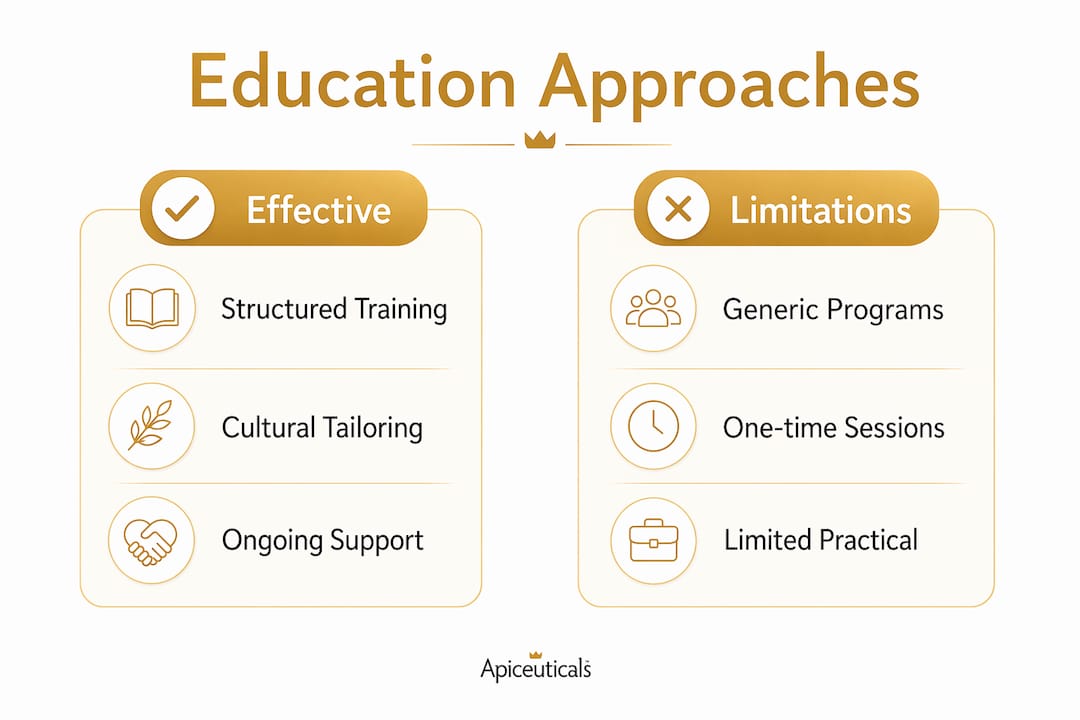
Culturally and linguistically tailored education produces outcomes that generic programs cannot replicate. A bilingual community intervention targeting an underserved population increased sun protection intentions from 73% to 100%. Planned application of sunscreen to all sun-exposed areas rose from 54% to 72% after the intervention. The program succeeded because it addressed both the knowledge gap and the confidence gap within a cultural framework that participants recognized as their own.
| Educational approach | Strength | Limitation |
|---|---|---|
| Structured professional training (e.g., FarmaSoludable) | Measurable competency gains; shifts personal and professional behavior | Resource-intensive; requires institutional support |
| Bilingual community interventions | High confidence gains; culturally resonant; reaches underserved groups | Requires community partnerships and linguistic expertise |
| Online ingredient literacy content | Scalable; accessible; supports self-directed learning | No accountability mechanism; attitude change is limited |
| Personalized counseling (dermatologist or pharmacist) | Addresses individual attitudes and self-efficacy directly | Limited reach; dependent on provider quality |
| Product trial and demonstration | Builds confidence through direct sensory experience | Requires physical access; influenced by marketing context |
For chronic skin conditions, ongoing education is not optional. Periodic follow-up and reinforcement are classified as critical components in 2026 guidelines for managing melanin hyperpigmentation disorders. A single educational encounter is insufficient when the condition requires consistent topical regimen adherence over months. This principle applies equally to consumer skincare: a routine built on one-time learning erodes without reinforcement.
How can you apply skincare education to build a better routine?
Translating education into a functional skincare routine requires a structured approach that addresses knowledge, attitude, and consistency simultaneously. The science of mindful beauty routines confirms that deliberate, evidence-informed practice produces better outcomes than reactive product switching. The following sequence builds ingredient literacy into daily decision-making.
- Audit your current products. List every active ingredient in your routine and verify its function against a credible source such as the International Nomenclature of Cosmetic Ingredients (INCI) database or peer-reviewed dermatology literature. Remove products where the active concentration is below the evidence threshold.
- Identify your primary skin concern mechanistically. Hyperpigmentation involves melanin overproduction. Premature aging involves oxidative stress and collagen degradation. Acne involves sebaceous hyperactivity and bacterial colonization. Each mechanism requires a specific ingredient class, not a general “anti-aging” or “brightening” claim.
- Evaluate delivery systems, not just ingredients. An antioxidant that degrades on contact with air provides no measurable benefit. PROPOWAX™ Living Honeycomb’s patented continuous-release mechanism, validated by the Aristotle University of Thessaloniki, addresses this directly by maintaining antioxidant stability at the skin surface over time.
- Build attitude alongside knowledge. Set a 30-day commitment to a defined routine and photograph your skin weekly under consistent lighting. Visible evidence builds the positive attitude that mediates behavior change more effectively than additional reading.
- Use credible educational resources. The Apiceuticals antioxidant science resource provides evidence-based explanations of how antioxidants function in skin biology, without promotional framing. Peer-reviewed journals, university dermatology departments, and independent testing bodies are the gold standard.
Pro Tip: Beauty samples are not just marketing tools. Product trials serve a genuine educational function by allowing you to observe how your skin responds to an ingredient system before committing to a full product. Use them as controlled experiments, not free gifts.
Avoiding misinformation requires the same critical framework as evaluating evidence. Social media skincare content is rarely peer-reviewed. Influencer recommendations are not clinical endorsements. When a claim lacks a named ingredient, a stated concentration, and an independent study, treat it as marketing rather than science.
Key takeaways
Skincare education produces better choices only when it addresses knowledge, attitude, and cultural context together, not knowledge alone.
| Point | Details |
|---|---|
| Knowledge gap vs. behavior gap | Adequate ingredient knowledge does not guarantee consistent skincare practice without positive attitudes and self-efficacy. |
| Structured programs outperform information | Programs combining training with practice, like FarmaSoludable, produce measurable behavior change that reading alone cannot. |
| Cultural context shapes outcomes | Social norms can override health education; effective programs address social motivations, not just ingredient risks. |
| Delivery systems determine efficacy | Understanding how an ingredient reaches its target tissue is as important as knowing the ingredient itself. |
| Confidence is the missing variable | Education that builds confidence and realistic expectations changes behavior more reliably than fact-only content. |
Why ingredient literacy is the future of skincare education
From Apiceuticals’ perspective, the most significant shift in skincare education over the past decade is not the volume of information available. It is the growing consumer demand for mechanistic understanding. Consumers no longer accept “clinically proven” as a complete answer. They ask: proven by whom, at what concentration, and through what mechanism? That is ingredient literacy in practice, and it is changing which products earn sustained trust.
The knowledge-to-behavior gap remains the field’s central challenge. Apiceuticals has observed that consumers who understand why PROPOWAX™ Living Honeycomb continuously releases antioxidants, rather than simply that it does, are more consistent in their routines. Understanding the mechanism creates the positive attitude that sustains the behavior. This is why PROPOWAX™ technology is explained through its biochemistry, not its aesthetics.
Cultural tailoring is an area where the beauty industry still underinvests. Designing educational content that addresses social motivations alongside ingredient science is not a niche concern. It is the difference between education that informs and education that changes behavior. The 2026 research on skin whitening behavior makes this obligation clear: education that ignores social context can inadvertently reinforce the practices it intends to correct.
The opportunity ahead is significant. As consumers become more scientifically literate, brands that invest in genuine education, rather than simplified marketing, will earn the deeper trust that drives long-term loyalty. Apiceuticals was built on that premise from the beginning.
— Apiceuticals
Discover skincare education backed by science at Apiceuticals

Apiceuticals was founded on the principle that consumers deserve to understand exactly what they are applying to their skin and why it works. Every product in the antioxidant skincare range is formulated around PROPOWAX™ Living Honeycomb, a patented technology that holds the global record for highest antioxidant activity in cosmetics, validated by the Aristotle University of Thessaloniki. The HONEY BALM™ Series delivers clinically proven 26% wrinkle reduction. The PROPOWAX™ Series provides continuous antioxidant protection for hair, scalp, and body. Every formulation excludes over 2,000 potentially harmful ingredients and is dermatologically tested with 0% irritation on sensitive skin. If you want skincare choices grounded in evidence, explore the full Apiceuticals product range and the science behind every ingredient.
FAQ
What is the role of education in skincare choices?
Education enables consumers to understand active ingredients, evaluate product efficacy claims, and build routines based on evidence rather than marketing. The role of education in skincare choices is to convert ingredient literacy into consistent, informed practice.
Why doesn’t knowing more about skincare automatically improve my routine?
A 2026 study confirmed that knowledge alone has no significant direct effect on skincare practice. Attitudes, self-efficacy, and confidence mediate whether knowledge translates into consistent behavior.
What educational resources are most effective for skincare?
Structured programs that combine knowledge with practical application, such as the FarmaSoludable pharmacist training program, produce the most measurable behavior change. For consumers, personalized counseling and product trials are more effective than passive content consumption.
How does cultural background affect skincare education outcomes?
A systematic review found that in some cultures, higher education correlates with increased use of potentially harmful skin-lightening products because social-status motivations outweigh health risk awareness. Effective education must address social motivations directly.
How does PROPOWAX™ Living Honeycomb relate to skincare ingredient education?
PROPOWAX™ Living Honeycomb is a patented antioxidant delivery system validated by the Aristotle University of Thessaloniki for the highest antioxidant activity in cosmetics. It serves as a concrete example of how delivery mechanism science, not just ingredient selection, determines real-world skincare efficacy.
How can I build a skincare routine based on ingredient knowledge?
Start by identifying your primary skin concern mechanistically, audit your current products against INCI data, and prioritize ingredients with independent clinical validation. Pair this with a 30-day commitment to a defined routine to build the positive attitude that sustains consistent practice.
Recommended


Related posts

How bees and biodiversity sustain each other, what the science says about Greece and the Aegean, and how antioxidant beauty can start from a hive...

How organic propolis extraction works, from hive to extract: collection, solvents, EU organic rules, Greek propolis phenolics and what it means for skincare.

Build an anti pollution skincare routine that fits Greek city life: what pollution does to skin, the morning and evening steps, and the antioxidants with...

Honey moisture content explained: the EU and Greek limits, how to take a refractometer reading, what excess water does to honey, and why it matters...

How antioxidant activity measurement works: DPPH, ABTS, FRAP and ORAC explained, why results differ, and what a lab number can and cannot say about skin...















