
No products in the cart.
Return To Shop
The Role of Minerals in Skin Care: Science Explained
TL;DR:
- Minerals in skin care perform vital functions such as UV protection, barrier repair, and oxidative defense. Their efficacy depends on proper form, concentration, and formulation, with mineral-antioxidant combinations offering synergistic benefits. Consistent, evidence-based use enhances skin health and addresses multiple vulnerabilities effectively.
Minerals are defined as inorganic elements that perform specific biological functions in the skin, including UV attenuation, barrier repair, cellular regulation, and antioxidant defense. The role of minerals in skin care extends far beyond passive ingredients: zinc oxide blocks ultraviolet radiation through semiconductor-level absorption, magnesium strengthens the epidermal barrier, and calcium governs skin cell turnover. These are not marketing claims. They are mechanisms validated by clinical research and formulation science. Understanding how each mineral operates, and in what form and concentration, is what separates genuinely effective products from those that simply list minerals on a label. Apiceuticals’ PROPOWAX™ Living Honeycomb technology, which holds a global patent for the highest antioxidant activity in cosmetics validated by the Aristotle University of Thessaloniki, represents a complementary approach: pairing antioxidant defense with the barrier-supporting properties that minerals provide.
What is the role of minerals in skin care?
Mineral skincare ingredients fall into two broad categories in dermatology: photoprotective agents and barrier-active compounds. Zinc oxide and titanium dioxide occupy the first category. Magnesium, calcium, selenium, and iron oxides occupy the second, each with distinct and measurable effects on skin physiology.
The distinction matters because it changes how you select and layer products. A zinc oxide sunscreen and a magnesium-rich serum serve entirely different functions, and combining them is not redundant. It is additive. Skin faces simultaneous threats from UV radiation, oxidative stress, transepidermal water loss, and inflammatory triggers. No single mineral addresses all of them, which is why formulation context and ingredient synergy determine real-world outcomes.
How do mineral UV filters protect skin compared to chemical sunscreens?
Zinc oxide and titanium dioxide are the two globally approved mineral UV filters, and they protect skin primarily by absorbing ultraviolet radiation rather than reflecting it. This is a critical distinction that most consumers misunderstand. Mineral sunscreens function through semiconductor physics: UV photons are absorbed and dissipated as heat, making these filters photostable in a way that many organic chemical filters are not. The practical implication is that mineral formulas maintain their SPF value throughout sun exposure without the photodegradation that affects some chemical alternatives.
Particle size and surface coating significantly influence both efficacy and cosmetic feel. Coated zinc oxide particles improve dispersibility, reduce photocatalytic activity, and minimize the white cast that has historically made mineral sunscreens cosmetically unappealing. Uncoated, larger particles scatter visible light more aggressively, producing opacity. Nano-sized particles reduce whitening but require careful formulation to maintain UV attenuation performance. The quality of the coating technology, not the SPF number on the label, is what separates a well-engineered mineral sunscreen from a poorly performing one.
Tinted mineral sunscreens introduce a third dimension of protection. Iron-oxide-containing formulations provide enhanced defense against visible and blue light, which standard mineral or chemical sunscreens do not adequately address. Randomized studies show that tinted formulas yield earlier and more sustained improvement in melasma from approximately eight weeks of consistent use compared to non-tinted mineral sunscreens. For anyone managing hyperpigmentation or melasma, this is a clinically meaningful difference, not a cosmetic preference.
- Zinc oxide provides broad-spectrum UVA and UVB coverage; titanium dioxide is stronger in the UVB range
- Particle coating determines both skin feel and photocatalytic safety
- Iron oxide concentration and dispersion quality govern visible-light protection beyond SPF
- Water resistance in mineral formulas depends on film-forming agents in the base, not the mineral itself
- Formulation quality determines performance; SPF alone is an incomplete measure
Pro Tip: When evaluating a mineral sunscreen, look for “coated zinc oxide” or “surface-treated titanium dioxide” on the ingredient list. These designations indicate the particle engineering that reduces white cast and improves UV performance simultaneously.
How do minerals support skin barrier repair and hydration?
The skin barrier, technically the stratum corneum, functions like a brick-and-mortar wall: corneocytes are the bricks, and lipids are the mortar. Minerals act on both components. Magnesium, in particular, has a well-documented role in supporting ceramide synthesis and reducing inflammatory signaling, two processes that are directly disrupted in atopic dermatitis and chronically dry skin.
A 2005 randomized study found that Dead Sea salt bathing at a 5% concentration over six weeks improved skin barrier function, enhanced hydration, and reduced roughness and inflammation in atopic dry skin compared with tap water controls. This is a meaningful clinical result because it demonstrates that mineral absorption through the skin is not theoretical. It is measurable. Dead Sea salt is exceptionally rich in magnesium chloride, which appears to be the primary active component driving these barrier improvements.
Topical mineral formulations deliver similar, if more modest, benefits. Dermatology experts frame minerals as supportive agents for barrier recovery and soothing rather than curative treatments. This framing is accurate and important. Minerals reduce erythema and itching, improve hydration readings, and calm reactive skin, but they do not replace prescription therapies for clinical conditions. They work best as part of a routine that also includes occlusives like shea butter or squalane and humectants like hyaluronic acid.
The synergy between mineral salts and antioxidants is particularly well-supported. A prospective study demonstrated that mineral-antioxidant topical treatment significantly reduced the severity of intrinsic dermatitis with excellent long-term tolerability. This is the scientific rationale behind pairing mineral-active formulas with antioxidant-rich systems like Apiceuticals’ PROPOWAX™ Living Honeycomb, which continuously releases antioxidants onto the skin surface.
- Begin with a gentle, pH-balanced cleanser to avoid stripping the barrier before applying mineral actives
- Apply magnesium or mineral-rich serum to damp skin to support absorption
- Follow with a humectant to draw water into the epidermis
- Seal with an occlusive to prevent transepidermal water loss
- Apply mineral sunscreen as the final daytime step
Pro Tip: Practitioners recommend avoiding harsh exfoliants or retinoids on the same days you use mineral-active barrier repair products. The combination can overwhelm a compromised barrier and reduce the benefit of both.
What are the essential minerals in skincare and their specific benefits?
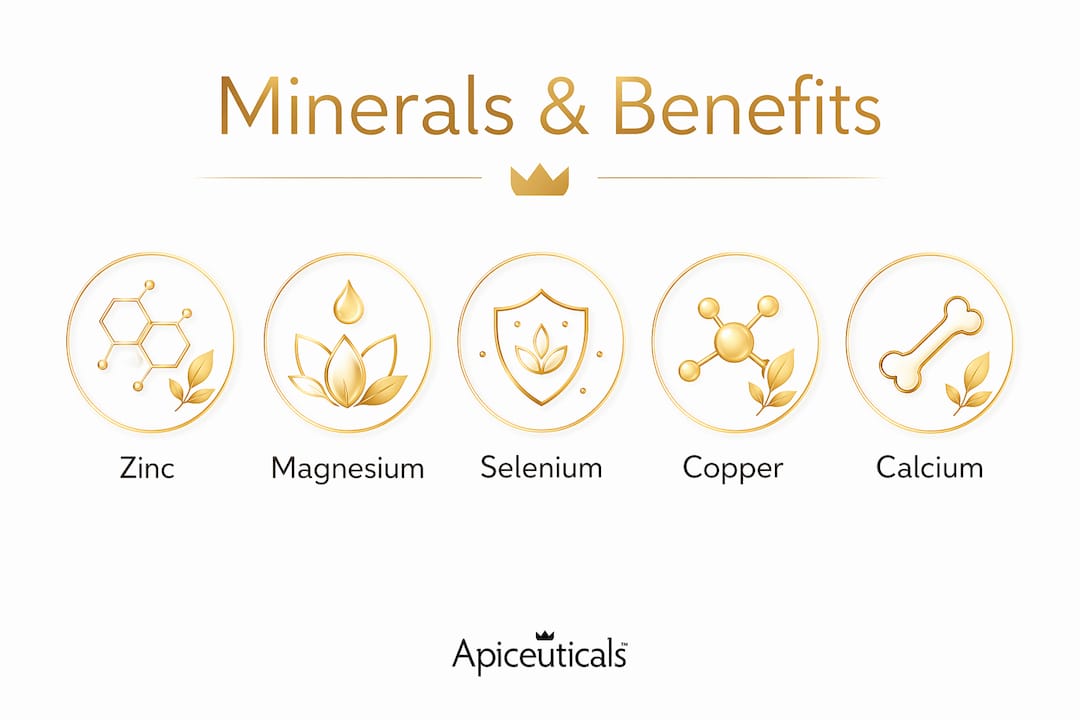
The following table maps the most clinically relevant mineral skincare ingredients to their primary mechanisms and target skin concerns. Each mineral operates through a distinct pathway, which is why multi-mineral formulations can address several skin concerns simultaneously without ingredient conflict.
| Mineral | Primary mechanism | Key skin benefit |
|---|---|---|
| Zinc | Anti-inflammatory, UV absorption, wound healing | Reduces acne, supports repair, broad-spectrum UV protection |
| Magnesium | Ceramide synthesis support, anti-inflammatory | Barrier repair, hydration, calming sensitive and atopic skin |
| Calcium | Regulates keratinocyte differentiation | Controls cell turnover, strengthens barrier integrity |
| Selenium | Glutathione peroxidase activation | Antioxidant defense against free radical damage |
| Iron oxides | Visible and blue light absorption | Pigmentation management, melasma protection |
Zinc deserves particular attention because its role spans three distinct functions: UV protection as zinc oxide, anti-inflammatory activity in acne formulas, and wound-healing support in repair products. These are not the same zinc compound or the same concentration, which is why zinc’s skin benefits are context-dependent. A 1% zinc acetate in an acne treatment operates differently from 20% zinc oxide in a sunscreen.
Selenium is the least discussed of the group but arguably the most important for oxidative stress defense. It activates glutathione peroxidase, an enzyme that neutralizes lipid peroxides before they can damage cell membranes. Think of selenium as the skin’s internal rust inhibitor: without it, free radicals corrode cellular structures the way moisture corrodes unprotected metal. For anyone focused on antioxidant protection for skin, selenium-containing formulas represent an underutilized tool.
What do mineral baths and thermal spring waters actually do for skin?
Mineral-rich bath therapies have a longer clinical history than most topical skincare categories. The Dead Sea, with its exceptional concentration of magnesium, potassium, calcium, and bromide, has been studied in the context of psoriasis and atopic dermatitis for decades. The 6-week Dead Sea salt protocol referenced above used a 5% concentration, which is a meaningful data point: lower concentrations in commercial bath salts may not replicate these results, and dose and frequency are the variables most often ignored in consumer applications.
Thermal spring waters from recognized dermatological sources provide a different mineral profile. Blue Lagoon, La Roche-Posay, Avène, and Vichy each deliver a distinct mineral composition that has been validated through scientific research for hydration, calming, and barrier reinforcement. La Roche-Posay thermal water, for example, contains selenium at concentrations that support antioxidant activity. Avène’s spring water is characterized by low mineral content and a specific silicate profile that reduces skin reactivity. These are not interchangeable, and the source determines the benefit.
- Dead Sea salt baths: effective at 5% concentration over a minimum of six weeks for barrier repair in atopic skin
- Thermal spring water sprays: deliver immediate soothing and hydration, best used between skincare steps or post-sun exposure
- Mineral water-based toners: provide trace mineral delivery with each application, supporting cumulative barrier reinforcement
- DIY mineral baths: require attention to concentration; commercial bath salts rarely specify mineral percentages, making clinical replication difficult
- Integration with topical products: applying a mineral-rich serum immediately after bathing, while skin is still slightly damp, maximizes absorption
The practical guidance here is consistency over intensity. A single mineral bath produces measurable but transient hydration. Six weeks of regular exposure at the correct concentration produces structural barrier improvement. This mirrors the broader principle in evidence-based skincare: outcomes are determined by sustained, correctly dosed application, not by occasional use of premium products.
Key takeaways
Minerals perform specific, measurable biological functions in skin care, and their efficacy depends entirely on form, concentration, and formulation context.
| Point | Details |
|---|---|
| Mineral UV filters absorb, not reflect | Zinc oxide and titanium dioxide attenuate UV through semiconductor absorption, providing photostable broad-spectrum protection. |
| Tinted formulas add visible-light defense | Iron oxides in tinted sunscreens protect against blue and visible light, improving melasma outcomes from around eight weeks of use. |
| Magnesium drives barrier repair | Dead Sea salt bathing at 5% concentration over six weeks measurably improves barrier function and hydration in atopic skin. |
| Mineral-antioxidant synergy is clinically supported | Combining mineral salts with antioxidants reduces dermatitis severity with high tolerability, validating multi-ingredient approaches. |
| Dose and consistency determine outcomes | Mineral benefits accumulate with sustained, correctly concentrated use; occasional application produces only transient effects. |
Apiceuticals’ perspective on minerals and antioxidant skin protection
The most common mistake in mineral skincare is treating minerals as a category rather than as individual compounds with specific mechanisms. Zinc oxide in a sunscreen and zinc acetate in an acne serum are not the same ingredient performing the same function. Calcium in a barrier cream and calcium in a cell-turnover formula operate through different pathways at different concentrations. Evaluating dose and clinical evidence rather than relying on marketing claims is the only reliable approach to building a mineral-based routine that actually works.
From Apiceuticals’ perspective, minerals and antioxidants are not competing categories. They are complementary systems addressing different threats to skin integrity. Minerals handle UV attenuation, barrier structure, and cellular regulation. Antioxidants, including those continuously released by PROPOWAX™ Living Honeycomb, neutralize the oxidative stress that UV radiation and environmental pollution generate after the fact. A routine that includes both is more complete than one that prioritizes either in isolation. The Aristotle University of Thessaloniki’s independent validation of PROPOWAX™’s antioxidant activity places this technology in the same evidence-based framework that rigorous mineral research occupies. That alignment is intentional. Skin protection is a systems problem, and the solution requires layering products strategically rather than relying on any single ingredient category to carry the full load.
— Apiceuticals
Explore antioxidant skin care from Apiceuticals
The science of mineral skin care points consistently toward one conclusion: protection and repair require multiple mechanisms working together. UV attenuation, barrier reinforcement, and oxidative stress defense each address a distinct vulnerability in the skin’s architecture.

Apiceuticals’ antioxidant skin care products are formulated around PROPOWAX™ Living Honeycomb, a patented technology that delivers continuous antioxidant release validated by the Aristotle University of Thessaloniki and recognized by British Vogue as “arguably the global leader in antioxidant activity.” The HONEY BALM™ Series offers waterless facial care with clinically proven 26% wrinkle reduction, and every formulation excludes over 2,000 potentially harmful ingredients. For those building a mineral-informed routine, understanding how antioxidants complement mineral benefits is the logical next step. Explore the PROPOWAX™ technology to see how this patented system integrates with the skin science discussed here.
FAQ
What is the role of minerals in skin care?
Minerals serve as UV filters, barrier repair agents, antioxidants, and cellular regulators in skin care. Zinc oxide and titanium dioxide absorb UV radiation, while magnesium, calcium, and selenium support hydration, cell turnover, and oxidative defense.
Are mineral sunscreens better than chemical sunscreens?
Mineral sunscreens using zinc oxide and titanium dioxide are photostable and provide broad-spectrum protection through UV absorption. Chemical sunscreens can be more cosmetically elegant but may degrade with sun exposure; the best choice depends on skin type, formulation quality, and specific protection needs.
How does zinc benefit the skin beyond sun protection?
Zinc supports wound healing, reduces inflammatory signaling relevant to acne, and regulates sebum production. The form and concentration of zinc determine which benefit is active: zinc oxide for UV protection, zinc acetate or zinc gluconate for anti-inflammatory and antimicrobial effects.
Can mineral baths genuinely improve skin barrier function?
Yes, at the correct concentration and duration. A randomized study found that 5% Dead Sea salt bathing over six weeks measurably improved barrier function and hydration in atopic dry skin. Lower concentrations or shorter exposure periods produce more modest and transient results.
How do minerals and antioxidants work together for skin health?
Minerals address structural and photoprotective functions, while antioxidants neutralize free radicals generated by UV exposure and environmental pollution. Prospective research confirms that mineral-antioxidant combinations reduce dermatitis severity with excellent tolerability, supporting their use as a complementary system rather than competing alternatives.
Recommended


Related posts

How bees and biodiversity sustain each other, what the science says about Greece and the Aegean, and how antioxidant beauty can start from a hive...

How organic propolis extraction works, from hive to extract: collection, solvents, EU organic rules, Greek propolis phenolics and what it means for skincare.

Build an anti pollution skincare routine that fits Greek city life: what pollution does to skin, the morning and evening steps, and the antioxidants with...

Honey moisture content explained: the EU and Greek limits, how to take a refractometer reading, what excess water does to honey, and why it matters...

How antioxidant activity measurement works: DPPH, ABTS, FRAP and ORAC explained, why results differ, and what a lab number can and cannot say about skin...















