
No products in the cart.
Return To Shop
The Role of Propolis in Skin Care: 2026 Science Guide
TL;DR:
- Propolis is a bee-derived resin rich in flavonoids and phenolic acids that supports skin healing, reduces inflammation, and combats oxidative stress. Its clinical benefits include accelerating wound closure, modulating inflammatory pathways, and preventing skin aging from pollutants and UV exposure. Proper formulations with appropriate concentrations and delivery systems enhance its regenerative and antioxidant potential, making it a potent ingredient in advanced skincare.
Propolis is defined as a resinous compound produced by honeybees from plant resins, beeswax, and salivary enzymes, and its role in skin care is now supported by a substantial body of clinical evidence. Rich in flavonoids, phenolic acids, and caffeic acid phenethyl ester (CAPE), propolis functions as a biological shield against oxidative stress, microbial invasion, and chronic inflammation. These are not surface-level effects. Propolis actively modulates keratinocyte behavior, suppresses inflammatory signaling, and supports extracellular matrix repair. Apiceuticals has built its PROPOWAX™ Living Honeycomb technology around this bioactive profile, holding a global patent for the highest antioxidant activity in cosmetics, independently validated by the Aristotle University of Thessaloniki.
What does the science say about propolis’s role in skin care?
Propolis accelerates wound closure and reduces tissue inflammation at concentrations of 5%–10%, making it one of the most clinically relevant natural bioactives in dermatology. Studies show that propolis formulations at these concentrations produce superior extracellular matrix remodeling compared to base dressings, with measurably reduced TNF-alpha levels both in vitro and in vivo. TNF-alpha is a primary driver of chronic skin inflammation. Lower levels mean faster, cleaner healing.

The mechanism goes deeper than surface repair. Propolis suppresses NF-kB and COX pathways, two central signaling cascades responsible for sustaining inflammation in conditions like acne, rosacea, and post-procedural irritation. Unlike many anti-inflammatory actives that also strip the skin barrier, propolis achieves this suppression without drying effects. That distinction matters for anyone managing chronic inflammatory skin conditions alongside a compromised barrier.
Keratinocyte proliferation is another measurable outcome. Propolis stimulates the skin’s own repair cells to divide and migrate across wound sites, accelerating re-epithelialization. Clinical studies report barrier repair benefits within 72 hours of continuous application. The table below summarizes concentration-dependent outcomes from current research.
| Propolis Concentration | Primary Clinical Outcome | Mechanism |
|---|---|---|
| 1%–3% | Antioxidant protection, mild anti-inflammatory | Free radical scavenging, NF-kB modulation |
| 5%–10% | Wound healing, tissue remodeling | Keratinocyte proliferation, TNF-alpha reduction |
| Above 10% | Enhanced antimicrobial activity | Flavonoid-mediated microbial membrane disruption |
Pro Tip: When evaluating propolis skin care products, look for formulations that specify both the concentration and the botanical source of the propolis. A product listing “propolis extract” without these details may not deliver the therapeutic concentrations validated in clinical studies.
How does propolis protect skin from oxidative stress and aging?
Propolis functions as a biological shield, not merely a moisturizer, neutralizing oxidative stress from pollutants and UV radiation before it triggers premature skin aging. The phenolic compounds and flavonoids in propolis scavenge free radicals with the same chemical logic as rust inhibitors on metal: they donate electrons to unstable molecules, neutralizing the chain reaction before cellular damage accumulates. Skin exposed to urban pollution and UVB radiation generates oxidative markers like malondialdehyde at rates the skin’s endogenous antioxidant systems cannot always match.
Research on Thai Apis mellifera propolis demonstrates that propolis inhibits PI3K activity and restores oxidative balance in UVB-damaged keratinocytes. PI3K is an enzyme whose overactivation accelerates photoaging pathways. Blocking it preserves skin structural integrity over time. This is why propolis extract in skincare is increasingly positioned within the antioxidant beauty category rather than simply as a wound-care ingredient.
The sources of oxidative stress that propolis actively mitigates include:
- UVB radiation: Propolis reduces oxidative marker accumulation in irradiated keratinocytes and suppresses photoaging enzyme cascades.
- Urban air pollutants: Particulate matter and ozone generate reactive oxygen species on the skin surface; propolis flavonoids intercept these before membrane penetration.
- Glycation and metabolic byproducts: Phenolic acids in propolis inhibit advanced glycation end-product formation, which stiffens collagen over time.
- Post-inflammatory oxidative burden: After acne or rosacea flares, residual oxidative stress prolongs redness; propolis addresses both the inflammation and its oxidative aftermath.
Understanding how to prevent skin oxidation is the foundation of any serious anti-aging protocol. Propolis fits into that protocol at the antioxidant layer, applied after cleansing and before sunscreen.
Pro Tip: Layer a propolis-rich serum or treatment beneath a broad-spectrum SPF. Propolis addresses the oxidative damage that UV radiation initiates at the cellular level, while sunscreen reduces the UV load reaching the skin. The two work on different parts of the same problem.
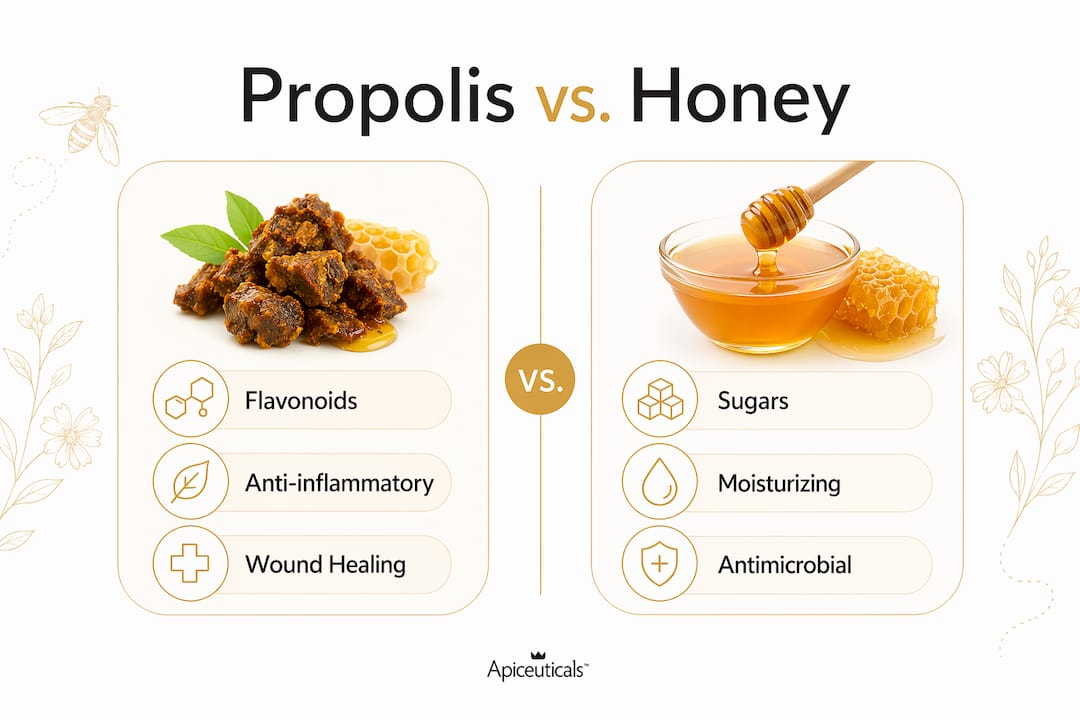
Propolis vs. honey: what sets them apart in skincare?
Propolis and honey are both bee-derived, but conflating them is a formulation error with real consequences for efficacy. Propolis and honey serve distinct therapeutic roles: propolis is antimicrobial and regenerative, while honey acts as a humectant that moisturizes and soothes. Their chemical compositions reflect this difference entirely.
Propolis is dense with bioactive flavonoids, CAPE, and phenolic acids. These compounds drive its antimicrobial, anti-inflammatory, and antioxidant functions. Honey, by contrast, is primarily composed of fructose, glucose, and water, with its skin benefits derived from osmotic moisture retention and mild hydrogen peroxide activity. MGO manuka honey adds methylglyoxal to that profile, giving it stronger antimicrobial properties than standard honey, but it still lacks the flavonoid complexity that makes propolis a regenerative active.
The comparison table below clarifies where each ingredient excels.
| Property | Propolis | Honey (including Manuka) |
|---|---|---|
| Primary bioactives | Flavonoids, CAPE, phenolic acids | Sugars, hydrogen peroxide, MGO (manuka) |
| Core skin function | Antimicrobial, anti-inflammatory, regenerative | Humectant, soothing, mild antimicrobial |
| Antioxidant activity | High (free radical scavenging, PI3K inhibition) | Low to moderate |
| Barrier repair | Active (keratinocyte stimulation) | Passive (moisture retention) |
| Best suited for | Acne, rosacea, photoaging, wound repair | Dry skin, sensitivity, hydration maintenance |
Used together, they are genuinely complementary. Apiceuticals integrates both in its PROPOWAX™ Living Honeycomb formulations, where propolis delivers the antioxidant and regenerative activity while honey-derived compounds support moisture balance. The honey and propolis synergy in a single formulation addresses both the structural and hydration dimensions of skin health simultaneously. For a deeper look at honey’s distinct contribution, the honey ingredient profile at Apiceuticals explains its role in the broader bee-science framework.
What formulation challenges exist in propolis-based skincare?
Raw propolis presents three well-documented formulation obstacles: stickiness, dark coloration, and a strong resinous odor. These properties make it difficult to incorporate into consumer-facing products without significant processing. Advanced delivery systems like in situ film-forming systems (FFS), nanoemulgels, and nanofiber dressings overcome these challenges by encapsulating propolis bioactives in matrices that improve skin retention, permeation, and sensory experience while preserving biological activity.
Nanoemulgels are particularly relevant for topical skincare. They reduce propolis particle size to the nanometer range, which increases surface area for absorption and allows the formulation to feel lightweight on skin. Film-forming systems create a breathable, bioactive layer on the skin surface that releases propolis compounds gradually, extending therapeutic contact time. Both approaches maintain the flavonoid and CAPE content that drives clinical outcomes.
Sourcing geography also affects formulation quality in ways that are rarely communicated on product labels. Korean, Brazilian, and European propolis have distinct bioactive compositions because bees collect resins from different plant species in each region. A product without geographic or botanical source qualifiers may lack specific therapeutic flavonoids or CAPE concentrations. This is not a minor detail. It determines whether a formulation delivers the anti-inflammatory and antioxidant outcomes seen in clinical studies.
Formulation best practices for propolis-based products include:
- Specify the botanical source: Poplar-derived European propolis and Brazilian green propolis have different flavonoid profiles. Match the source to the intended skin benefit.
- Confirm concentration: Therapeutic outcomes in wound healing and inflammation require 5%–10% propolis content. Cosmetic-grade products often use far less.
- Prioritize encapsulation technology: Nanoemulgels and film-forming systems improve bioavailability and user experience over raw extract suspensions.
- Check safety data: A survey of 500 European cosmetic products found no propolis presence, which reflects formulation difficulty rather than safety concerns. Propolis has a well-documented low irritation profile when properly processed.
How to incorporate propolis effectively into your skincare routine
Using propolis for acne, rosacea, or general antioxidant protection requires attention to timing, layering, and concentration. Patch testing is the correct starting point, not because allergic reactions are common, but because bee-product sensitivities do exist. Clinical evidence shows that many individuals with propolis allergies can still tolerate beeswax-containing products due to low cross-reactivity, but confirming individual tolerance before full-face application is sound practice.
For acne-prone skin, propolis works best as a targeted treatment or serum applied after cleansing and before moisturizer. Its NF-kB suppression reduces the inflammatory response around active breakouts, while its antimicrobial flavonoids address the bacterial component without the drying effect of benzoyl peroxide or salicylic acid. For aging or UV-stressed skin, propolis fits into the antioxidant serum layer, ideally paired with vitamin C or niacinamide for complementary free radical defense. Exploring antioxidant serum science provides a useful framework for understanding how propolis fits within a broader antioxidant layering strategy.
Texture concerns are legitimate and worth addressing directly. Raw propolis extracts can feel tacky. Properly formulated propolis products, particularly those using nanoemulgel or film-forming technology, apply smoothly and absorb without residue. If a propolis product feels heavy or sticky, the formulation has not adequately addressed the raw material’s inherent properties.
Pro Tip: Apply propolis treatments at night when skin enters its natural repair cycle. Keratinocyte proliferation peaks during sleep, and propolis’s regenerative bioactives work in concert with this biological rhythm. Morning application is still beneficial for antioxidant protection, but evening use maximizes the healing and remodeling outcomes.
Key takeaways
Propolis is the most biochemically complex bee-derived ingredient in skincare, delivering antimicrobial, anti-inflammatory, antioxidant, and regenerative effects that honey cannot replicate.
| Point | Details |
|---|---|
| Therapeutic concentration matters | Propolis at 5%–10% concentration drives wound healing and TNF-alpha reduction; lower amounts offer antioxidant support only. |
| Antioxidant mechanism is specific | Propolis inhibits PI3K and scavenges free radicals, directly countering UV-induced photoaging at the cellular level. |
| Propolis and honey are not interchangeable | Propolis provides regenerative and antimicrobial activity; honey delivers humectant moisture. Both are needed for complete skin support. |
| Formulation quality determines efficacy | Nanoemulgels and film-forming systems preserve bioactivity and improve absorption; raw extract suspensions often underperform. |
| Sourcing geography affects bioactive profile | Korean, Brazilian, and European propolis differ in flavonoid and CAPE content; source transparency is a marker of product quality. |
Why propolis deserves a more precise conversation in natural skincare
The natural skincare space has a tendency to celebrate ingredients before fully understanding them. Propolis has been used in folk medicine for centuries, but the clinical science validating its specific mechanisms is relatively recent and still developing. What strikes us most, after years of working with bee-derived bioactives, is how often propolis is treated as a general “good ingredient” without any reference to concentration, source, or delivery system. That imprecision does a disservice to both the science and the consumer.
The glow commonly observed from propolis-enriched skincare results from improved barrier function and reduced micro-inflammation, not from any surface-coating effect. That distinction is worth holding onto. It means propolis is doing structural work, not cosmetic work. And structural work requires the right tool at the right concentration.
The PROPOWAX™ Living Honeycomb technology represents what we believe is the correct approach to this challenge. Rather than dissolving propolis into a formula and hoping for residual activity, PROPOWAX™ creates a continuous-release matrix that delivers antioxidants to skin over time. The Aristotle University of Thessaloniki validated this as the highest antioxidant activity achieved in cosmetics. British Vogue described it as “arguably the global leader in antioxidant activity.” Those are not marketing claims. They are the result of solving the formulation problem that most propolis products have not yet addressed.
The limitation worth acknowledging is that propolis research, while growing rapidly, still lacks large-scale randomized controlled trials for many skin conditions. The mechanistic evidence is strong. The clinical evidence is promising but not yet exhaustive. For natural skincare enthusiasts, this means propolis is a well-supported choice, not a proven pharmaceutical. Use it with that understanding, and it will perform.
— Apiceuticals
Discover Apiceuticals’ propolis-powered antioxidant skincare
Apiceuticals was built on the premise that bee science, applied with clinical rigor, produces skincare that performs beyond conventional formulations. The PROPOWAX™ Living Honeycomb at the core of every Apiceuticals product is not an extract or an additive. It is a patented delivery system that continuously releases propolis antioxidants onto skin, validated for the highest antioxidant activity in cosmetics.

Every formulation excludes over 2,000 potentially harmful ingredients, is dermatologically tested on sensitive skin with 0% irritation, and is built from organically harvested bee ingredients sourced from over 1,000 beehives in Arcadia, Greece. If you want to understand what propolis in Apiceuticals products actually delivers at the ingredient level, the dedicated propolis ingredient page provides the full scientific profile. To explore the complete antioxidant skincare range, the Apiceuticals collection brings together the PROPOWAX™ Series, the HONEY BALM™ Series, and the Gods’ Nectar organic honeys under one scientifically grounded framework.
FAQ
What is the role of propolis in skin care?
Propolis is a bee-derived resinous compound that functions as an antimicrobial, anti-inflammatory, antioxidant, and regenerative active in skincare. Its flavonoids and CAPE suppress inflammatory pathways, accelerate wound healing, and neutralize oxidative stress from UV radiation and pollutants.
How does propolis help with acne-prone skin?
Propolis suppresses NF-kB and COX inflammatory pathways while delivering antimicrobial activity against acne-associated bacteria, reducing both the inflammatory response and the microbial load without drying the skin barrier.
Is propolis safe for sensitive skin?
Clinical evidence shows propolis has a low irritation profile when properly formulated, with dermatological testing confirming 0% irritation in sensitive skin applications. Patch testing is still recommended for individuals with known bee-product sensitivities.
How is propolis different from honey in skincare?
Propolis is rich in bioactive flavonoids and CAPE that drive regenerative and antimicrobial effects, while honey primarily functions as a humectant through its sugar content. The two ingredients address different aspects of skin health and work best in combination.
What concentration of propolis is effective in skincare products?
Studies show that 5%–10% propolis concentration produces measurable wound healing and anti-inflammatory outcomes, including reduced TNF-alpha levels and accelerated keratinocyte proliferation. Lower concentrations still provide antioxidant benefits but do not reach the therapeutic threshold for tissue repair.
Does the source of propolis affect its skincare benefits?
Yes. Korean, Brazilian, and European propolis have distinct bioactive compositions because bees collect resins from different plant species. Products without geographic or botanical source information may lack specific flavonoids or CAPE concentrations needed for targeted therapeutic outcomes.
Recommended


Related posts

How bees and biodiversity sustain each other, what the science says about Greece and the Aegean, and how antioxidant beauty can start from a hive...

How organic propolis extraction works, from hive to extract: collection, solvents, EU organic rules, Greek propolis phenolics and what it means for skincare.

Build an anti pollution skincare routine that fits Greek city life: what pollution does to skin, the morning and evening steps, and the antioxidants with...

Honey moisture content explained: the EU and Greek limits, how to take a refractometer reading, what excess water does to honey, and why it matters...

How antioxidant activity measurement works: DPPH, ABTS, FRAP and ORAC explained, why results differ, and what a lab number can and cannot say about skin...















