
No products in the cart.
Return To Shop
Antioxidant Delivery Technologies: A Formulator’s Guide
The main types of antioxidant technologies used in topical beauty formulation fall into six classes: lipid vesicles (liposomes, deformable variants, and HA-decorated hyalutocosomes), the lipid nanoparticle family (nanoemulsions, solid lipid nanoparticles, and nanostructured lipid carriers), polymeric nanoparticles and controlled-release polymer systems, microencapsulation and waterless matrices, collagen and gel hybrid systems, and patented continuous-release platforms such as PROPOWAX™ Living Honeycomb. For most beauty products, lipid-based carriers suit lipophilic antioxidants and amenity formats well; for sustained anti-aging release, polymeric nanoparticles are the stronger choice. The FDA classifies topical antioxidant products as cosmetics unless a drug claim is made, so every technology choice carries labeling consequences from day one. Independent academic validation, such as the work conducted at the Aristotle University of Thessaloniki on PROPOWAX™ Living Honeycomb, remains the clearest signal that a delivery platform performs as claimed.
Key Takeaways
Matching the carrier class to the active’s chemistry and the product’s release target is the single decision that determines whether an antioxidant delivery technology performs or merely adds cost.
| Point | Details |
|---|---|
| Match active polarity to carrier | Lipophilic actives (vitamin E, curcumin) suit lipid nanoparticles; hydrophilic actives suit vesicular or aqueous-core systems. |
| Demand three data points | Always request EE%, particle-size distribution (PDI), and independent penetration or stability data before approving a supplier. |
| Verify proprietary platforms independently | Patent documentation and third-party academic validation (as with PROPOWAX™ Living Honeycomb, Aristotle University of Thessaloniki) distinguish real delivery science from marketing language. |
| Waterless matrices for amenity formats | Anhydrous and microencapsulated systems resist microbial growth and suit refillable hotel dispensers without preservative systems. |
| Apiceuticals PROPOWAX™ Living Honeycomb | A globally patented, continuously releasing antioxidant platform with 0% irritation on sensitive skin and clinical wrinkle-reduction data. |
Table of Contents
- Why delivery technology determines antioxidant performance
- 1. Liposomes and HA-decorated vesicles: when biomimetic delivery matters
- 2. Nanoemulsions, SLNs, and NLCs: the lipid nanoparticle family
- 3. Polymeric nanoparticles and controlled-release systems
- 4. Microencapsulation, waterless matrices, and gel hybrids
- 5. PROPOWAX™ Living Honeycomb: a patented continuous-release platform
- 6. How to choose the right antioxidant delivery technology
- 7. US market practicalities: labeling, claims, and manufacturing standards
- 8. Representative evidence: what the studies actually show
- When advanced delivery technology genuinely changes the outcome
- Apiceuticals’ PROPOWAX™ for continuous antioxidant release
- Sources
- FAQ
Why delivery technology determines antioxidant performance
Antioxidants are chemically fragile. Vitamin C oxidizes within hours of air exposure; curcumin is nearly insoluble in water, and resveratrol degrades under UV light before it reaches the dermis. A delivery platform’s job is to protect the active from that degradation, carry it to the right tissue layer, and release it at a rate that produces a measurable effect. Without the right carrier, even a high-potency antioxidant can arrive at the skin surface already spent.
The metrics that matter most are encapsulation efficiency (EE%), particle size and distribution, and stability across shelf life and post-application conditions. Ask any supplier for all three before evaluating a formulation claim. A comprehensive review of nanotechnology-based topical delivery systems confirms that particle size directly governs penetration depth, release kinetics, and long-term stability across all major carrier classes.
| Formulation problem | What the right carrier delivers |
|---|---|
| Active oxidizes before skin contact | Encapsulation shields from oxygen and light |
| Poor aqueous solubility (lipophilic actives) | Lipid matrix solubilizes and stabilizes |
| Low epidermal retention | Controlled release extends residence time |
| Skin irritation from high free-active load | Gradual release reduces peak concentration |
| Incompatible packaging (amenity dispensers) | Waterless or anhydrous matrices resist microbial growth |
1. Liposomes and HA-decorated vesicles: when biomimetic delivery matters
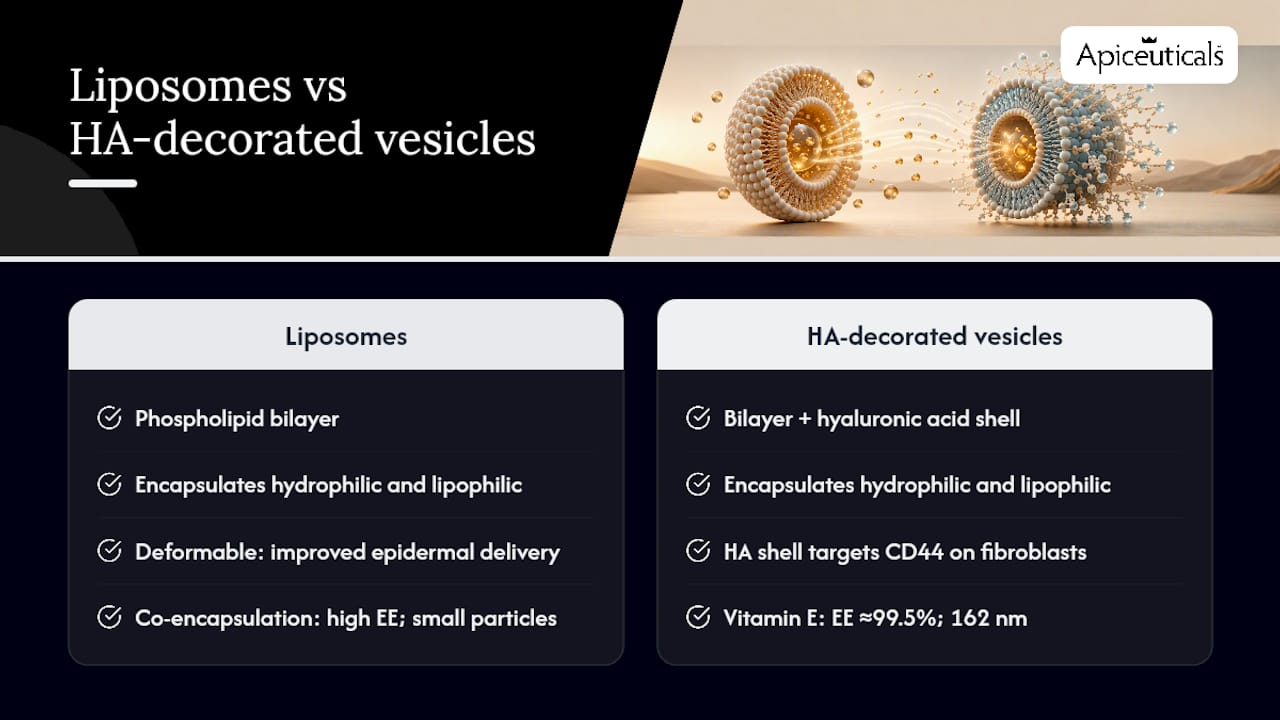
Vesicular systems are chosen because their phospholipid bilayer mirrors the structure of cell membranes, allowing encapsulation of both hydrophilic actives in the aqueous core and lipophilic actives within the bilayer itself. That dual-compatibility is rare among carrier classes and makes liposomes particularly useful for complex antioxidant blends.
Deformable liposomes squeeze through tight intercellular junctions, improving epidermal delivery. HA-decorated variants, called hyalutocosomes or hyalurosomes, add a hyaluronic acid shell that targets CD44 receptors expressed in skin, directing the vesicle toward dermal fibroblasts. An in vivo study of hyalutocosomes loaded with vitamin E reported encapsulation efficiency of approximately 99.5% and particle size of roughly 162 nm; treated subjects showed restored antioxidant enzyme activity (SOD and CAT) and reduced inflammatory biomarkers including IL-6, TNF-α, and MMP-9 compared with free vitamin E. A separate liposomal co-encapsulation study achieved very high encapsulation efficiency for gallic acid and curcumin in particles of small size, with improved skin retention and controlled release versus unencapsulated actives.
The practical limitations are real. A critical review of liposomes in cosmeceutical delivery documents stability challenges including phospholipid hydrolysis, aggregation, and variable skin permeability. Mitigation strategies include cholesterol addition to rigidify the bilayer, lyophilization for long-term storage, and microfluidics-based manufacturing for tighter size control. Scale-up cost is higher than for emulsion systems, so liposomal formats are best justified for high-value facial serums, targeted dermal treatments, and antioxidant facial treatments where clinical endpoints are part of the product story.
2. Nanoemulsions, SLNs, and NLCs: the lipid nanoparticle family
The lipid nanoparticle family is the preferred platform for lipophilic antioxidants that benefit from occlusive film formation, enhanced hydration, and improved storage stability. All three subtypes share a lipid core, but their internal architecture differs in ways that affect performance and manufacturing.
- Nanoemulsions (typically 20–200 nm) are kinetically stable oil-in-water or water-in-oil systems. They are relatively straightforward to manufacture, improve skin feel, and enhance penetration through the stratum corneum. The trade-off is surfactant load, which must be managed to avoid irritation, particularly for sensitive-skin or hotel amenity formats.
- Solid lipid nanoparticles (SLNs) use a solid lipid matrix at room temperature, which improves protection from oxidation and extends shelf stability. The known limitation is recrystallization: as the lipid matrix reorganizes over time, it can expel encapsulated actives, reducing EE and altering release kinetics. Request long-term EE data, not just initial measurements.
- Nanostructured lipid carriers (NLCs) blend solid and liquid lipids to create a disordered matrix that resists recrystallization and accommodates higher active loading than SLNs. For most lipophilic antioxidants, NLCs represent a more stable long-term option.
A focused review on nanocarriers for topical antioxidants stresses that matching carrier choice to the active’s physicochemical properties, specifically hydrophobic versus hydrophilic character, is the single most critical selection criterion. For hotel amenity dispensers, ask suppliers for 90-day accelerated stability data at the intended storage temperature and confirm compatibility with the dispenser pump mechanism.
3. Polymeric nanoparticles and controlled-release systems
Polymeric carriers enable sustained or stimuli-responsive release, which makes them well-suited to long-term anti-aging applications and scalp serums where prolonged antioxidant exposure improves outcomes. Unlike lipid systems, the release rate can be tuned by adjusting polymer molecular weight, composition, and surface modification.
Biodegradable polymers such as PLGA (poly lactic-co-glycolic acid) are widely studied for sustained vitamin delivery because they degrade into lactic and glycolic acid, both naturally metabolized. Polymeric micelles solubilize poorly water-soluble antioxidants, expanding the formulator’s active palette. The formulation complexity is higher than for lipid systems: polymer selection demands biocompatibility testing, and degradation products require regulatory review, particularly for leave-on products under FDA cosmetic guidelines. For skincare absorption goals where a prolonged antioxidant depot in the epidermis is the target, polymeric nanoparticles justify the added development cost.
4. Microencapsulation, waterless matrices, and gel hybrids
Microencapsulation and waterless matrices protect highly labile actives and suit travel and hotel amenity systems with refillable dispensers. Removing water from the formulation eliminates the need for preservatives, reduces microbial risk, and extends shelf life, all of which matter for high-turnover hospitality environments.
- Waterless sticks and anhydrous balms (such as the HONEY BALM™ format) provide a stable matrix for wax-encapsulated antioxidants that release on contact with skin moisture and warmth.
- Single-dose sachets protect oxygen-sensitive actives from batch-level oxidation and suit amenity programs where portion control is required.
- Refillable amenity cartridges demand moisture-ingress resistance and pump compatibility; confirm that the matrix does not phase-separate or harden at the storage temperatures typical of hotel back-of-house environments.
- Gel hybrid systems combine a polymeric gel with encapsulated lipid vesicles, offering both immediate surface hydration and deeper controlled release.
For actives that migrate or oxidize on exposure, specify oxygen-scavenging packaging or nitrogen-flushed filling at the manufacturing stage. Apiceuticals’ hotel amenity systems are designed around refillable formats that maintain antioxidant integrity across the product’s full service life.
5. PROPOWAX™ Living Honeycomb: a patented continuous-release platform
PROPOWAX™ Living Honeycomb is a patented antioxidant delivery platform developed by Apiceuticals and independently validated by the Aristotle University of Thessaloniki, holding a global patent for the highest antioxidant activity in cosmetics. The platform is built around a living honeycomb matrix that continuously releases antioxidants onto skin, scalp, and hair rather than delivering a single bolus dose at application.

The PROPOWAX™ technology page documents the patent and academic validation in detail.
For buyers evaluating PROPOWAX™ or any proprietary delivery platform, request the following from the supplier:
- Patent documentation and registration number
- Independent academic validation reports (not internal white papers alone)
- Dermatological testing summaries, including irritation and sensitization data
- Encapsulation efficiency and antioxidant activity assay results (crocin bleaching or equivalent standardized method)
- Stability data under intended packaging and storage conditions
6. How to choose the right antioxidant delivery technology
Match active chemistry (hydrophilic vs. lipophilic) and desired release profile to the carrier class first, then validate every claim with supplier data.
- Define the active and target tissue. Hydrophilic antioxidants (vitamin C, gallic acid) suit aqueous-core vesicles or gel systems. Lipophilic actives (vitamin E, curcumin, coenzyme Q10) perform better in lipid nanoparticle or waterless matrices. Scalp and hair shaft targets may require different penetration depths than facial dermis.
- Require encapsulation efficiency and particle-size reports. EE below 80% for a premium active is a red flag. Particle size distribution (PDI below 0.2 is a common benchmark) indicates manufacturing consistency.
- Request stability data under intended packaging. A 3-month accelerated stability report at 40°C/75% relative humidity is a standard minimum. For amenity dispensers, add pump-compatibility and moisture-ingress testing.
- Ask for dermatological test data and safety certificates. Patch testing on sensitive skin, HRIPT data, and allergen declarations (especially for bee-derived materials) are non-negotiable for retail and hospitality channels.
- Verify manufacturing scale and batch-release testing. A technology that performs at lab scale but cannot be reproduced at commercial batch size is not procurement-ready.
Pro Tip: Request a standardized in vitro penetration study (Franz cell or tape-strip method) alongside the 3-month accelerated stability report. A supplier who cannot provide both is asking you to take the delivery claim on faith.
Supplier questions to ask with every sample submission: encapsulation method and EE%, particle-size distribution with PDI, long-term stability data, sterilization and fill methods, and evidence of clinical or ex vivo penetration studies. Red flags include missing EE data, no stress-stability testing, vague claim language such as “enhanced bioavailability” without a measured comparator, and absence of independent validation.
7. US market practicalities: labeling, claims, and manufacturing standards
In the US, most topical antioxidant products are regulated as cosmetics under the Federal Food, Drug, and Cosmetic Act. The FDA cosmetic definition covers products intended to cleanse, beautify, or alter appearance; any claim that a product treats, prevents, or cures a condition (including “reduces UV-induced DNA damage” or “stimulates collagen synthesis”) can trigger drug classification and the full regulatory burden that follows.
Key regulatory considerations for US buyers and formulators:
- Allowable cosmetic claims include “reduces the appearance of fine lines,” “brightens skin tone,” and “improves skin texture.” Avoid structure/function language.
- Ingredient listing follows INCI nomenclature in descending order of concentration; nanocarrier components must be listed individually.
- SPF and photoprotection claims require OTC drug monograph compliance; pairing an antioxidant with an SPF claim requires full drug-product registration.
- Bee-derived materials (propolis, beeswax, honey) require allergen disclosure in product labeling and should be supported by sensitization testing data.
- cGMP-aligned quality systems are expected for any product sold through retail or hospitality channels; stability testing and preservative efficacy (for aqueous systems) are standard documentation requirements.
For hotel amenity programs, confirm ADA-compliant dispenser compatibility and verify that refill cartridge shelf life covers the full service interval between replacements.
8. Representative evidence: what the studies actually show
Controlled formulation studies generally show that nanocarriers increase active retention, protect against oxidation, and sometimes improve biological endpoints compared with free actives. The evidence base is growing but remains weighted toward preclinical and small-sample in vitro and ex vivo models; ask suppliers for formulation-specific validation rather than citing general literature about a carrier class.
| Study | Carrier type | Key outcome |
|---|---|---|
| Hyalutocosome/vitamin E in vivo (rat, UVB model) | HA-decorated deformable vesicle | EE ~99.5%; restored SOD and CAT; reduced IL-6, TNF-α, MMP-9 vs. free vitamin E |
| Gallic acid + curcumin liposomal co-encapsulation | Emulsification-based liposome | EE 99% (GA), 92% (curcumin); particle size <150 nm; improved skin retention vs. free actives |
| Nanocarrier class review (five systems) | Nanoemulsions, liposomes, SLNs, NLCs, polymeric NPs | Carrier-active matching identified as primary determinant of clinical endpoint achievement |
Standardized antioxidant activity assays such as crocin bleaching provide an objective benchmark for comparing formulations; raw literature citations about a carrier type are not a substitute for formulation-specific assay data from the actual product being evaluated.
When advanced delivery technology genuinely changes the outcome
The honest answer is: not always. For a simple rinse-off body wash, a sophisticated nanocarrier adds cost without proportionate consumer benefit because contact time is too short for controlled release to matter. Where advanced delivery earns its place is in leave-on formats targeting measurable endpoints: wrinkle depth, scalp inflammation, UV-induced oxidative stress markers, or amenity longevity across hundreds of guest uses.
Procurement teams should pilot with small batches, insist on independent validation rather than brand-authored white papers, and run packaging compatibility checks before committing to a full amenity rollout. A technology that works beautifully in a lab jar may behave differently in a wall-mounted dispenser at 68°F for six months.
Apiceuticals’ PROPOWAX™ for continuous antioxidant release
For formulators and procurement teams ready to evaluate a delivery platform with documented independent validation, Apiceuticals offers the PROPOWAX™ Living Honeycomb technology, a globally patented continuous-release system validated by the Aristotle University of Thessaloniki. The PROPOWAX™ technology page provides patent documentation, academic validation references, and product format details. Hotel and hospitality buyers can review the full luxury amenity program including refillable dispenser specifications and dermatological testing summaries. To explore the full product range, visit Apiceuticals directly and request samples with the supplier documentation checklist from Section 6.

Sources
- Advances in Nanotechnology-Based Topical Delivery Systems for Skincare Applications – PMC
- The Potential Application of Nanocarriers in Delivering Topical Antioxidants
- Hyaluronic Acid–Phospholipid Hybrid Nanocarriers (Hyalutocosomes) for Enhanced Dermal Delivery of Vitamin E and Photoprotection | Scientific Reports
- Liposomes for delivery of antioxidants in cosmeceuticals: Challenges and development strategies
FAQ
What are the main types of antioxidant technologies used in topical skincare?
The primary types of antioxidant technologies in topical formulation are lipid vesicles (liposomes, hyalutocosomes), lipid nanoparticles (nanoemulsions, SLNs, NLCs), polymeric nanoparticles, microencapsulation and waterless matrices, and patented continuous-release platforms such as PROPOWAX™ Living Honeycomb.
How do antioxidant delivery technologies work to protect skin?
They encapsulate the antioxidant active to shield it from oxidation before skin contact, then release it at a controlled rate at the target tissue layer, whether the stratum corneum, epidermis, or dermis.
Which carrier is best for lipophilic antioxidants like vitamin E or coenzyme Q10?
Lipid nanoparticles, particularly NLCs, are generally the strongest choice for lipophilic actives because their disordered lipid matrix resists recrystallization and accommodates higher active loading than SLNs.
What three data points should I always request from a supplier?
Ask for encapsulation efficiency (EE%), particle-size distribution with polydispersity index (PDI), and an independent penetration or stability study specific to the formulation, not just general literature about the carrier class.
Is PROPOWAX™ Living Honeycomb suitable for hotel amenity systems?
Yes.
Does the FDA regulate antioxidant skincare products as drugs or cosmetics?
Most topical antioxidant products are regulated as cosmetics under the Federal Food, Drug, and Cosmetic Act. Claims that imply treatment or prevention of a medical condition can trigger drug classification, so formulators should restrict language to appearance-based claims.
Recommended


Related posts

How bees and biodiversity sustain each other, what the science says about Greece and the Aegean, and how antioxidant beauty can start from a hive...

How organic propolis extraction works, from hive to extract: collection, solvents, EU organic rules, Greek propolis phenolics and what it means for skincare.

Build an anti pollution skincare routine that fits Greek city life: what pollution does to skin, the morning and evening steps, and the antioxidants with...

Honey moisture content explained: the EU and Greek limits, how to take a refractometer reading, what excess water does to honey, and why it matters...

How antioxidant activity measurement works: DPPH, ABTS, FRAP and ORAC explained, why results differ, and what a lab number can and cannot say about skin...















