
No products in the cart.
Return To Shop
Types of Natural Antioxidants for Skin, Scalp & Hair
The most useful types of natural antioxidants for topical cosmetics fall into six molecular classes: polyphenols (resveratrol, EGCG), flavonoids and phenolic acids (baicalin, guava leaf phenolics, gallic acid), curcuminoids (curcumin, tetrahydrocurcuminoids), carotenoids and gamma-oryzanol, marine pigments (phycocyanin), and bee-derived antioxidant complexes such as PROPOWAX™ Living Honeycomb, with a patented continuous-release mechanism independently validated by the Aristotle University of Thessaloniki. The delivery systems that most reliably solve stability and penetration are liposomes, nanoemulsions, nanostructured lipid carriers (NLCs), silk fibroin nanoparticles (SFNs), and nanogels. A 24-week randomized, double-blind, placebo-controlled clinical trial confirmed that topical antioxidant regimens reduce hair shedding and improve total hair count, establishing scalp-directed antioxidant delivery as clinically meaningful, not merely theoretical.
- Polyphenols: resveratrol, EGCG, guava leaf phenolics, gallic acid
- Flavonoids / phenolic acids: baicalin, myricetin, apigenin, ellagic acid
- Curcuminoids: curcumin, tetrahydrocurcuminoids (THC)
- Carotenoids / sterol ferulates: gamma-oryzanol, beta-carotene
- Marine pigments: phycocyanin
- Bee-derived complexes: PROPOWAX™ Living Honeycomb (patented; Aristotle University of Thessaloniki validation)
- Delivery systems: liposomes, nanoemulsions, NLCs/SLNs, SFNs, nanogels
Table of Contents
- What types of natural antioxidants work best topically?
- Comparing delivery systems: which one fits your formulation?
- Research snapshots: what the studies actually measured
- Pre-launch checklist for antioxidant topical products
- Which antioxidant and delivery pairings perform best?
- Key Takeaways
- The formulation gap no one talks about
- Apiceuticals’ antioxidant products, grounded in bee science
- FAQ
What types of natural antioxidants work best topically?
Topical polyphenols, flavonoids, and related plant compounds reduce reactive oxygen species (ROS), upregulate Nrf2-mediated cytoprotection, and suppress inflammatory NF-κB signaling — three pathways directly relevant to photoaging, scalp inflammation, and hair follicle stress. Understanding each class helps you choose the right ingredient for the right tissue.
Polyphenols (stilbenes and catechins). Resveratrol, a stilbene from grape skin, inhibits MMP-1 collagen degradation and modulates 5α-reductase activity relevant to scalp DHT accumulation. EGCG (epigallocatechin gallate), the dominant catechin in green tea, activates β-catenin and AKT signaling in dermal papilla cells, supporting anagen phase maintenance. Both are highly susceptible to oxidation and UV degradation without encapsulation.
Flavonoids and phenolic acids. Baicalin, a flavone glycoside from Scutellaria baicalensis, shows strong ROS scavenging and anti-inflammatory activity in epidermal models. Guava leaf phenolics (myricetin, apigenin, ellagic acid) carry a total phenolic content of 312.6 mg GAE/g dry weight and a DPPH IC50 of approximately 5.397 µg/mL, making them among the more potent plant-derived topical antioxidants measured. Gallic acid, a hydroxybenzoic acid, pairs well with curcumin in liposomal co-delivery.
Curcuminoids. Curcumin and its reduced form tetrahydrocurcuminoids (THC) are highly lipophilic, which limits aqueous formulation but makes them well-suited for lipid-based carriers. THC in particular shows superior photostability compared to curcumin and is preferred for leave-on skin products.
Carotenoids and gamma-oryzanol. Gamma-oryzanol, a mixture of sterol ferulates from rice bran, is both a UV absorber and a free-radical scavenger. Its lipophilic character makes NLCs the natural carrier of choice. Beta-carotene and lycopene are similarly lipophilic and function best in oil-rich or lipid nanoparticle systems.
Marine pigments. Phycocyanin, the blue pigment from Spirulina, shows strong radical inhibition in nanoemulsion studies and adds measurable antioxidant capacity to sunscreen formulations. Its water solubility distinguishes it from most other antioxidants in this list.
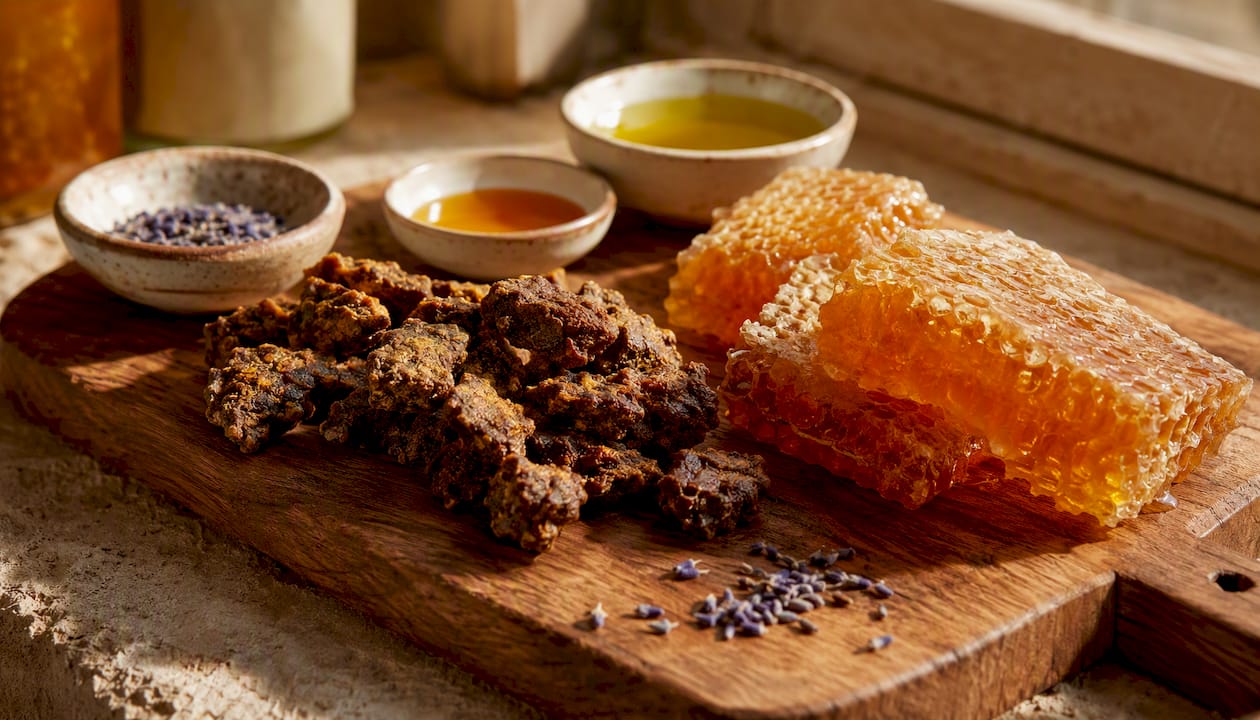
Bee-derived complexes. Propolis-derived antioxidants represent a chemically complex class combining polyphenols, flavonoids, and phenolic acids in a single matrix. PROPOWAX™ Living Honeycomb, Apiceuticals’ patented delivery architecture, continuously releases this antioxidant complex onto skin, scalp, and hair. The PROPOWAX™ technology page details the independent validation data.
For hair and scalp specifically, preclinical and clinical research documents resveratrol, arctiin, and taxifolin as natural antioxidants with measurable effects on hair follicle biology, acting through β-catenin, AKT, and Wnt signaling pathways to support anagen maintenance and reduce oxidative follicle damage.
Pro Tip: When evaluating an antioxidant for scalp use, check whether the study used dermal papilla cell (DPC) models or in vivo anagen/catagen endpoints — those are the readouts that translate most directly to clinical hair retention.
| Antioxidant Class | Key Topical Examples | Primary Mechanism | Stability Risk |
|---|---|---|---|
| Polyphenols (stilbenes/catechins) | Resveratrol, EGCG | ROS scavenging, Nrf2, MMP inhibition | High (light, oxidation) |
| Flavonoids / phenolic acids | Baicalin, gallic acid, guava phenolics | NF-κB modulation, ROS scavenging | Moderate (pH, heat) |
| Curcuminoids | Curcumin, THC | Nrf2 activation, anti-inflammatory | High (light, alkaline pH) |
| Carotenoids / sterol ferulates | Gamma-oryzanol, beta-carotene | UV absorption, ROS scavenging | High (oxidation, heat) |
| Marine pigments | Phycocyanin | Radical inhibition | Moderate (heat, light) |
| Bee-derived complexes | PROPOWAX™ Living Honeycomb | Broad-spectrum ROS scavenging | Stabilized by patented matrix |
Comparing delivery systems: which one fits your formulation?
| Delivery System | Heat/Light Stability | Skin/Scalp Penetration | Typical EE% | Particle Size / PDI | Formulation Compatibility | Scalability / Cost | Safety / Regulatory |
|---|---|---|---|---|---|---|---|
| Liposomes | Moderate | Good (hydrophilic actives) | Up to 99% (gallic acid) | <150 nm / low PDI | O/W; limited SPF | Moderate cost; scalable | Well-established; GRAS phospholipids |
| Nanoemulsions | Moderate | Good; scalp-friendly | Variable | — / low PDI | O/W or W/O; SPF-boosting | Lower cost; scalable | Generally safe; surfactant selection critical |
| NLCs / SLNs | Good (lipid matrix) | Good (lipophilic actives) | High (gamma-oryzanol) | ~146 nm / PDI ~0.20 | O/W; SPF-compatible | Moderate; natural lipids available | Accepted; nanoparticle disclosure advised |
| Silk fibroin nanoparticles (SFNs) | Excellent (thermal) | Moderate; surface retention | >70% (guava phenolics) | Variable / low PDI | Aqueous; gel-compatible | Higher cost; less scalable | Biocompatible; limited regulatory precedent |
| Nanogels | Good | High epidermal deposition | EE% above 70% | — / — | Aqueous gel; scalp-compatible | Moderate | Safe; essential oil excipients need review |
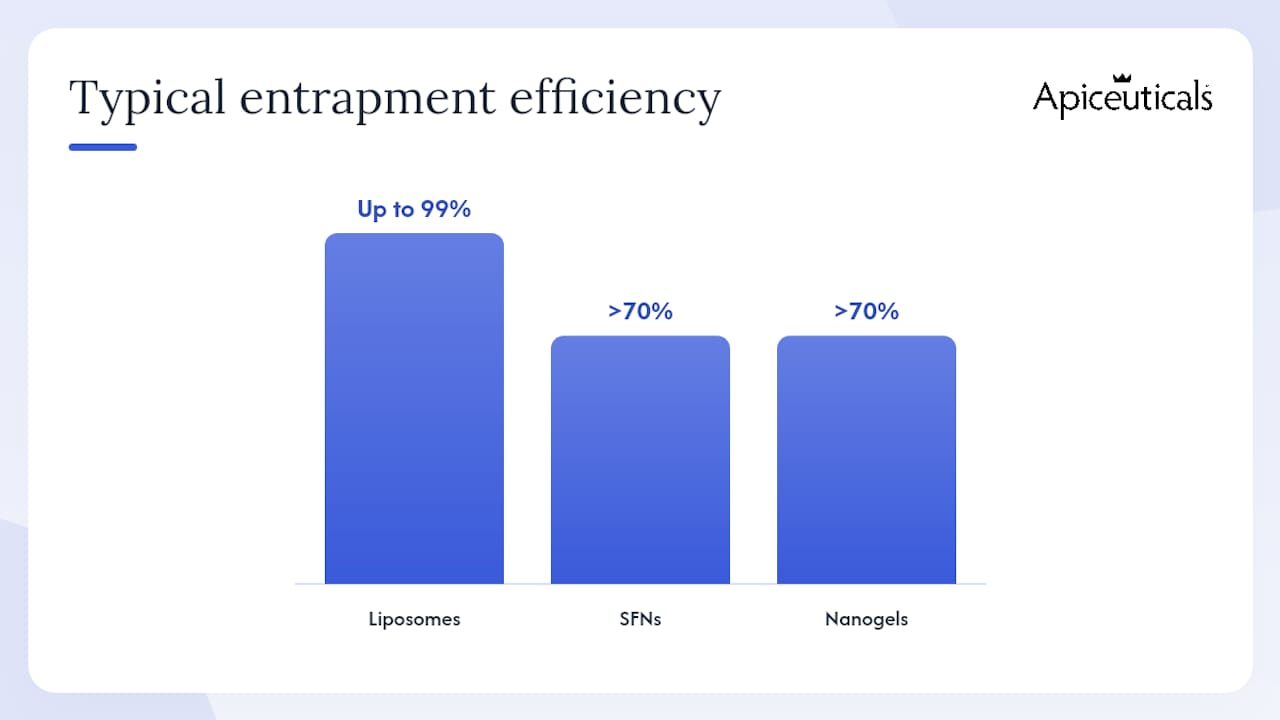
Liposomes are the preferred system for hydrophilic polyphenols such as gallic acid and EGCG when high EE% and controlled skin release are the priority. Their phospholipid bilayer mimics cell membranes, aiding percutaneous uptake. The limitation is physical instability over time, particularly at elevated temperatures.
Nanoemulsions suit phycocyanin and olive mill wastewater phenolics well, and they measurably raise SPF values in sunscreen lotions, making them practical for multifunctional photoprotective formulations. Surfactant selection is the key safety variable.
NLCs are the system of choice for lipophilic actives: gamma-oryzanol, curcumin, and carotenoids. A gamma-oryzanol NLC formulation achieved a particle size of approximately 146.5 nm, PDI of approximately 0.204, and zeta potential of approximately −34.9 mV, with a final SPF of 34 when combined with nanosized UV filters.
SFNs excel at thermal protection. Unencapsulated guava phenolics lost roughly five times their antioxidant activity at 70°C, while SFN-encapsulated material retained activity with entrapment efficiency above 70%. The tradeoff is higher manufacturing complexity and cost.
Nanogels combining lipid nanoparticles with a hydrogel matrix are well-suited for scalp application: the gel vehicle spreads easily through hair, and the nanoparticle core improves epidermal deposition. Baicalin in an essential-oil-based lipid nanoparticle hydrogel showed significantly greater epidermal deposition and higher total skin AUC versus a plain baicalin solution.
For scalp and hair applications, nanogels and nanoemulsions offer the best combination of spreadability and follicle-zone penetration. For facial anti-aging, liposomes and NLCs dominate based on skin retention data and formulation elegance.
Research snapshots: what the studies actually measured
| Study | Antioxidant + System | Key Metrics | Application Context |
|---|---|---|---|
| SFN + guava phenolics | Guava leaf extract in SFNs | EE% >70%; IC50 ~5.4 µg/mL retained post-heat | Face / body; heat-stable topical |
| Liposomes + gallic acid / curcumin | Gallic acid (EE% 99%) + curcumin (EE% 92%) in liposomes <150 nm | Improved skin retention; controlled release | Face anti-aging |
| NLC + gamma-oryzanol | Gamma-oryzanol in NLCs (~146.5 nm, PDI ~0.204, zeta −34.9 mV) | SPF 34 in final nanogel formulation | Body / face photoprotection |
| Nanoemulsion + phycocyanin | Phycocyanin + OMW phenolics in nanoemulsions | Increased radical scavenging; raised SPF in test lotions | Face / body SPF enhancement |
| Baicalin lipid nanoparticle hydrogel | Baicalin in essential-oil NP hydrogel with EE% above 70% | ~3× epidermal deposition; ~2.5× skin AUC vs. solution | Scalp / face |
Pro Tip: Structure an 8–12 week accelerated stability protocol by storing samples at 40°C/75% RH and under 1.2 million lux-hours of light exposure, then measure DPPH IC50 and EE% at weeks 4, 8, and 12. A drop in IC50 greater than 20% signals carrier failure, not just active degradation.
Pre-launch checklist for antioxidant topical products
Analytical
- DPPH/IC50 baseline and post-stability
- HPLC quantification of active marker compound
- EE%, particle size, PDI, zeta potential
Performance
- Ex-vivo skin permeation and dermatokinetic AUC
- SPF-boost testing when UV-active ingredients are present
- Photostability under ICH Q1B conditions
Stability
- Accelerated heat/light (40°C/75% RH; 1.2 M lux-hours)
- Packaging compatibility (air exposure, pump vs. jar)
- Microbial challenge and preservative efficacy testing
Regulatory and safety (U.S.)
- Cosmetic ingredient safety review per FDA voluntary guidelines
- Nanoparticle inhalation risk assessment for spray formats
- Label disclosure for nanomaterials and allergens
- Claim language review: cosmetic vs. drug claim boundary
Manufacturing
- Process window documentation for sonication or high-pressure homogenization
- Solvent removal validation for lipid nanoparticle batches
- Cost-per-unit modeling at pilot and commercial scale
Which antioxidant and delivery pairings perform best?
For face anti-aging, liposomal gallic acid and curcumin (EE% 99% and 92% respectively, particle size <150 nm) deliver the strongest combination of skin retention and controlled release currently documented in peer-reviewed literature.
For scalp anti-shedding, the clinical evidence points to broad-spectrum antioxidant regimens that address the scalp as a living ecosystem under oxidative load. Resveratrol, taxifolin, and arctiin are the best-supported individual actives for follicle biology. A nanogel or nanoemulsion vehicle ensures adequate distribution through hair and contact with the follicular zone.
For body photoprotection, gamma-oryzanol in NLCs combined with nanosized UV filters achieved SPF 34 in a published study, making this pairing the most evidence-supported option for multifunctional body formulations.
PROPOWAX™ Living Honeycomb stands apart from single-molecule approaches by continuously delivering a chemically complex bee-derived antioxidant matrix rather than a single-dose burst. Its global patent for highest antioxidant activity in cosmetics, independently validated by the Aristotle University of Thessaloniki, makes it the most rigorously documented consumer-ready option in this category. For technical details and sourcing, the PROPOWAX™ technology page and Apiceuticals’ antioxidant haircare and skincare lines are the direct reference points.
Key Takeaways
The most effective topical antioxidant strategy pairs the right molecular class with a validated encapsulation system — without documented EE%, particle size, and ex-vivo skin data, efficacy claims are unsubstantiated.
| Point | Details |
|---|---|
| Six antioxidant classes matter topically | Polyphenols, flavonoids/phenolic acids, curcuminoids, carotenoids, marine pigments, and bee-derived complexes each address distinct oxidative pathways. |
| Encapsulation is non-negotiable | Unprotected guava phenolics lost roughly five times their antioxidant activity at 70°C; SFNs with EE% >70% retained it. |
| NLCs lead for photoprotection | Gamma-oryzanol NLCs (~146.5 nm, PDI ~0.204) combined with UV filters reached SPF 34 in a published formulation study. |
| Clinical scalp evidence exists | A 24-week double-blind trial confirmed topical antioxidants reduce hair shedding and improve total hair count. |
| PROPOWAX™ Living Honeycomb | Apiceuticals’ patented bee-derived antioxidant complex, validated by the Aristotle University of Thessaloniki, is the most documented consumer option in this category. |
The formulation gap no one talks about
The conversation around types of natural antioxidants in cosmetics has matured considerably, but a persistent gap remains: brands invest in sourcing potent actives, then under-invest in the carrier. A resveratrol serum with no encapsulation data is, chemically speaking, a resveratrol-degradation product by the time it reaches the consumer. The encapsulation research reviewed here makes this concrete: five-fold activity loss in unprotected guava phenolics at moderate heat is not an edge case; it is what happens in a warehouse or a bathroom cabinet.
What excites me about the current research frontier is the convergence of natural excipients with validated delivery architectures. Essential oils as functional co-excipients, silk fibroin as a biocompatible thermal shield, and lipid matrices built from vegetable oils rather than synthetic waxes: these are not compromises; they are genuinely better solutions for clean beauty formulations. PROPOWAX™ Living Honeycomb represents exactly this principle applied at the patent level: a bee-derived matrix that continuously releases antioxidants rather than depleting them in a single application. The Aristotle University of Thessaloniki validation gives it the independent credibility the category needs more of.
The near-term research frontier worth watching is co-encapsulation: delivering two or three complementary antioxidants in a single carrier to address multiple ROS pathways simultaneously. The stability chemistry is complex, but the clinical upside for scalp and skin applications is significant.
Apiceuticals’ antioxidant products, grounded in bee science
Apiceuticals builds every product around the PROPOWAX™ Living Honeycomb, a patented antioxidant delivery system validated by the Aristotle University of Thessaloniki for the highest antioxidant activity in cosmetics. For consumers who want an evidence-backed topical antioxidant without navigating formulation complexity, the Apiceuticals antioxidant skincare and haircare range brings together clean, organic bee-science ingredients with dermatologically tested, 0% irritation formulas free from SLS, SLES, parabens, silicones, and mineral oils.

The HONEY BALM™ Series delivers clinically proven 26% wrinkle reduction in a waterless facial format. The PROPOWAX™ Series addresses scalp oxidative stress and hair retention with the same patented continuous-release mechanism. Full technical validation and ingredient sourcing details are available on the PROPOWAX™ technology page. Browse the full range and find the formulation that fits your skin or scalp goal.
FAQ
What are the main types of natural antioxidants used in skincare?
The primary classes are polyphenols (resveratrol, EGCG), flavonoids and phenolic acids (baicalin, gallic acid, guava phenolics), curcuminoids, carotenoids and gamma-oryzanol, marine pigments (phycocyanin), and bee-derived complexes. Each class targets distinct ROS pathways in skin and scalp tissue.
Do topical antioxidants actually reduce hair shedding?
Yes. A 24-week randomized, double-blind, placebo-controlled clinical trial confirmed that topical antioxidant regimens reduce hair shedding and improve total hair count, with measurable improvements in scalp biomarkers.
Why do natural antioxidants need encapsulation in cosmetics?
Most natural antioxidants degrade rapidly on exposure to heat, light, air, or pH extremes. Encapsulation in liposomes, NLCs, SFNs, or nanogels preserves activity, improves skin penetration, and enables controlled release.
What delivery system works best for scalp applications?
Nanogels and nanoemulsions are best suited for scalp use because they spread through hair easily and deliver actives to the follicular zone. Baicalin in a lipid nanoparticle hydrogel achieved approximately three times greater epidermal deposition versus a plain solution.
What metrics should I look for when evaluating an antioxidant topical product?
Request EE%, particle size, PDI, zeta potential, accelerated stability data (heat and light), and ex-vivo skin deposition or dermatokinetic AUC. Products without these data points cannot substantiate their efficacy claims.
What makes PROPOWAX™ Living Honeycomb different from standard antioxidant serums?
PROPOWAX™ Living Honeycomb is a patented bee-derived antioxidant delivery system that continuously releases a complex of polyphenols, flavonoids, and phenolic acids onto skin, scalp, and hair. Its global patent for highest antioxidant activity in cosmetics was independently validated by the Aristotle University of Thessaloniki.
Recommended


Related posts

How bees and biodiversity sustain each other, what the science says about Greece and the Aegean, and how antioxidant beauty can start from a hive...

How organic propolis extraction works, from hive to extract: collection, solvents, EU organic rules, Greek propolis phenolics and what it means for skincare.

Build an anti pollution skincare routine that fits Greek city life: what pollution does to skin, the morning and evening steps, and the antioxidants with...

Honey moisture content explained: the EU and Greek limits, how to take a refractometer reading, what excess water does to honey, and why it matters...

How antioxidant activity measurement works: DPPH, ABTS, FRAP and ORAC explained, why results differ, and what a lab number can and cannot say about skin...















