
No products in the cart.
Return To Shop
Body Care vs Skincare Difference: What Your Skin Actually Needs
The body care vs skincare difference comes down to biology, not preference. Facial skin is thinner, more reactive, and renews itself roughly every 28–30 days, while body skin is structurally thicker, slower to turn over, and prone to a different set of concerns entirely. These distinctions demand genuinely different formulations, not just different packaging. Understanding the difference between body care and skincare is the first step toward building a routine that actually works for your whole body, not just the two square inches between your cheekbones.
At a glance, here is what separates the two disciplines:
- Facial skincare targets a thinner, more sensitive surface with lightweight, often active-ingredient-rich formulas addressing acne, pigmentation, and aging.
- Body care addresses thicker, drier skin across a much larger surface area, prioritizing barrier repair, deep hydration, and texture improvement.
- Formulation logic differs: body products use richer emollients and can tolerate stronger actives; facial products stay lightweight and non-comedogenic.
- Antioxidant protection benefits both, but delivery must match each skin type. Technologies like Apiceuticals’ PROPOWAX™ Living Honeycomb, which holds a global patent for the highest antioxidant activity in cosmetics, validated by the Aristotle University of Thessaloniki, demonstrate how science-backed antioxidant support can be calibrated for both face and body.
How face and body skin are biologically different
The skin covering your forearm and the skin on your cheek share the same three-layer architecture: epidermis, dermis, and hypodermis. What differs is the thickness and behavior of each layer, and those differences have real consequences for how products should be formulated.
Facial skin is thinner and more delicate, with a higher density of sebaceous glands, particularly in the T-zone. That oil production keeps facial skin naturally moisturized but also makes it more prone to acne and more reactive to active ingredients. Body skin, by contrast, has fewer oil glands, which is why dryness and rough texture are the dominant body skin complaints rather than breakouts or sensitivity.
Cell turnover rate is another key variable. Facial skin renews faster, around every 28–30 days, which supports a smoother surface but also means it reacts quickly to over-exfoliation or harsh ingredients. Body skin sheds dead cells at a slower pace, so buildup accumulates on high-friction areas like elbows, knees, and heels, making more vigorous exfoliation not just acceptable but necessary.
The table below captures the core structural contrasts that drive every formulation decision in skincare and body care.
| Feature | Facial skin | Body skin |
|---|---|---|
| Epidermis thickness | Thinner, especially around eyes and lips | Thicker, especially on back, thighs, and soles |
| Sebaceous gland density | High; prone to oiliness and acne | Low; prone to dryness |
| Cell turnover rate | Faster (approx. 28–30 days) | Slower; dead cell buildup more common |
| Sensitivity | Higher; reacts to actives and environment | Lower; tolerates stronger formulations |
| Primary moisture concern | Trans-epidermal water loss (TEWL) | Dryness, flakiness, rough texture |
| Typical active tolerance | Lower concentrations required | Higher concentrations tolerated |
One practical consequence: body acne treatments can safely use higher concentrations of benzoyl peroxide (5–10%) than facial formulas, precisely because the thicker dermis absorbs and buffers actives differently. That is not a minor detail. It is the reason why applying a body wash to your face, or vice versa, can produce results ranging from ineffective to actively irritating.
How body care and skincare routines diverge in practice
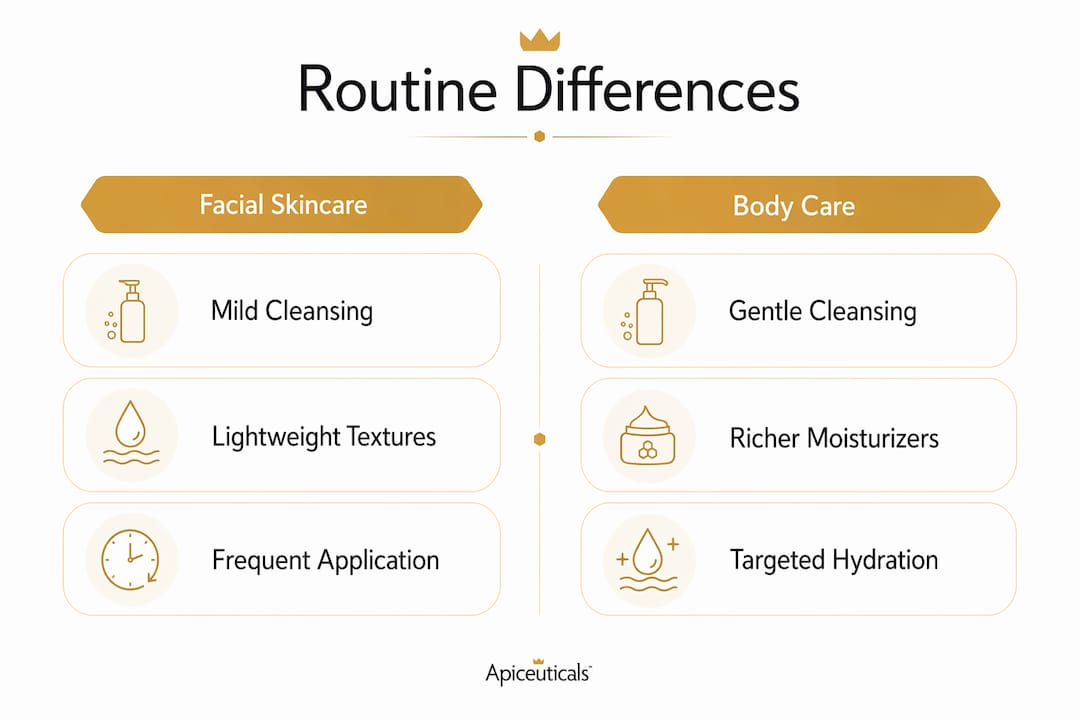
The difference between body care and skincare becomes most visible in the daily routine. Facial skincare follows a well-established sequence: gentle cleansing, targeted treatment (serums, retinoids, vitamin C), moisturizing, and broad-spectrum SPF. Each step addresses the face’s specific vulnerabilities: rapid moisture loss, UV exposure, and sensitivity to environmental aggressors.

Body care routines follow a different logic. Effective body care centers on three pillars: gentle cleansing that does not strip the skin’s natural lipid barrier, regular exfoliation to compensate for slower cell turnover, and rich moisturization applied immediately after showering to lock in hydration. SPF on exposed areas like the neck, arms, and hands completes the picture, though it is still underused in most people’s body routines.
Product textures reflect these different priorities. Facial skincare products in the US are typically lightweight and non-comedogenic, formulated to treat without clogging pores. Body care products lean toward richer creams, oils, and lotions containing shea butter, ceramides, and urea, ingredients that provide the sustained hydration thicker, drier skin actually needs.
The comparison table below shows where the two routines align and where they diverge.
| Routine step | Facial skincare | Body care |
|---|---|---|
| Cleansing | Mild, pH-balanced face wash, 1–2x daily | Gentle or medicated body wash; warm (not hot) water |
| Exfoliation | Enzymes or mild acids, 1–2x per week | Physical scrubs or glycolic/lactic acid washes, 2–3x per week |
| Treatment | Serums: vitamin C, retinoids, niacinamide | Targeted body treatments for acne, hyperpigmentation, keratosis pilaris |
| Moisturizing | Lightweight, non-comedogenic formula | Richer cream or lotion applied post-shower |
| Sun protection | Daily SPF 30+ on face and neck | SPF on all exposed areas: arms, hands, décolletage |
A common misconception is that facial products can simply be used on the body to save time or money. Many facial skincare products can be safely applied to the body, but the reverse carries real risk: body products are formulated for thick, dry skin and can cause breakouts or a greasy film when applied to the face. The formulation logic runs in one direction only.
Body skin also contends with friction, clothing contact, and temperature fluctuations that facial skin rarely encounters. Body products need different performance profiles, emphasizing breathability and deep penetration rather than surface-level comfort. A body lotion that sits on top of the skin without absorbing is not just unpleasant; it is failing at its primary job.
Pro Tip: Apply body moisturizer within three minutes of stepping out of the shower, while skin is still slightly damp. This timing significantly improves ingredient absorption and reduces trans-epidermal water loss.
What is “skinification” of body care, and why does it matter?
Skinification is the term dermatologists and formulators use to describe the migration of facial skincare science into body care. The concept is straightforward: if the skin barrier matters on the face, it matters on the body too. If antioxidants protect facial skin from oxidative stress, they should do the same for the arms, legs, and torso. The science supports this reasoning, and the beauty industry has been catching up to it.

The practical shift means body care products are increasingly formulated with ingredients once reserved for facial serums: ceramides, peptides, niacinamide, and antioxidants. This is not cosmetic inflation. Dermatologists emphasize maintaining the skin barrier consistently on the body as much as on the face, recognizing that neglected body skin ages, loses elasticity, and develops texture issues just as facial skin does, only more slowly and less visibly.
Antioxidant technology is where this evolution becomes most scientifically compelling. Free radicals generated by UV exposure, pollution, and metabolic processes degrade collagen and disrupt the skin barrier on the body just as they do on the face. Think of free radical damage as rust forming on metal: left unchecked, it spreads and weakens the structure beneath. Apiceuticals’ PROPOWAX™ Living Honeycomb addresses this through a patented mechanism that continuously releases antioxidants onto the skin’s surface, a technology validated by the Aristotle University of Thessaloniki and recognized by British Vogue as “arguably the global leader in antioxidant activity.” The PROPOWAX™ technology applies this antioxidant delivery to both body and hair care, not just facial formulations, which is precisely the skinification principle in action.
Understanding why antioxidants in body care matter reframes body care from a hydration-only discipline into a genuine skin health practice. Barrier maintenance, oxidative protection, and cellular support are not facial-only concerns. They are whole-body concerns that most body care routines have historically underserved.
Pro Tip: When evaluating body care products for antioxidant content, look for formulations that specify delivery mechanisms, not just ingredient lists. An antioxidant that cannot penetrate the stratum corneum provides minimal benefit regardless of its concentration on the label.
How to build a basic, effective body care routine
A well-constructed body care routine does not require a dozen products. Three core steps, executed consistently, address the majority of body skin concerns: gentle cleansing, targeted exfoliation, and deep moisturization. The science behind each step is straightforward.
Cleanse gently. Body skin does not need aggressive cleansing. Harsh sulfate-based washes strip the skin’s natural lipid barrier, triggering the same dryness cycle they are meant to prevent. Choose a gentle, sulfate-free body wash formulated to cleanse without over-stripping. Warm water, not hot, preserves the skin’s natural oils during the shower.
Exfoliate regularly, but not daily. Because body skin has a slower cell turnover rate, dead skin cells accumulate more readily on the elbows, knees, and heels. A physical scrub or a wash containing glycolic, lactic, or salicylic acid used two to three times per week keeps texture smooth and allows moisturizers to penetrate more effectively. Body exfoliation can be more vigorous than facial exfoliation precisely because the skin is thicker and more resilient.
Moisturize immediately post-shower. Applying a rich body lotion or cream within minutes of showering, while the skin retains some moisture, dramatically improves hydration retention. Look for formulas containing ceramides, shea butter, or urea for dry skin; lighter oil-based formulas work well for normal to combination body skin. An antioxidant body lotion adds a layer of oxidative protection that standard moisturizers do not provide.
Target specific concerns. Keratosis pilaris, the rough bumps common on the upper arms and thighs, responds well to lactic acid or urea-based formulas applied consistently. Body hyperpigmentation on the elbows and knees benefits from niacinamide or alpha-arbutin. These are not facial-grade concerns; they are body skin concerns that deserve body-specific solutions.
Apply SPF to exposed areas. The neck, décolletage, hands, and forearms accumulate UV damage year-round, even in winter. A water-resistant broad-spectrum SPF 30 or higher applied to these areas prevents the premature aging and hyperpigmentation that most people attribute to genetics rather than sun exposure.
Incorporate antioxidant support. Oxidative stress affects body skin just as it does facial skin. Incorporating an antioxidant-rich body product, whether a lotion, oil, or treatment, into the routine supports the skin barrier and helps neutralize free radical damage from environmental exposure. For those interested in preventing skin oxidation across the whole body, this step moves body care from reactive to genuinely protective.
Consider fragrance and layering. Moisturized skin holds fragrance significantly longer than dry skin, because hydrated cells absorb and retain scent molecules more effectively. Applying a well-formulated body lotion before fragrance is a practical technique for extending wear. For a deeper look at how moisturizing and fragrance interact, fragrance longevity guidance offers useful context on layering strategies.
The body care essentials outlined above are not aspirational. They are the minimum a dermatologically sound routine requires. Consistency matters more than complexity: a three-step routine performed daily outperforms a ten-step routine used twice a week.
Key Takeaways
Body care and facial skincare address the same organ through fundamentally different biological lenses, and the formulations must reflect that difference to be effective.
| Point | Details |
|---|---|
| Biological differences drive formulation | Facial skin renews every 28–30 days and is more sensitive; body skin is thicker with slower turnover and fewer oil glands. |
| Routines serve different goals | Facial care targets sensitivity, aging, and acne; body care prioritizes barrier repair, hydration, and texture. |
| Cross-use has limits | Facial products can generally be used on the body, but body products are too rich and often too fragranced for facial skin. |
| Skinification is science-backed | Dermatologists confirm that barrier maintenance and antioxidant protection are as important for body skin as for the face. |
| Antioxidants belong in both routines | Technologies like PROPOWAX™ Living Honeycomb, validated by the Aristotle University of Thessaloniki, demonstrate that antioxidant delivery can be calibrated for both face and body. |
FAQ
Is skincare and body care the same thing?
No. Skincare typically refers to facial care, while body care addresses the skin from the neck down. The two disciplines use different formulations because facial skin and body skin have distinct structures, oil gland densities, and sensitivity levels.
Can I use facial skincare products on my body?
Generally yes. Because facial products are formulated for thinner, more sensitive skin, they are safe to use on the body. The reverse is not recommended: body products are too rich and often too fragranced for facial skin, and can cause breakouts or irritation.
What is considered body care?
Body care encompasses all products and practices designed for the skin below the neck, including body washes, exfoliants, body lotions and creams, body oils, and SPF for exposed areas. It also includes targeted treatments for concerns like keratosis pilaris, body acne, and hyperpigmentation.
What does a basic body care routine include?
A basic body care routine covers three steps: gentle cleansing with a sulfate-free body wash, regular exfoliation two to three times per week to address slower cell turnover, and rich moisturization applied immediately after showering to restore the skin barrier.
Why do body care products feel richer than facial moisturizers?
Body skin has fewer sebaceous glands and a slower cell turnover rate, making it structurally drier and more prone to moisture loss through friction and clothing contact. Richer emollients, ceramides, and occlusive ingredients are needed to compensate for what the skin cannot produce on its own.
Recommended


Related posts

How bees and biodiversity sustain each other, what the science says about Greece and the Aegean, and how antioxidant beauty can start from a hive...

How organic propolis extraction works, from hive to extract: collection, solvents, EU organic rules, Greek propolis phenolics and what it means for skincare.

Build an anti pollution skincare routine that fits Greek city life: what pollution does to skin, the morning and evening steps, and the antioxidants with...

Honey moisture content explained: the EU and Greek limits, how to take a refractometer reading, what excess water does to honey, and why it matters...

How antioxidant activity measurement works: DPPH, ABTS, FRAP and ORAC explained, why results differ, and what a lab number can and cannot say about skin...















