
No products in the cart.
Return To Shop
What Is Hair Balm? Benefits, Uses, and Ingredients
TL;DR:
- Hair balm is a semi-solid product that melts on contact to provide light-to-medium hold and nourishment.
- It combines oils, butters, and waxes to coat hair, reduce frizz, and improve shine while supporting hair health.
Hair balm is defined as a semi-solid, hybrid styling and conditioning product that melts on contact with hair to deliver light-to-medium hold while simultaneously nourishing each strand. It sits at the intersection of treatment and styler, combining oils, butters, and waxes to coat the hair cuticle, reduce frizz, lock in moisture, and enhance shine. Unlike a gel, which stiffens, or a serum, which only adds gloss, a hair balm addresses both structure and health in a single step. Advanced formulations now incorporate antioxidant complexes like PROPOWAX™ Living Honeycomb, elevating the category from simple styling aid to scientifically grounded hair care.
What is hair balm made of, and why do ingredients matter?
Hair balm is a hybrid formulation combining oils, butters, waxes, and structuring agents, which makes it more versatile for repair and styling than standalone serums or creams. Each ingredient class plays a distinct biological role in how the product interacts with the hair shaft and scalp.
The core ingredient categories in a well-formulated hair balm are:
- Oils (argan, jojoba, sweet almond): Penetrate or coat the hair shaft to deliver hydration and add shine. Lighter oils like jojoba closely mimic the scalp’s natural sebum, making them suitable for fine or oily hair types.
- Butters (shea, mango, kokum): Provide nourishment and smoothness by forming a protective film over the cuticle. They add density to the balm’s texture and slow moisture loss.
- Waxes (beeswax, candelilla wax): Give the product its semi-solid structure and provide hold. Beeswax, in particular, creates a breathable, flexible film rather than a stiff cast.
- Humectants (glycerin, panthenol): Draw water vapor from the environment into the hair shaft, actively increasing hydration levels.
- Emollients: Fill gaps between cuticle scales to smooth the surface and reduce friction between strands.
The balance of these components determines everything. A balm heavy in wax delivers more hold and is better suited to thick, coarse, or highly textured hair. A balm weighted toward oils and butters performs better as a nourishing treatment for dry or damaged hair. Reading the ingredient list from top to bottom tells you which category dominates.
| Ingredient Type | Primary Function | Best For |
|---|---|---|
| Oils (argan, jojoba) | Hydration, shine, cuticle coating | Dry, dull, or fine hair |
| Butters (shea, mango) | Nourishment, moisture retention | Coarse, damaged, or thick hair |
| Waxes (beeswax, candelilla) | Hold, structure, frizz control | Textured, curly, or edge styling |
| Humectants (glycerin) | Active moisture attraction | Dehydrated or brittle hair |
| Antioxidant complexes | Oxidative stress protection | All hair types, especially color-treated |
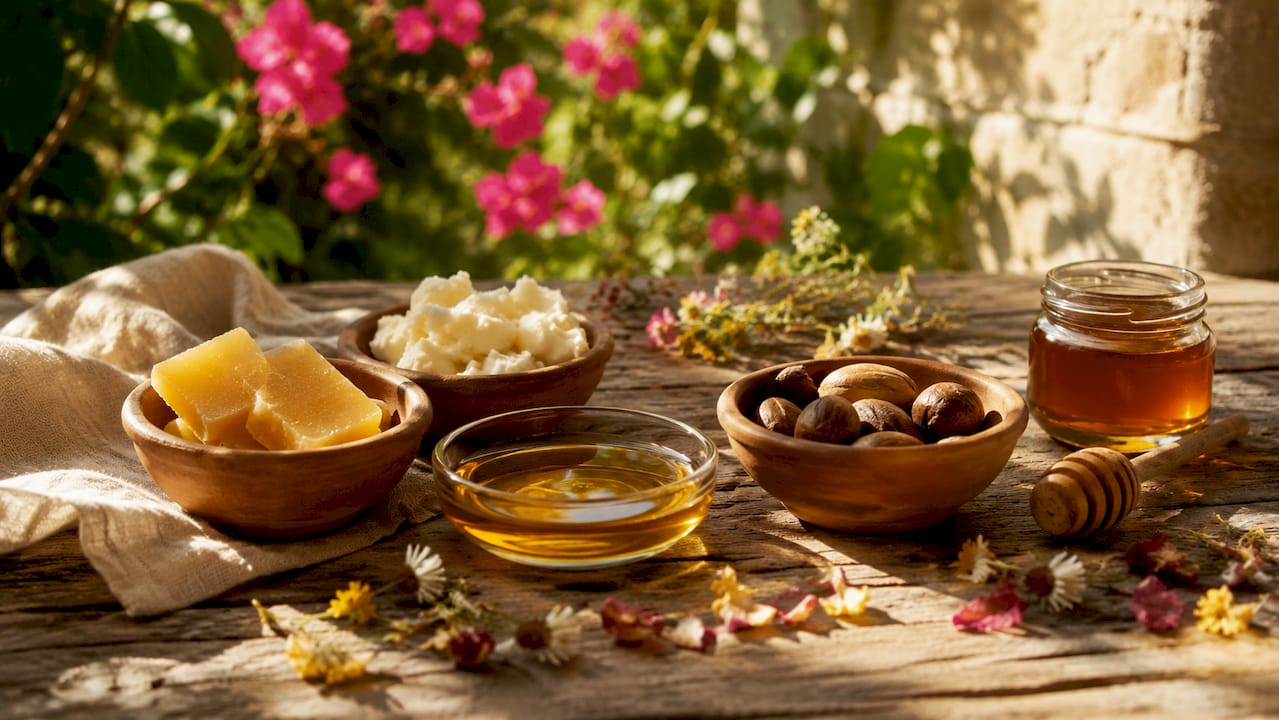
Advanced balms now include bonding complexes, fermented botanicals, and antioxidant systems. Apiceuticals’ PROPOWAX™ Living Honeycomb is a globally patented technology, validated by the Aristotle University of Thessaloniki, that continuously releases antioxidants onto the hair and scalp. This mechanism protects against free radical damage, which degrades keratin and accelerates color fade in much the same way rust corrodes unprotected metal.
Pro Tip: When evaluating a hair balm, check whether wax or oil appears first on the ingredient list. If wax leads, expect more hold. If oil leads, expect more nourishment and a lighter finish.
How to use hair balm for maximum results
Application technique determines whether a hair balm performs or disappoints. Hair balm works best on damp, towel-dried hair, warmed between the palms until it becomes a sheer glaze before being worked through the mid-lengths and ends. This warming step is not optional. It changes the product’s viscosity, allowing even distribution without clumping or patchiness.
The step-by-step method for optimal results:
- Towel-dry hair until it is damp but not dripping. Excess water dilutes the balm and reduces its ability to coat the cuticle effectively.
- Scoop a pea- or rice-grain-sized amount and place it in the center of both palms. Starting with a small amount prevents the over-application that weighs down fine hair and creates an oily appearance near the roots.
- Rub palms together until the balm melts into a thin, even film across both hands.
- Apply from ends upward, working through the mid-lengths before finishing with any remaining product on the surface of the hair. Avoid the roots unless your hair is very thick and dry.
- Style as desired: scrunch for curl definition, smooth downward for sleekness, or use fingertips to tame flyaways and edges.
- For dry hair touch-ups, use an amount smaller than a grain of rice, warmed thoroughly, and press lightly onto frizzy sections rather than raking through.
Hair balm also functions as a pre-shampoo mask: apply generously to dry hair, leave on for 30–60 minutes under low heat, then double-shampoo to remove. This method delivers the deepest conditioning benefit and is particularly effective for hair that is severely dry or heat-damaged.
Pro Tip: For wavy hair, apply balm in the shower after rinsing conditioner, while hair is fully saturated. This technique enhances natural wave pattern without adding stiffness or disrupting the curl formation process.
Is hair balm good for hair health beyond styling?
Hair balm benefits extend well past aesthetics. Balms include humectants to hydrate, emollients to smooth, and butters and oils to seal moisture in, making them effective for protective styles, curl definition, and managing the appearance of split ends. The product’s ability to coat the cuticle reduces friction between strands, which directly lowers the mechanical breakage that occurs during brushing and styling.
The scalp benefits are equally significant. Massaging balm directly onto scalp parts during protective styles like braids or twists stimulates blood flow and prevents the dryness that commonly develops when the scalp is inaccessible for weeks at a time. The scalp functions as a living ecosystem: when its moisture balance is disrupted, hair growth and follicle health suffer. Targeted balm application addresses this without transferring product to pillowcases or linens.
One limitation deserves honest acknowledgment. Balms temporarily mask split ends by smoothing the cuticle, but they do not repair the underlying structural break. Regular trims remain the only permanent solution for split ends. Think of balm as a precision tool for managing appearance and preventing further damage, not as a substitute for cutting away compromised length.
The most underappreciated benefit of a well-formulated hair balm is its antioxidant potential. Free radicals generated by UV exposure, pollution, and heat styling degrade the keratin protein structure and accelerate melanin breakdown, dulling color and weakening the strand. Antioxidant systems like PROPOWAX™ Living Honeycomb, which continuously releases protective compounds validated by the Aristotle University of Thessaloniki, represent the next generation of hair balm science. They do not simply coat the hair. They actively defend it.
Explore antioxidants for hair to understand how this protection translates into measurable improvements in hair resilience and color longevity.
How to choose the right hair balm for your hair type
Choosing the right hair balm requires matching the oil-to-wax ratio to your hair’s density and moisture needs. Optimal formulation balance is essential: a balm that works well for thick, coarse hair will flatten fine hair and create buildup. Understanding the difference between product categories prevents wasted investment and poor results.
| Product Type | Texture | Hold Level | Finish | Best For |
|---|---|---|---|---|
| Hair balm | Semi-solid, melts on contact | Light to medium | Natural, glossy | Frizz control, nourishment, curl definition |
| Hair gel | Liquid to thick gel | Medium to strong | Wet or crunchy | Defined styles, edges, slicked looks |
| Hair cream | Soft cream | Light | Soft, natural | Everyday moisture, detangling |
| Hair serum | Liquid | None | High gloss | Shine, heat protection, smoothing |
| Pomade | Waxy or creamy | Medium to strong | Shiny or matte | Sleek styles, edges, men’s styling |
Hair balm differs from gel and jelly by having a solid texture that melts to oil on contact, providing light-to-medium hold without stiffness. This distinction matters when selecting a product for frizz control: gel creates a cast that can crack, while balm maintains flexibility and movement.
Ingredients to avoid include silicones (which create non-breathable buildup over time), parabens, sulfate-based emulsifiers, and heavy mineral oils. Apiceuticals’ clean beauty formulation standard excludes over 2,000 potentially harmful ingredients, including SLS, SLES, parabens, silicones, and mineral oils, and is dermatologically tested on sensitive skin with 0% irritation.
For readers seeking personalized guidance on selecting products suited to their specific hair and scalp profile, a professional skin care consultation can provide structured recommendations based on individual hair texture, porosity, and condition.
Pro Tip: If your hair feels heavy or greasy after using a balm, the wax content is too high for your hair density. Switch to a balm where oil or butter appears first on the ingredient list, and reduce your application amount by half.
Key Takeaways
Hair balm is the most versatile category in hair care because it simultaneously conditions, protects, and styles without the stiffness of gel or the passivity of a serum.
| Point | Details |
|---|---|
| Definition and texture | Hair balm is a semi-solid hybrid that melts on contact to deliver light-to-medium hold with nourishment. |
| Ingredient hierarchy | The oil-to-wax ratio determines hold strength and suitability for your hair density and moisture needs. |
| Application technique | Warm a pea-sized amount between palms and apply from ends upward on damp hair to avoid root buildup. |
| Health benefits | Balms smooth the cuticle, reduce breakage, support scalp moisture, and mask split ends without repairing them. |
| Antioxidant advancement | Technologies like PROPOWAX™ Living Honeycomb add a protective antioxidant layer that defends hair against oxidative damage. |
Apiceuticals’ perspective on hair balm’s evolving role
Hair balm has moved from a niche styling product to one of the most scientifically interesting categories in hair care. At Apiceuticals, we see this shift clearly in how formulation priorities have changed. A decade ago, the conversation was almost entirely about hold and shine. Now, the most meaningful questions concern what a balm does to the hair’s structural integrity over time.
The misconception we encounter most often is that balm is interchangeable with cream or serum. It is not. Balm’s semi-solid wax matrix creates a physical barrier that neither a cream nor a serum can replicate. That barrier is what makes balm uniquely effective for frizz control in humid conditions and for protective styling applications where the scalp needs sustained moisture over days or weeks.
What excites us most is the convergence of balm technology with antioxidant science. PROPOWAX™ Living Honeycomb does not behave like a standard ingredient. It functions as a continuous-release system, delivering antioxidant protection throughout the day rather than in a single application burst. That distinction, validated by the Aristotle University of Thessaloniki and recognized by British Vogue as “arguably the global leader in antioxidant activity,” represents a genuine advance in what a hair balm can accomplish. The category is no longer just about how hair looks. It is about how hair survives.
— Apiceuticals
Apiceuticals PROPOWAX™ hair balms: where science meets the hive
Apiceuticals brings bee science and antioxidant chemistry together in a hair care range built on the PROPOWAX™ Living Honeycomb, a globally patented technology that continuously releases antioxidants onto the scalp and hair. Every formulation excludes silicones, parabens, mineral oils, and over 2,000 potentially harmful ingredients, and is dermatologically tested on sensitive skin with 0% irritation.

The PROPOWAX™ antioxidant hair care range is designed for pre-wash masking, leave-in conditioning, and daily styling, making it a genuine multi-use system rather than a single-purpose product. For readers ready to experience the difference that antioxidant-enriched balm formulation makes, the Hair Care Premium Gift Set offers a complete introduction to the Apiceuticals approach, curated for all hair types and textures.
FAQ
What is hair balm and how does it differ from conditioner?
Hair balm is a semi-solid styling and conditioning hybrid containing oils, butters, and waxes that melts on contact to provide hold and nourishment. A rinse-out conditioner is a water-based treatment removed in the shower, while balm is a leave-in product that continues working after application.
Can hair balm help with frizzy hair?
Hair balm is one of the most effective products for frizz control because its wax component creates a flexible physical barrier over the cuticle that resists humidity. Unlike gel, it does not produce a stiff cast, so hair remains soft and movable.
How often should you use hair balm?
Hair balm can be used daily as a leave-in styler or two to three times per week as a pre-shampoo treatment, depending on your hair’s density and moisture needs. Fine hair benefits from less frequent application to avoid buildup.
Does hair balm repair split ends?
Hair balm smooths the cuticle to temporarily improve the appearance of split ends, but it does not repair the structural break in the hair fiber. Regular trims remain the only permanent solution for split ends.
What should I avoid in a hair balm formula?
Avoid balms containing silicones, parabens, sulfate-based emulsifiers, and mineral oils, as these ingredients can create non-breathable buildup, disrupt scalp health, or cause long-term dryness. Look for formulations that are dermatologically tested and free from these compounds.
Recommended


Related posts

How bees and biodiversity sustain each other, what the science says about Greece and the Aegean, and how antioxidant beauty can start from a hive...

How organic propolis extraction works, from hive to extract: collection, solvents, EU organic rules, Greek propolis phenolics and what it means for skincare.

Build an anti pollution skincare routine that fits Greek city life: what pollution does to skin, the morning and evening steps, and the antioxidants with...

Honey moisture content explained: the EU and Greek limits, how to take a refractometer reading, what excess water does to honey, and why it matters...

How antioxidant activity measurement works: DPPH, ABTS, FRAP and ORAC explained, why results differ, and what a lab number can and cannot say about skin...















