
No products in the cart.
Return To Shop
What Is Multi-Step Skincare? A Science-Backed Guide
TL;DR:
- Multi-step skincare involves applying multiple targeted products in a specific order to hydrate, protect, and treat the skin at different depths effectively. Evidence shows that layered routines significantly improve deep and superficial hydration, offering superior skin benefits compared to simple routines. Proper sequencing, gradual introduction, and selective actives optimize results while minimizing irritation and barrier compromise.
Multi-step skincare is a deliberate, sequenced routine in which multiple targeted products are applied in a specific order to hydrate, protect, and treat the skin at different depths simultaneously. Known in dermatology as a layered skincare protocol, this approach uses products with varying molecular weights to penetrate the skin at different levels, achieving results that a single moisturizer simply cannot replicate. The Korean 10-step routine popularized this framework globally, but the science behind it predates K-beauty by decades. Apiceuticals’ PROPOWAX™ Living Honeycomb technology, validated by the Aristotle University of Thessaloniki for the highest antioxidant activity in cosmetics, represents exactly the kind of evidence-based innovation that makes multi-step skincare worth understanding at a deeper level.
What is multi-step skincare and how does it work?
Multi-step skincare is defined as a structured routine of three or more distinct product applications, each serving a separate biological function, applied in a sequence that maximizes absorption and efficacy. The core principle is hydration layering: products with smaller molecules are applied first to penetrate deeper skin layers, followed by progressively larger molecules that seal in moisture and form a protective barrier. Think of it like applying coats of paint on a wall. Each coat adheres better because of the one beneath it.
The Korean 10-step routine is the most recognized framework, but it functions as a flexible modular system rather than a rigid daily checklist. Users select steps based on their skin’s condition that day, the season, and their specific goals. This modularity is what separates multi-step skincare from a rigid prescription. It is a philosophy of intentional layering, not a mandatory ten-product commitment every morning.
The science behind why this works is straightforward. Multiple thin layers penetrate more effectively and hydrate deeper skin layers than a single thick application. Careful sequencing from toner to essence to serum to moisturizer also supports the skin’s acid mantle, the slightly acidic film that protects against bacteria and environmental damage. Disrupting that sequence reduces efficacy. Following it amplifies results cumulatively.

What are the steps in a multi-step skincare routine?
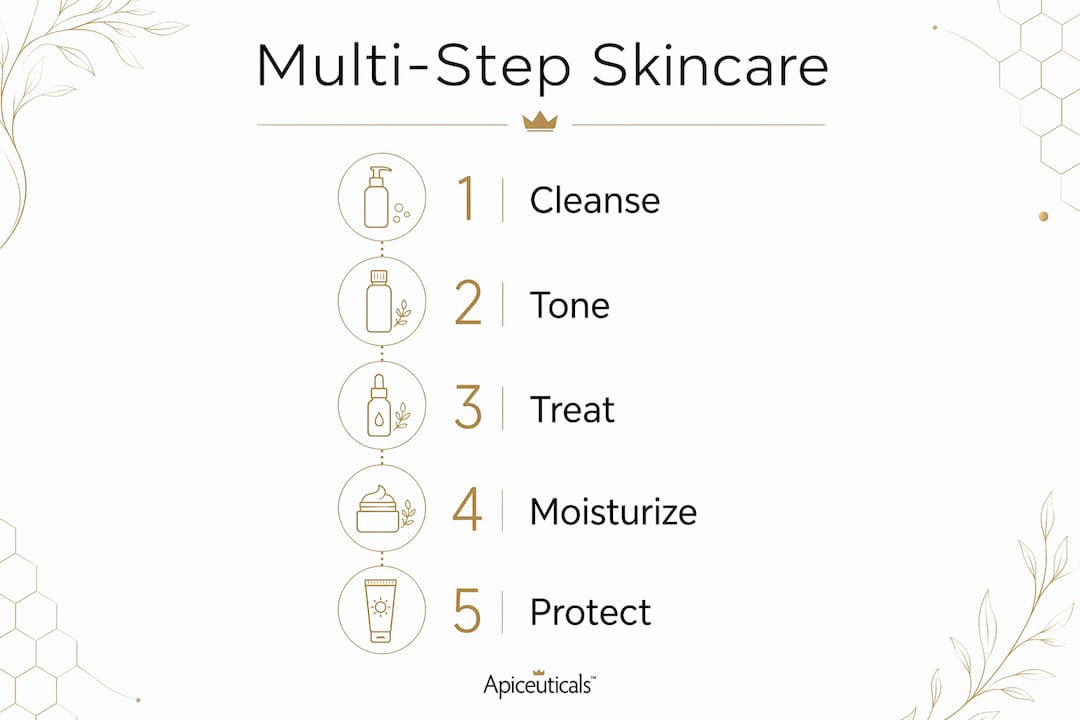
A well-constructed multi-step skincare routine follows a consistent logic: apply the thinnest, most water-based products first and finish with the thickest, most occlusive formulas. The standard components, in order, are:
- Oil cleanser — dissolves sunscreen, makeup, and sebum without stripping the skin barrier.
- Water-based cleanser — removes water-soluble impurities left after oil cleansing. This two-step cleanse is the foundation of the Korean method.
- Exfoliant — used 1–2 times weekly, not daily. Chemical exfoliants like AHAs and BHAs resurface without the micro-tears caused by physical scrubs.
- Toner — restores the skin’s pH after cleansing and primes the surface for absorption of subsequent products.
- Essence — a lightweight, hydrating concentrate that delivers active ingredients at a cellular level. This is the step most often skipped in Western routines and most often responsible for the visible difference in skin texture.
- Serum or ampoule — high-concentration actives targeting specific concerns: vitamin C for oxidative stress, niacinamide for pore reduction, or antioxidant complexes for barrier repair.
- Sheet mask — used a few times per week, not daily, to deliver an intensive dose of hydration and actives.
- Eye cream — formulated for the thinner, more sensitive periorbital skin.
- Moisturizer — seals in all previous layers and supports the skin barrier.
- Sunscreen (AM) or sleep mask (PM) — the final protective or reparative step depending on the time of day.
Morning routines prioritize protection: antioxidants, hydration, and SPF. Evening routines prioritize repair: exfoliation, treatment serums, and richer moisturizers. Not every step is used every day. Sheet masks and exfoliants are used selectively to prevent over-layering and sensitivity.
Pro Tip: Apply each product to slightly damp skin. Water on the skin surface acts as a carrier, helping water-soluble actives penetrate more efficiently before the next layer seals them in.
What are the proven benefits of multi-step skincare?
The clinical evidence for multi-step skincare routines is specific and measurable. An advanced multi-step routine increased superficial skin hydration by 92% and deep hydration by 25% over four weeks. That result is not incremental. It represents a fundamentally different category of outcome compared to simpler approaches.
The same study found that simple routines, typically a 3-step cleanser, moisturizer, and sunscreen protocol, produced meaningful improvements in superficial hydration but minimal changes in deep hydration, skin roughness, or pore area. The gap between the two approaches widens precisely because of layering: each product in a multi-step routine builds on the previous one, creating a cumulative effect that no single product can replicate.
| Outcome Measure | Simple Routine | Advanced Multi-Step Routine |
|---|---|---|
| Superficial hydration increase | Moderate improvement | 92% increase over 4 weeks |
| Deep hydration increase | Minimal change | 25% increase over 4 weeks |
| Skin roughness reduction | Minimal change | Significant improvement |
| Pore area reduction | Minimal change | Measurable reduction |
“Layering skincare with multiple lightweight products of varying molecular sizes achieves deeper, more effective hydration than single heavy creams, supporting better skin barrier functioning and cumulative benefits.” — K-Beauty Hydration Science
The dermatology community holds a nuanced position on these results. 79.8% of dermatologists acknowledge the benefits of multi-step routines, yet only 12.5% actively recommend them. The concern is not efficacy. It is the risk of irritation and allergic reactions when too many actives are layered without adequate spacing or skin assessment. The data supports multi-step skincare. The clinical caution is about execution, not the principle itself.
Antioxidant layering adds another dimension to these benefits. Applying antioxidants in sequence nourishes the skin more effectively than a single antioxidant product, supporting protection against oxidative damage that accelerates visible aging. PROPOWAX™ Living Honeycomb, which holds a global patent for the highest antioxidant activity in cosmetics, is validated precisely on this principle: continuous, layered antioxidant release outperforms a single-dose application.
How to build a multi-step skincare routine safely
The most common mistake in building a multi-step skincare routine is starting with too many products at once. Starting with a 3-step routine and adding one product every 2–4 weeks is the clinically supported approach. This spacing allows the skin barrier to adapt and makes it possible to identify exactly which product causes a reaction if one occurs.
Here is a practical framework for building your routine:
- Foundation first. Begin with a gentle cleanser, a hydrating toner, and a broad-spectrum SPF. These three steps address cleansing, pH restoration, and UV protection. They are non-negotiable regardless of how minimal or extensive your routine becomes.
- Add actives one at a time. Introduce a vitamin C serum in the morning before your moisturizer, or a niacinamide serum in the evening. Wait 2–4 weeks before adding the next active to assess tolerance.
- Select antioxidants with documented efficacy. Not all antioxidant claims are equal. Look for ingredients with independent validation, such as propolis-derived antioxidants or vitamin C derivatives, and understand how antioxidants work at a cellular level before layering them.
- Adjust seasonally. Skin barrier function changes with humidity and temperature. A lightweight essence sufficient in summer may need to be supplemented with a richer serum in winter.
- Monitor your skin barrier. Tightness, redness, or increased sensitivity after adding a new product signals over-layering or ingredient incompatibility. Remove the newest addition and allow the barrier to recover before reintroducing it.
Pro Tip: Never layer a low-pH AHA or BHA exfoliant directly under a niacinamide serum in the same application. The pH difference reduces the efficacy of both. Apply them in separate routines, morning and evening, or on alternating days.
Understanding how to layer skincare products correctly is as important as which products you choose. Sequence errors are the primary reason well-formulated routines underperform.
Common misconceptions about multi-step skincare routines
The most persistent misconception about multi-step skincare is that more products always produce better results. This is false. Skin has a finite absorption capacity, and exceeding it does not enhance outcomes. It compromises the barrier.
Several other misunderstandings consistently undermine results:
- The 10-step routine is not a daily requirement. It is a menu of options. Dermatologists confirm that the Korean 10-step framework is designed to be adapted, not followed rigidly. Selecting three to five steps on a given day is entirely consistent with the method.
- Mixing strong actives without spacing causes irritation, not enhancement. Retinol, AHAs, BHAs, and high-concentration vitamin C each lower the skin’s tolerance threshold. Combining them in a single routine without adequate barrier preparation is a common cause of reactive skin.
- Cultural context shapes expectations. The Korean skincare tradition emphasizes prevention and long-term skin health over rapid visible change. Western consumers often approach multi-step routines with a results-in-days expectation that misaligns with how layered hydration actually works. Barrier repair and deep hydration improvements accumulate over weeks, not days.
- Multifunctional products can replace multiple steps. A well-formulated essence-serum hybrid or a toner with active ingredients reduces the total number of products without reducing efficacy. Step count is not the measure of a good routine. Ingredient function is.
The goal of a multi-step skincare routine is purposeful layering, not product accumulation. Every step should have a defined function. If you cannot articulate why a product is in your routine, it probably should not be there.
Key takeaways
Multi-step skincare delivers measurably superior hydration and barrier support compared to simplified routines, but only when products are sequenced correctly and introduced gradually.
| Point | Details |
|---|---|
| Layering logic drives results | Apply thinnest to thickest formulas to maximize absorption at each skin depth. |
| Clinical hydration gains are significant | Advanced routines increased deep hydration by 25% and superficial hydration by 92% over four weeks. |
| Gradual introduction reduces risk | Add one new product every 2–4 weeks to protect the barrier and identify sensitivities. |
| 10 steps is a flexible framework | Select steps based on daily skin condition, not a fixed daily checklist. |
| Antioxidant layering amplifies protection | Sequential antioxidant application provides cumulative defense against oxidative damage beyond single-product use. |
Why antioxidant science changes the multi-step equation
At Apiceuticals, we have spent years studying what separates a routine that looks good on paper from one that produces measurable, lasting change in skin health. The answer, consistently, is antioxidant integrity.
Most multi-step routines address hydration and barrier repair well. Fewer address oxidative stress, the process by which free radicals degrade collagen, disrupt melanin production, and accelerate visible aging. Free radicals damage skin cells the way rust corrodes metal: gradually, invisibly, and cumulatively. A routine that does not include a validated antioxidant layer is incomplete by design.
What we find genuinely differentiated about PROPOWAX™ Living Honeycomb is not the claim but the mechanism. The global patent for highest antioxidant activity in cosmetics, validated by the Aristotle University of Thessaloniki, is built on continuous release. The antioxidants do not deposit once and deplete. They release progressively, which mirrors how layered skincare is supposed to work. That alignment between technology and protocol is not coincidental. It is the result of understanding that skin protection is not a single event. It is an ongoing biological process.
Our perspective is that the future of multi-step skincare is not more steps. It is smarter antioxidant delivery within fewer, better-chosen steps. Readers who want to explore antioxidant-rich routine building will find that the science points consistently in this direction.
— Apiceuticals
Build your routine with Apiceuticals’ antioxidant skincare
Apiceuticals designs every product around one principle: antioxidant delivery that is clinically validated, not cosmetically implied. The HONEY BALM™ Series offers waterless facial care with clinically proven 26% wrinkle reduction, formulated without SLS, SLES, parabens, silicones, or mineral oils. The PROPOWAX™ Living Honeycomb technology, recognized by British Vogue as “arguably the global leader in antioxidant activity,” integrates directly into a multi-step routine as a serum-level antioxidant layer with continuous-release efficacy.
Every Apiceuticals formula is dermatologically tested on sensitive skin with 0% irritation, making it a reliable choice for building a layered routine without compromising barrier health. Explore the full range of antioxidant skincare products and find the formulas that belong in your routine, not just on your shelf.
FAQ
What is multi-step skincare in simple terms?
Multi-step skincare is a routine of three or more products applied in a specific sequence, each targeting a different skin function such as cleansing, hydrating, treating, and protecting. The layered approach delivers ingredients at different skin depths for results a single product cannot achieve.
How many steps does a multi-step skincare routine need?
A functional multi-step skincare routine requires a minimum of three steps: cleanser, treatment or serum, and moisturizer with SPF. Additional steps like essence, exfoliant, and antioxidant serum are added gradually based on skin goals and tolerance.
Is multi-step skincare worth it compared to a simple routine?
Clinical data shows an advanced multi-step routine increased deep skin hydration by 25% and superficial hydration by 92% over four weeks, significantly outperforming simple routines. The results are worth the investment when products are chosen deliberately and layered correctly.
Can multi-step skincare cause skin irritation?
Yes. Layering too many actives without adequate spacing between introductions is a documented cause of irritation and barrier compromise. Dermatologists recommend introducing one new product every 2–4 weeks and monitoring skin response before adding the next.
Where does antioxidant protection fit in a multi-step routine?
Antioxidants belong in the serum or treatment step, applied after toning and before moisturizer. Layered antioxidant application provides cumulative protection against oxidative stress, which degrades collagen and accelerates visible aging beyond what hydration alone can address.
Recommended


Related posts

How bees and biodiversity sustain each other, what the science says about Greece and the Aegean, and how antioxidant beauty can start from a hive...

How organic propolis extraction works, from hive to extract: collection, solvents, EU organic rules, Greek propolis phenolics and what it means for skincare.

Build an anti pollution skincare routine that fits Greek city life: what pollution does to skin, the morning and evening steps, and the antioxidants with...

Honey moisture content explained: the EU and Greek limits, how to take a refractometer reading, what excess water does to honey, and why it matters...

How antioxidant activity measurement works: DPPH, ABTS, FRAP and ORAC explained, why results differ, and what a lab number can and cannot say about skin...















