No products in the cart.
Return To Shop
Patent Skincare Technology: What It Means and Why It Matters
Patent skincare technology refers to the legal protection granted to a novel formula, delivery system, manufacturing process, or product design in the cosmetics industry, giving the rights holder the exclusive ability to prevent others from making, using, or selling that invention for a defined period. That right is not merely defensive. It allows brands to license the technology to third parties, use it as a valuation asset, and signal to the market that the underlying science has been formally examined and found to be genuinely new. A patented liposomal encapsulation system, for example, controls exactly how an active ingredient penetrates the skin barrier, and that control is what the patent protects, not the ingredient itself. Apiceuticals’ PROPOWAX™ Living Honeycomb operates on the same principle: a globally patented antioxidant delivery architecture, independently validated by the Aristotle University of Thessaloniki, that continuously releases antioxidants onto skin, scalp, and hair. It is the delivery mechanism, not the propolis alone, that the patent covers.
Key Takeaways
Patent skincare technology grants enforceable, time-limited exclusivity over a novel formula, delivery system, or process, and the strongest patents combine a granted claim with independent clinical or university validation.
| Point | Details |
|---|---|
| What a patent protects | Legal exclusivity over a novel formula, process, delivery system, or design, typically for up to 20 years. |
| Four claim types | Composition, process, use/application, and crystalline architecture each protect a different dimension of formulation science. |
| Patent vs. trade secret | Patents offer enforceable licensing rights; trade secrets offer indefinite protection without disclosure. Hybrid strategies are common. |
| Consumer verification | Always locate the patent number, confirm grant status on Espacenet or Google Patents, and look for independent clinical validation. |
| PROPOWAX™ validation | Apiceuticals holds a global patent for highest antioxidant activity, independently validated by the Aristotle University of Thessaloniki. |
Table of Contents
- What types of patents apply to patent skincare technology?
- What do patent claims actually cover in a skincare formula?
- Why do brands invest in patent skincare technology?
- How does a skincare idea become a granted patent?
- Patents versus trade secrets: when does secrecy make more sense?
- What do patents mean for you as a skincare consumer?
- How to read and verify a skincare patent claim
- Two patent snapshots from the industry
- PROPOWAX™ Living Honeycomb: a verified example of patented antioxidant delivery
- A quick checklist for evaluating any “patented” skincare claim
- Patents are a long-term science commitment, not a marketing shortcut
- Where to learn more about PROPOWAX™ and patented antioxidant delivery
- Sources
- FAQ
What types of patents apply to patent skincare technology?
As a practical industry guide explains, utility patents are the most common tool in cosmetics; they protect new formulas, active-ingredient combinations, and manufacturing methods for a limited period from the filing date. They are the instrument of choice when a brand has developed a genuinely novel process or composition.
- Utility patents cover formulations (specific ingredient ratios, excipient architecture), manufacturing processes (homogenization parameters, order of addition), and delivery systems (encapsulation, crystalline structures). The claim must be novel, non-obvious, and industrially applicable.
- Design patents protect the ornamental appearance of packaging, applicator geometry, or bottle form, not the formula inside. A distinctive dropper cap or a sculpted compact can qualify.
- Plant or variety patents are relevant when a brand develops or selects a proprietary cultivar of a botanical ingredient, though these are less common in mainstream cosmetics.
Territory matters significantly. A US utility patent filed with the USPTO does not automatically protect the invention in the EU or Asia. Brands seeking broad protection typically file a Patent Cooperation Treaty (PCT) application, which initiates a single international procedure and then enters national or regional phases. Some jurisdictions, including Germany and Japan, also offer utility model registrations, which have shorter terms but faster grant timelines, making them useful for incremental innovations.
What do patent claims actually cover in a skincare formula?
The scope of a patent is defined entirely by its claims, and understanding claim types is the clearest way to interpret what a “patented” product label actually means. A regional IP analysis identifies four high-value claim paths that underpin modern cosmetic patents: composition, process, use/application, and crystalline architecture.
| Claim type | What it covers | Practical consumer effect |
|---|---|---|
| Composition | Specific ingredient ratios, excipient combinations | Competitors cannot copy the exact formula |
| Process | Shear profile, homogenization sequence, temperature | Manufacturing method is protected even if ingredients are public |
| Use/application | Claimed benefit tied to a measured endpoint (e.g., reduced TEWL, wrinkle markers) | The specific therapeutic application is exclusive |
| Crystalline architecture | Polymorphic form, droplet size, structural stability | Sensory performance and shelf stability are protected |
Composition claims are the most intuitive: a patent may specify that a ceramide complex must contain a defined ratio of ceramide NP, cholesterol, and fatty acid to achieve a particular skin-barrier restoration effect. Process claims are often more commercially durable, because the manufacturing parameters are harder to reverse-engineer even when the ingredient list is publicly disclosed. Use claims tie the protection to a specific, measurable outcome, which is why clinical endpoints matter so much in patent strategy. Crystalline architecture claims, less familiar to consumers, protect the physical form of an ingredient, since the same molecule in a different crystal structure can behave entirely differently in a formula.
Why do brands invest in patent skincare technology?
The commercial logic is straightforward: a granted patent gives a brand the legal standing to exclude imitators, which translates directly into pricing power and distribution control during the protection window. An industry legal analysis explains that patents reward research while requiring public disclosure, creating a strategic balance between exclusivity and publishing technical details. That balance is the central tension every brand must navigate.
Beyond exclusivity, owning a formulation via IP adds portability and is often attractive to investors or acquirers. A brand that can demonstrate it holds enforceable rights over its core technology is a fundamentally different asset than one that relies on a contract manufacturer’s proprietary blend. Licensing is a parallel revenue stream: a brand with a patented delivery system can license that technology to other formulators, generating income without selling a single additional unit of its own product.
The disclosure trade-off deserves attention. Filing a patent requires publishing the invention in enough detail that a skilled practitioner could reproduce it. Once published, competitors can read the specification and attempt to design around the claims. This is why many brands patent the delivery architecture while keeping exact manufacturing parameters, batch controls, and quality thresholds as internal trade secrets. The patent secures the legal right; the undisclosed know-how maintains the practical barrier.
How does a skincare idea become a granted patent?
Patentability rests on three criteria that patent offices worldwide apply, though the precise language varies by jurisdiction.
- Novelty. The invention must not have been publicly disclosed anywhere in the world before the priority date. A single prior-art reference, whether a scientific paper, an earlier patent, or even a public presentation, can destroy novelty.
- Inventive step (non-obviousness). The invention must not be an obvious modification of what already exists to a person skilled in the relevant field. This is the criterion most frequently contested during examination.
- Industrial applicability (usefulness). The invention must be capable of being made or used in industry. For cosmetics, this is rarely a barrier, but the claimed benefit must be credibly achievable.
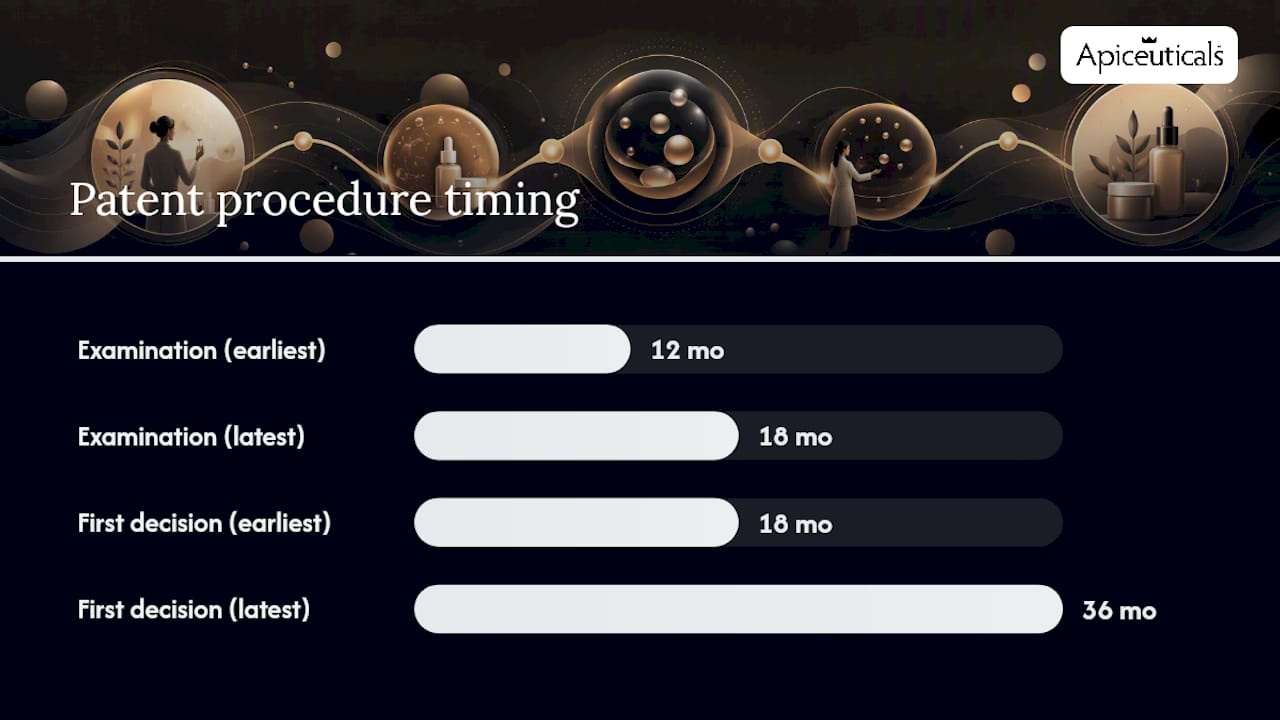
A founder-focused guide recommends working with patent counsel to assess novelty and market protection before filing, since a thorough prior-art search at the outset avoids costly prosecution later. The procedural timeline typically runs as follows: a priority application is filed, establishing the priority date; examination begins, often 12–18 months later; office actions (examiner objections) are addressed; and a grant or final rejection follows. Average pendency in many jurisdictions runs 18–36 months for a first decision. During that window, the application carries “patent pending” status, which signals an active claim but confers no enforceable rights until the patent is granted.
Key terms you will encounter in patent documents: claims define the legal scope; the specification describes the invention in full technical detail; the priority date is the date from which novelty is assessed; and prior art is any public disclosure that predates that date.
Patents versus trade secrets: when does secrecy make more sense?
Formulators often weigh patenting a new active or delivery system against keeping exact manufacturing parameters as trade secrets, and the choice is rarely obvious. Patents offer enforceable exclusivity and the ability to license, but they require full public disclosure and expire after a limited time period. Trade secrets offer potentially indefinite protection and require no disclosure, but they are lost the moment the information becomes public, whether through a leak, reverse engineering, or an employee departure.
The hybrid approach is common in advanced skincare science. A brand might patent the delivery system architecture, making the core innovation legally defensible, while keeping the specific manufacturing sequence, temperature profiles, and quality control thresholds as internal know-how. Patent disclosure enables others to design around claims; the undisclosed manufacturing controls are what prevent a technically compliant but practically inferior copy from performing at the same level.
When secrecy is preferable: if the manufacturing process is genuinely difficult to reverse-engineer and the commercial window is expected to exceed 20 years, a trade secret may preserve competitive advantage longer than a patent. When a patent makes more sense: if the technology is likely to be independently discovered by competitors, if licensing income is part of the business model, or if the brand needs to signal credibility to investors, a granted patent is the stronger instrument.
What do patents mean for you as a skincare consumer?
Understanding how patents affect the products you buy is practical knowledge, not just legal trivia. Here is what to watch for:
- Price and exclusivity window. During the patent term, the rights holder can price the technology at a premium because no direct equivalent is legally available. After expiry, other brands can formulate with the same approach, which typically brings prices down.
- “Patent pending” versus granted. “Patent pending” means an application has been filed but not yet approved. It signals intent, not confirmed protection. A granted patent number (e.g., US10,123,456 B2) is the verifiable claim.
- Patent does not equal clinical proof. A patent confirms novelty and inventive step; it does not confirm that the product works as marketed. Look for independent clinical studies or university validation alongside the patent.
- Expired patents and generic formulas. When a foundational patent expires, other brands can legally use the same composition or process. This is why some ingredient categories, once exclusive, become widely available across price points.
- Label language. “Inspired by patented technology” or “based on a patented process” may mean the product does not itself hold a patent. Ask for the patent number and verify it.
For beauty professionals evaluating supplier claims, using patent documents and scientific publications together is the most reliable method to validate formulation claims and clinical endpoints. A supplier who cannot provide a patent number or a peer-reviewed validation study is asking you to take the claim on faith.
How to read and verify a skincare patent claim
The process is more accessible than most consumers assume.
Start with the product’s marketing copy and identify any patent number listed. Numbers follow a standard format: a country code (US, EP, WO), a numeric string, and a kind code (B1, B2 for granted patents; A1, A2 for published applications). Take that number to Espacenet (the European Patent Office’s free database), Google Patents, or the USPTO and search directly.
Once you have the document, navigate to the claims section, not the abstract. The abstract summarizes; the claims define the legal scope. Independent claims (those that do not reference another claim) are the broadest and most commercially significant. Read claim 1 carefully: it tells you exactly what the patent protects.
Check the priority date and filing date. A patent filed in 2005 with a 20-year term may already have expired, meaning the technology is no longer exclusively protected. Confirm the grant status in the database.
Finally, look for cited prior art and any referenced clinical studies within the specification. If the brand also cites independent university validation, locate the original study and confirm the findings match the marketing claim.
Pro Tip: If a product claims to be “patented” but lists no patent number, ask the brand directly. A legitimate granted patent is a public document with a searchable number. If none is provided, treat the claim as unverified.
Two patent snapshots from the industry
Ceramide complex composition patent
One well-documented category of cosmetic patents covers ceramide formulation architecture. Composition claims in this space typically specify the molar ratio of ceramide NP to cholesterol to long-chain fatty acid required to reconstitute a lamellar lipid structure that mimics the skin’s natural barrier. The patent’s value lies not in the ceramides themselves, which are known ingredients, but in the precise structural relationship between components that produces measurable barrier restoration. Wearable skincare tech innovations increasingly incorporate such patented barrier-repair compositions into device-assisted delivery protocols, extending the commercial application of the underlying IP.
Encapsulated active delivery system
A second common patent category covers micro- or nano-encapsulation processes for active ingredients. Here, the claims typically protect the encapsulation method, including the polymer shell composition, particle size range, and release-trigger mechanism, rather than the active itself. The practical effect for consumers is a formula where the active ingredient remains stable until it contacts the skin surface, at which point the shell degrades and releases the compound. Process claims of this type are among the most commercially durable in cosmetics because the manufacturing parameters are difficult to replicate without the original know-how.
PROPOWAX™ Living Honeycomb: a verified example of patented antioxidant delivery
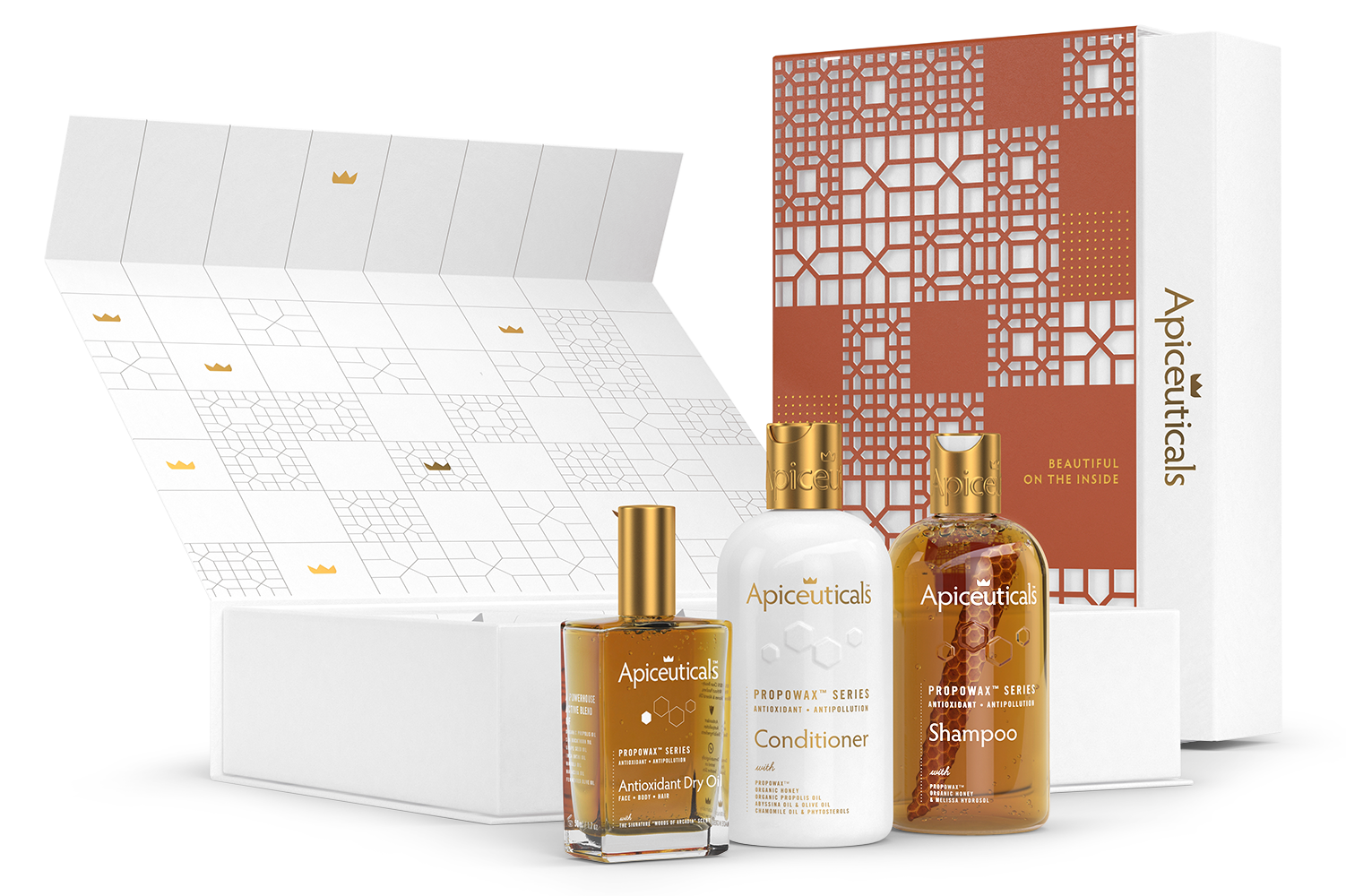
Apiceuticals’ PROPOWAX™ technology is a relevant and transparent example of patent skincare technology in practice, and as the publisher of this article, Apiceuticals discloses that PROPOWAX™ is its own patented technology.
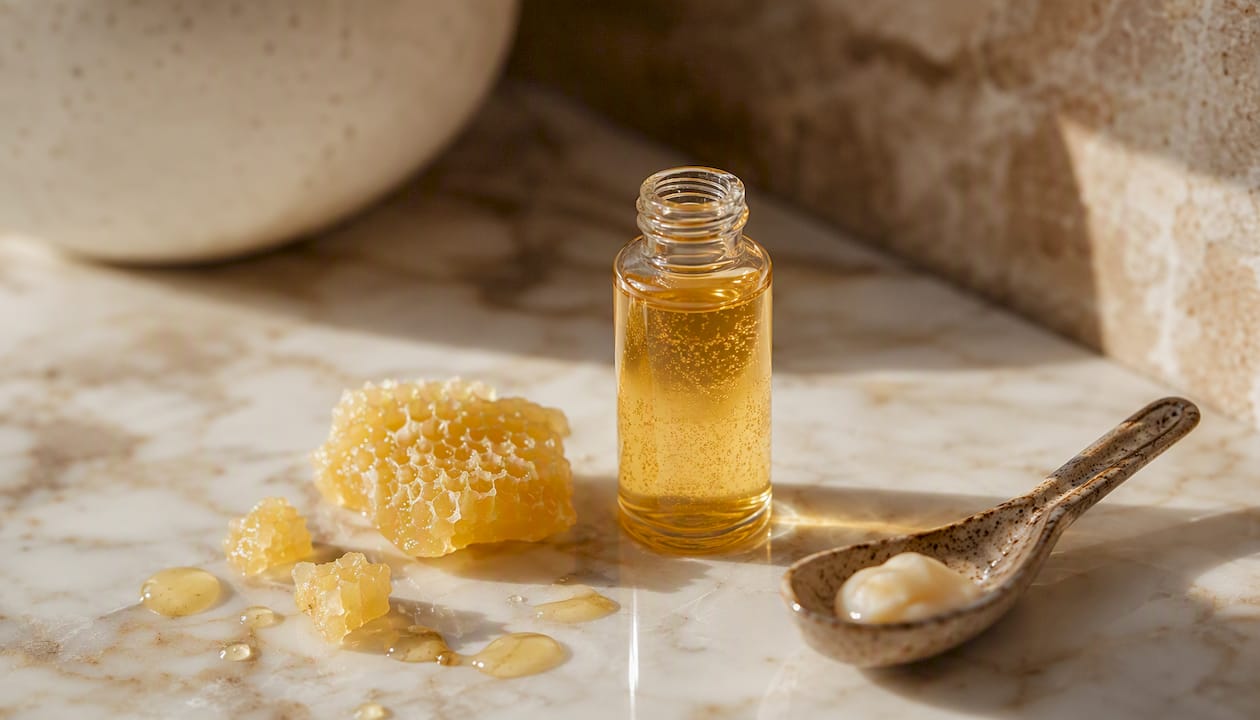
Technically, PROPOWAX™ functions as a Living Honeycomb matrix embedded within each product formulation. The matrix continuously releases antioxidants, including propolis-derived polyphenols, onto the skin, scalp, and hair rather than delivering a single dose at application. The architecture is the patent’s subject: the structural mechanism that governs sustained antioxidant release, not the propolis ingredient alone.
Key verified facts about PROPOWAX™:
- Apiceuticals holds a global patent for the highest antioxidant activity in cosmetics through this technology.
- The antioxidant activity claim was independently validated by the Aristotle University of Thessaloniki, one of Greece’s leading research institutions.
- British Vogue described Apiceuticals as “arguably the global leader in antioxidant activity.”
- The technology is used across the PROPOWAX™ Series (antioxidant haircare and bodycare) and the HONEY BALM™ Series, the latter with clinically documented 26% wrinkle reduction.
- All bee-derived inputs are organic and ethically harvested from over 1,000 beehives in Arcadia, Greece.
Independent academic validation is what separates a verified patent claim from a marketing assertion. For beauty professionals evaluating the role of science in beauty products, the combination of a granted patent and university-level validation represents the strongest available signal of formulation integrity.
A quick checklist for evaluating any “patented” skincare claim
Before accepting a patent claim at face value, run through these verification points:
- Patent number present? A real granted patent has a searchable number. No number means no verifiable claim.
- Jurisdiction confirmed? A US patent does not protect the invention in the EU. Check which offices granted protection.
- Filing and priority dates visible? These determine how much of the protection term remains.
- Grant status confirmed? Search Espacenet or Google Patents to confirm the patent is granted, not merely pending.
- Clinical or university validation cited? A patent confirms novelty; independent validation confirms efficacy.
- “Patent pending” versus granted? Pending status means the application is under examination. No enforceable rights exist yet.
To verify a number: enter it into Espacenet or Google Patents, navigate to the legal status tab, and confirm the grant date and current status. A search for “WO2020/XXXXXX” will show the international publication; national phase entries confirm where protection was actually granted.
Patents are a long-term science commitment, not a marketing shortcut
The beauty industry has a complicated relationship with the word “patented.” Brands use it as a trust signal, sometimes legitimately, sometimes as a veneer over incremental reformulations that barely clear the novelty threshold. What the best patent strategies share is a commitment to a specific, measurable scientific outcome, not just a novel ingredient combination.
From an editorial standpoint, the most durable patents in skincare are those built around a delivery architecture or a process claim, not a composition alone. Composition claims are vulnerable to design-around strategies; a competitor who changes one ratio or substitutes one excipient may escape the claim scope entirely. Process and use claims, particularly those tied to clinical endpoints, are harder to circumvent without sacrificing the performance that made the original patent worth filing.
For beauty professionals considering IP strategy, the advice is to align patent claims with clear clinical endpoints from the outset. A patent that claims “reduced transepidermal water loss” backed by a controlled study is commercially and legally stronger than one that claims a novel ingredient ratio with no performance data. The patent office grants novelty; the market rewards efficacy. The strongest formulations earn both.
Where to learn more about PROPOWAX™ and patented antioxidant delivery
Apiceuticals’ PROPOWAX™ technology page provides the full technical description of the Living Honeycomb delivery system, including the global patent status and the Aristotle University of Thessaloniki validation. The HONEY BALM™ Series and PROPOWAX™ Series products that use this technology are available directly through Apiceuticals’ antioxidant skincare range.

For readers interested in how patented delivery systems translate into measurable skin outcomes, the science of skin oxidation prevention page explains the antioxidant mechanism in accessible terms. All products are available for direct purchase at Apiceuticals.
Sources
- The patents behind your skincare routine
- PMC article
- Patent For Skincare in Cosmetic Industry – Am Badar
- When science meets beauty: The patent strategies behind cosmetic innovation in Indonesia | Asia IP
Patent citation format example: Roumeliotis, [Inventor Name]. Antioxidant Delivery System for Cosmetic Use. Patent No. [Number]. [Patent Office], [Year of Grant].
FAQ
Can you patent a skincare product?
Yes. Skincare products can be patented when the formula, delivery system, or manufacturing process meets the criteria of novelty, inventive step, and industrial applicability. The patent protects the specific invention, not the product category.
What does “patent pending” mean on a skincare label?
“Patent pending” means an application has been filed with a patent office but has not yet been granted. The brand has no enforceable rights during this period; the phrase signals intent, not confirmed protection.
How long does a skincare patent last?
Utility patents typically last up to 20 years from the filing date, as confirmed by industry guidance. After expiry, other brands can legally use the same composition or process.
Does a patent prove that a skincare product works?
No. A patent confirms that an invention is novel and non-obvious; it does not confirm clinical efficacy. Look for independent clinical studies or university validation alongside any patent claim. Apiceuticals’ PROPOWAX™, for example, holds a global patent and carries independent validation from the Aristotle University of Thessaloniki.
How do you verify a skincare patent claim?
Locate the patent number on the product or brand website, then search it on Espacenet, Google Patents, or the USPTO. Confirm the grant status, check the priority date to assess how much protection remains, and read the independent claims to understand exactly what is protected.
What is the difference between a patented formula and a trade secret in skincare?
A patented formula is publicly disclosed and legally enforceable for up to 20 years; a trade secret is kept confidential with no expiration but is lost if the information becomes public. Many brands use both: patenting the delivery architecture while keeping manufacturing parameters confidential.
Recommended


Related posts

How bees and biodiversity sustain each other, what the science says about Greece and the Aegean, and how antioxidant beauty can start from a hive...

How organic propolis extraction works, from hive to extract: collection, solvents, EU organic rules, Greek propolis phenolics and what it means for skincare.

Build an anti pollution skincare routine that fits Greek city life: what pollution does to skin, the morning and evening steps, and the antioxidants with...

Honey moisture content explained: the EU and Greek limits, how to take a refractometer reading, what excess water does to honey, and why it matters...

How antioxidant activity measurement works: DPPH, ABTS, FRAP and ORAC explained, why results differ, and what a lab number can and cannot say about skin...