
No products in the cart.
Return To Shop
What Is Skin Oxidation and How It Ages Your Skin
TL;DR:
- Skin oxidation occurs when free radicals damage skin cells faster than antioxidant defenses can handle, accelerating aging. External factors like UV rays, pollution, and blue light trigger ROS production, harming collagen, elastin, and cell membranes. Using sustained-release antioxidants like PROPOWAX™ and practicing sun safety help prevent ongoing oxidative damage to the skin.
Skin oxidation is defined as the biochemical imbalance where free radicals overwhelm the skin’s natural antioxidant defenses, triggering cellular damage that accelerates visible aging. This process, formally called oxidative stress, attacks collagen, elastin, and cell membranes simultaneously. UV radiation, environmental pollution, and lifestyle factors like smoking all drive reactive oxygen species (ROS) production deep within skin tissue. Understanding what is skin oxidation, and why it matters, is the first step toward building a defense that actually works. Apiceuticals’ PROPOWAX™ Living Honeycomb, which holds a global patent for highest antioxidant activity validated by the Aristotle University of Thessaloniki, represents one of the most rigorously tested responses to this challenge in modern skincare science.
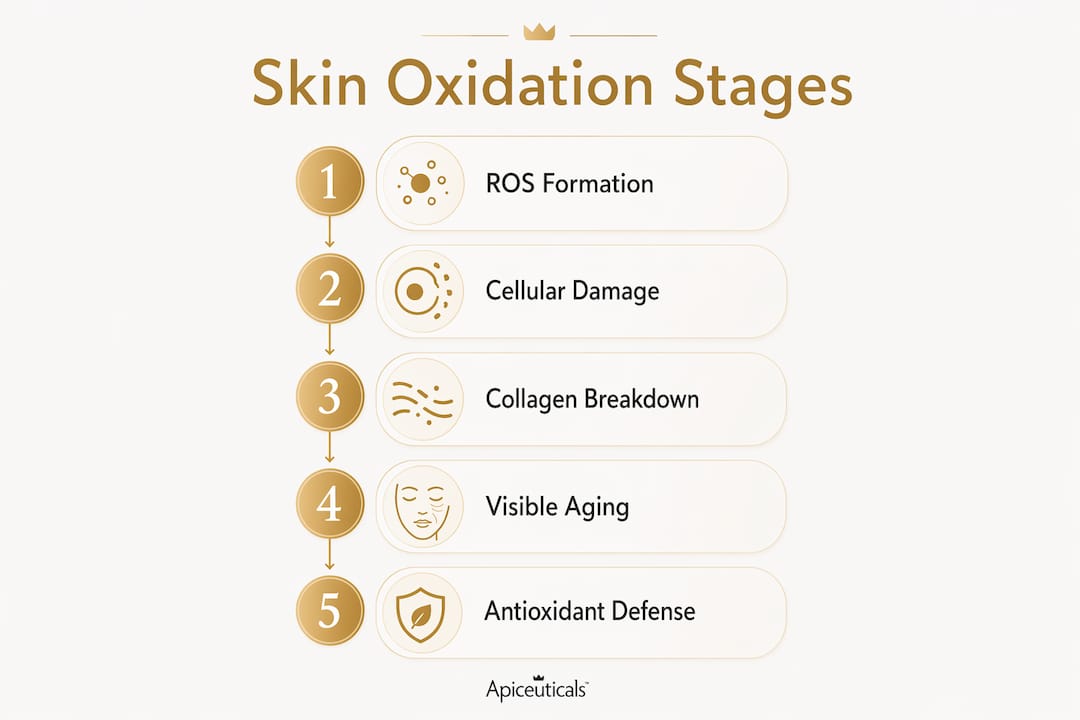
What is skin oxidation and how does it happen biochemically?
Skin oxidation begins inside the cell. Mitochondria generate ROS as a natural byproduct of cellular respiration, meaning a baseline level of oxidative activity is always present. The skin manages this through endogenous antioxidant enzymes: superoxide dismutase (SOD), catalase, and glutathione peroxidase. These enzymes neutralize ROS before they cause structural harm.
The problem intensifies with external triggers. UV radiation is the primary exogenous inducer of ROS in skin, increasing NADPH oxidase activity and superoxide anion production. That means even a short period of unprotected sun exposure measurably raises the oxidative burden on skin tissue.
The cascade that follows is where real damage accumulates. A single free radical can trigger a chain reaction causing extensive cellular destruction by stealing electrons from keratinocytes, fibroblasts, and extracellular matrix proteins. Think of it like rust spreading across metal: once the process starts, it self-propagates unless an antioxidant molecule interrupts the chain.
Pollution, cigarette smoke, and blue light from screens each add independent oxidative loads. They activate separate enzymatic pathways that generate additional ROS, compounding the burden. Once the skin’s antioxidant system is overwhelmed, the cascade amplifies exponentially and becomes increasingly difficult to halt.
The five primary triggers of exogenous skin oxidation are:
- UV radiation activating NADPH oxidase and generating superoxide anions
- Particulate air pollution depositing reactive compounds directly onto the skin surface
- Cigarette smoke introducing thousands of oxidizing chemicals through both direct contact and systemic circulation
- Blue light from digital screens penetrating the epidermis and generating ROS in dermal tissue
- Infrared radiation from heat sources, which penetrates deeper than UV and generates mitochondrial ROS
Pro Tip: Apply a broad-spectrum antioxidant serum before any screen-heavy workday, not just before outdoor activity. Blue light generates measurable ROS in skin tissue, and indoor exposure accumulates over hours.
What are the visible and cellular effects of oxidative stress on skin?
Oxidative stress on skin produces consequences at every structural level, from the cell membrane to the extracellular matrix. The most visible result is accelerated extrinsic aging, a process researchers now describe as “oxinflammaging,” where oxidative stress combined with chronic inflammation drives the majority of premature skin aging. This is not a gradual decline. It is an active, ongoing process that compounds daily without intervention.
The structural damage follows a predictable pattern:
- Collagen and elastin degradation: Free radicals oxidize the amino acid side chains in collagen fibers, reducing tensile strength and causing fine lines, wrinkles, and loss of firmness.
- Cell membrane damage: Lipid peroxidation disrupts the phospholipid bilayer of skin cells, impairing their ability to regulate hydration and nutrient exchange.
- Pigmentation changes: Oxidative damage triggers melanocyte dysregulation, producing uneven dark spots and hyperpigmentation.
- Barrier function impairment: Oxidative damage to tight junctions and the extracellular matrix reduces the skin’s ability to retain moisture, making even high-quality moisturizers less effective.
- Inflammatory pathway activation: ROS activate NF-κB signaling, a master switch for inflammatory gene expression, contributing to chronic skin conditions including rosacea and eczema.
The table below summarizes the key skin structures affected by oxidative stress and their functional consequences:
| Skin structure | Oxidative damage | Visible or functional result |
|---|---|---|
| Collagen fibers | Amino acid oxidation, cross-linking | Wrinkles, loss of firmness |
| Elastin network | Fragmentation by ROS | Sagging, reduced elasticity |
| Cell membranes | Lipid peroxidation | Impaired hydration, dull tone |
| Tight junctions | Structural disruption | Weakened skin barrier |
| Melanocytes | Dysregulated melanin production | Dark spots, uneven skin tone |
Skin damage from oxidation is cumulative. Each unprotected day adds to a deficit that topical repair alone cannot fully reverse. This is why prevention, not correction, is the clinically sound priority.
How do antioxidants protect skin from oxidative damage?
Antioxidants protect skin by donating electrons to free radicals, neutralizing them before they can initiate or continue the chain reaction of cellular damage. The skin relies on two layers of defense: endogenous enzymes produced within the body and exogenous antioxidants delivered through diet and topical application.
The endogenous layer, including SOD, catalase, and glutathione peroxidase, is effective but finite. Chronic environmental exposures exhaust these enzymes, and the skin cannot regenerate them fast enough to keep pace with modern pollution and UV loads. Topical antioxidants effectively refill these depleted reserves, maintaining the skin’s protective capacity when its own system falls short.
The most well-studied topical antioxidants include:
- Vitamin C (L-ascorbic acid): Neutralizes superoxide and hydroxyl radicals; also regenerates oxidized vitamin E.
- Vitamin E (tocopherol): A fat-soluble antioxidant that protects cell membranes from lipid peroxidation.
- Niacinamide: Reduces oxidative stress through NAD+ pathway support and has documented anti-inflammatory properties.
- Polyphenols: Plant-derived compounds with broad-spectrum radical-scavenging activity, including flavonoids and resveratrol.
- Propolis bioactives: Bee-derived polyphenols with high antioxidant potency, central to Apiceuticals’ formulation science.
Combining antioxidants with broad-spectrum sunscreen is the gold standard for preventing photoaging by reducing UV-induced ROS and DNA damage. Sunscreen blocks the initial photon absorption; antioxidants neutralize the ROS that still form despite that protection. Neither works as well alone.
Apiceuticals’ PROPOWAX™ Living Honeycomb operates on a different principle from conventional antioxidant serums. Rather than delivering a fixed dose of antioxidants at application, the PROPOWAX™ technology continuously releases antioxidants from a patented Living Honeycomb matrix embedded in each product. This sustained-release mechanism maintains antioxidant activity on the skin surface throughout the day, rather than peaking at application and declining within hours.
Dietary antioxidants also contribute meaningfully to skin defense. Foods rich in carotenoids, polyphenols, and vitamins C and E support the skin’s systemic antioxidant capacity. Hydration maintains the aqueous environment in which water-soluble antioxidants like vitamin C operate most effectively.
Pro Tip: Layer vitamin C serum under your sunscreen every morning. Vitamin C neutralizes the ROS that sunscreen cannot fully block, and the two together provide measurably stronger photoprotection than either alone.
What practical steps reduce skin oxidation every day?
Preventing skin oxidation requires a consistent, layered approach that addresses both external triggers and internal defenses. The most effective routines combine topical antioxidants, sun protection, and lifestyle modifications that reduce the total oxidative load on skin.
A science-backed daily protocol follows this structure:
- Morning cleanse: Use a gentle, pH-balanced cleanser that does not strip the skin’s acid mantle, which itself acts as a first-line barrier against oxidative insult.
- Antioxidant serum: Apply a vitamin C or polyphenol-rich serum to freshly cleansed skin. This is the most critical step for preventing skin oxidation before UV and pollution exposure begins.
- Broad-spectrum SPF: Apply a mineral or chemical sunscreen rated SPF 30 or higher. Reapply every two hours during outdoor activity.
- Barrier-supporting moisturizer: Choose formulations containing ceramides, hyaluronic acid, or niacinamide to repair tight junctions weakened by prior oxidative damage.
- Evening repair: Use products with higher concentrations of antioxidants and barrier-repair actives at night, when skin enters its natural regenerative cycle.
Lifestyle factors carry equal weight. Combining topical antioxidants with exposome management, including diet, pollution avoidance, and smoking cessation, produces the strongest reduction in oxidative skin aging. Smoking alone introduces thousands of oxidizing compounds into systemic circulation, accelerating collagen breakdown at a rate that topical products cannot fully offset.
Nutrition matters in concrete terms. A diet rich in colorful vegetables, berries, green tea, and omega-3 fatty acids provides the raw materials for both endogenous antioxidant enzyme production and systemic free radical neutralization. Adequate hydration supports the aqueous environment in which water-soluble antioxidants function. For those building an antioxidant-rich skincare routine, the dietary component is not optional. It is foundational.
Choosing products with scientifically validated antioxidant ingredients is the final filter. Not all antioxidant claims in skincare are equal. The PROPOWAX™ Living Honeycomb’s global patent for highest antioxidant activity, independently confirmed by the Aristotle University of Thessaloniki, sets a measurable benchmark against which other formulations can be evaluated.
Pro Tip: Store vitamin C serums in a cool, dark location. Ascorbic acid oxidizes rapidly when exposed to light and heat, turning the serum orange and rendering it ineffective before you finish the bottle.
Key Takeaways
Skin oxidation is a continuous, cumulative process that demands daily antioxidant defense rather than periodic repair.
| Point | Details |
|---|---|
| Definition of skin oxidation | Free radicals overwhelm antioxidant defenses, damaging collagen, elastin, and cell membranes. |
| Primary external trigger | UV radiation is the leading cause of ROS generation in skin tissue. |
| Antioxidant layering | Combining topical antioxidants with SPF provides stronger photoprotection than either alone. |
| Endogenous limits | The skin’s own antioxidant enzymes deplete under chronic exposure and need topical replenishment. |
| PROPOWAX™ advantage | Apiceuticals’ patented Living Honeycomb continuously releases antioxidants, sustaining protection throughout the day. |
Apiceuticals’ view on proactive antioxidant skin science
The skincare industry has spent decades focused on repair: retinoids for wrinkles already formed, brightening agents for spots already visible. Apiceuticals’ position, grounded in the science behind PROPOWAX™ Living Honeycomb, is that this approach addresses consequences rather than causes.
The concept of “oxinflammaging,” where oxidative stress and chronic low-grade inflammation drive extrinsic aging together, reframes the entire conversation. You cannot treat your way out of a process that is happening continuously. The only rational strategy is to maintain antioxidant saturation at the skin surface throughout the day, not just at the moment of product application.
This is why the sustained-release architecture of PROPOWAX™ matters scientifically, not commercially. A serum applied at 7 a.m. delivers its peak antioxidant concentration in the first hour. By midday, that protection has largely dissipated. A Living Honeycomb matrix that continuously releases antioxidants changes the pharmacokinetics of topical protection entirely.
Apiceuticals also believes that exposome management, the full picture of environmental inputs affecting skin, cannot be separated from product choice. The most potent antioxidant formula will underperform if the person using it smokes, eats a diet low in polyphenols, and spends hours under unfiltered blue light. Science-backed skincare and science-informed lifestyle choices are not alternatives. They are the same strategy.
— Apiceuticals
Apiceuticals’ antioxidant skincare for oxidative stress defense
Apiceuticals was built on a single scientific conviction: that antioxidant activity in skincare must be measurable, sustained, and clean. Every product in the PROPOWAX™ Series and HONEY BALM™ Series is formulated around the patented Living Honeycomb technology, which the Aristotle University of Thessaloniki validated for the highest antioxidant activity recorded in cosmetics.

The HONEY BALM™ Series delivers waterless facial care with clinically proven 26% wrinkle reduction, while the PROPOWAX™ Series extends antioxidant defense to hair, scalp, and body. All formulations exclude over 2,000 potentially harmful ingredients, are free from SLS, SLES, parabens, silicones, and mineral oils, and are dermatologically tested on sensitive skin with 0% irritation. For those ready to address skin oxidation effects at their biochemical root, Apiceuticals provides the science and the formulation to do it.
FAQ
What is skin oxidation in simple terms?
Skin oxidation is the process where unstable molecules called free radicals damage skin cells by stealing electrons, overwhelming the skin’s natural antioxidant defenses. The result is accelerated aging, including wrinkles, dark spots, and loss of firmness.
What causes oxidative stress on skin?
UV radiation is the primary external cause, followed by air pollution, cigarette smoke, blue light, and infrared radiation. Internal factors include cellular respiration byproducts and chronic inflammation.
How does skin oxidation affect collagen?
Free radicals oxidize the amino acid chains within collagen fibers, reducing their structural integrity. This leads directly to fine lines, wrinkles, and reduced skin firmness over time.
Can antioxidants reverse skin oxidation damage?
Antioxidants prevent further oxidative damage by neutralizing free radicals, but they cannot fully reverse structural changes like established wrinkles or deep pigmentation. Prevention is significantly more effective than correction.
How does PROPOWAX™ protect against skin oxidation?
PROPOWAX™ Living Honeycomb continuously releases antioxidants from a patented matrix embedded in each Apiceuticals product, maintaining protective antioxidant activity on the skin surface throughout the day rather than only at the moment of application.
What lifestyle changes reduce skin oxidation?
Avoiding smoking, limiting unprotected UV exposure, eating a diet rich in polyphenols and vitamins C and E, and staying hydrated all reduce the total oxidative load on skin and support the effectiveness of topical antioxidant products.
Recommended


Related posts

How bees and biodiversity sustain each other, what the science says about Greece and the Aegean, and how antioxidant beauty can start from a hive...

How organic propolis extraction works, from hive to extract: collection, solvents, EU organic rules, Greek propolis phenolics and what it means for skincare.

Build an anti pollution skincare routine that fits Greek city life: what pollution does to skin, the morning and evening steps, and the antioxidants with...

Honey moisture content explained: the EU and Greek limits, how to take a refractometer reading, what excess water does to honey, and why it matters...

How antioxidant activity measurement works: DPPH, ABTS, FRAP and ORAC explained, why results differ, and what a lab number can and cannot say about skin...















