
No products in the cart.
Return To Shop
Why Avoid Parabens: A Clean-Beauty Guide for Health-Conscious Shoppers
TL;DR:
- Parabens are synthetic preservatives linked to endocrine disruption and reproductive effects, with widespread human exposure. Reducing intake involves swapping leave-on products first and checking ingredient labels for “-paraben” terms. Innovative antioxidant systems like PROPOWAX™ offer a science-backed paraben-free formulation alternative.
The core reason to avoid parabens is precautionary: these synthetic preservatives mimic estrogen, and CDC/NHANES biomonitoring data show they are detectable in the urine of the vast majority of Americans, meaning chronic low-dose exposure is essentially universal. Animal and cellular studies link specific parabens to endocrine disruption and reproductive effects; human epidemiology shows associations that are concerning enough that the EU’s Scientific Committee on Consumer Safety (SCCS) has banned several long-chain variants. Brands like Apiceuticals have reformulated entirely around antioxidant-led preservation systems.
Three actions you can take right now:
- Read ingredient labels and look for any word ending in “-paraben” (methylparaben, butylparaben, propylparaben, and their relatives).
- Prioritize swapping leave-on products first: moisturizers, deodorants, and sunscreens deliver higher cumulative skin exposure than rinse-off formulas.
- Reduce the total number of daily products you use; fewer products means fewer simultaneous exposure sources.
This article walks through the evidence on parabens health risks, how exposure happens, what regulators have actually decided, the environmental picture, and how antioxidant-led formulations, including the PROPOWAX™ Living Honeycomb system, offer a scientifically validated alternative.
Table of Contents
- What Are Parabens and How Do You Spot Them on a Label?
- Where Are You Actually Being Exposed to Parabens?
- What Does the Science Say About Parabens Health Risks?
- How to Read Paraben Studies Without Being Misled
- What Regulators Have Actually Decided About Parabens
- Parabens in the Environment: What Happens After They Leave Your Bathroom
- How to Reduce Your Paraben Exposure Starting Today
- Safer Formulations: What Replaces Parabens and How PROPOWAX™ Fits In
- Key Takeaways
- The Paraben Debate Deserves More Nuance Than It Gets
- Paraben-Free, Antioxidant-Preserved: Apiceuticals’ Formulation Commitment
- Useful Sources
- FAQ
What Are Parabens and How Do You Spot Them on a Label?
Parabens are p-hydroxybenzoate esters, a class of synthetic preservatives that have been used in personal care products since the 1920s. Their function is straightforward: they inhibit the growth of bacteria, yeast, and mold, extending a product’s shelf life and protecting consumers from microbial contamination. That preservative efficacy is real and was, for decades, considered sufficient justification for their widespread use.
The chemical family includes several members with meaningfully different risk profiles. Longer side-chain parabens generally show stronger estrogenic activity than shorter-chain ones. The names to recognize on an ingredient panel are:
- Methylparaben and ethylparaben (shorter chain, lower estrogenic potency)
- Propylparaben and butylparaben (medium chain, more potent estrogenic activity)
- Isopropylparaben, isobutylparaben, and benzylparaben (longer/branched chain, highest concern)
On packaging, these appear under their INCI (International Nomenclature of Cosmetic Ingredients) names, which always end in “-paraben.” A product listing “methylparaben, propylparaben” near the end of its ingredient panel is using a paraben blend, a common formulation strategy. Learning to identify natural ingredients in skincare is the fastest way to build this label-reading habit.
Where Are You Actually Being Exposed to Parabens?
Parabens appear across a wider range of product categories than most people realize. Skincare, body lotions, deodorants, shampoos, conditioners, sunscreens, and cosmetics are the primary sources, but parabens also appear in some processed foods, pharmaceuticals, and paper products such as baby wipes.
The exposure routes matter as much as the sources. Skin absorption is the dominant pathway for personal care products, and it is not trivial: parabens penetrate the stratum corneum and enter systemic circulation. Accidental ingestion from lip products adds a secondary route. The most underappreciated factor, though, is cumulative exposure from stacking multiple products in a single daily routine. Someone applying a paraben-containing moisturizer, sunscreen, shampoo, conditioner, and deodorant every day is not experiencing five separate low-dose exposures; they are experiencing one continuous, overlapping burden.
Propylparaben has been detected in over 90% of Americans tested in NHANES biomonitoring studies, with butylparaben found in roughly 50%. Those figures reflect routine daily exposure, not unusual or occupational contact. Leave-on products (moisturizers, deodorants, sunscreens) contribute more than rinse-off products (shampoos, body wash) because contact time with skin is longer. Oral care products are another overlooked category; paraben-free oral formulations are increasingly available for those reducing exposure across all product types.
What Does the Science Say About Parabens Health Risks?
Parabens show estrogenic activity in laboratory and animal studies. That is not disputed. What remains debated is the magnitude of effect at real-world human exposure levels, and whether associations seen in epidemiological studies reflect causation or confounding.
The mechanistic evidence is the strongest part of the case. Parabens bind to estrogen receptors and activate estrogen-responsive genes, a property confirmed across multiple in vitro systems. At the reproductive level, butylparaben has been associated with reduced sperm concentration and motility, while propylparaben has been linked to altered follicle-stimulating hormone (FSH) concentrations in human studies. On the female side, associations between urinary paraben levels and fertility metrics have been reported in peer-reviewed literature, though effect sizes vary.
The cancer-related signals are more preliminary but biologically plausible. Laboratory work has demonstrated that low doses of certain parabens can activate growth-signaling pathways in breast cancer cell lines, suggesting a mechanism for carcinogenesis even if population-level causal proof is absent. A peer-reviewed toxicology review describes parabens as a double-edged sword: effective preservatives with documented toxicological risk, environmental persistence, and associations with reproductive and developmental harm.
Skin effects add another dimension. Research published in ScienceDirect shows parabens can disrupt the skin surface microbiome and compromise barrier function, producing effects that go beyond systemic endocrine concerns: rosacea flares, unexpected oiliness, and localized peeling are among the dermatological signals observed. Longer side-chain parabens tend to produce stronger sensitization responses, which is one reason the EU acted first on isobutyl- and isopropylparaben.
How to Read Paraben Studies Without Being Misled
Study design is the single biggest source of confusion in the paraben debate. In vitro work (cells in a dish) can demonstrate estrogenic activity at concentrations that may never occur in human tissue. Animal studies use doses and exposure routes that often do not reflect a person’s daily routine. Human epidemiology is the most relevant design, but it is also the most difficult to conduct cleanly because people are simultaneously exposed to dozens of endocrine-disrupting chemicals (EDCs).
A Springer toxicology review makes the key methodological point: inconsistent findings across the literature are largely explained by differences in dose, species, and exposure timing, not by genuine scientific disagreement about whether parabens have biological activity. The review recommends framing public-health attention around cumulative, chronic exposure to multiple EDCs rather than single-chemical assessments at isolated doses.
Biomonitoring data, particularly urinary paraben measurements, are the most practical window into real-world exposure. Parabens have a short half-life and are rapidly metabolized, which means a single urine sample reflects recent exposure rather than long-term accumulation. That short half-life is actually reassuring: urinary paraben concentrations can decline substantially within 72 hours after removing exposure sources. Intervention studies have confirmed this. The HERMOSA study and similar designs observed decreases of roughly 40–45% in urinary propylparaben within three days after participants switched to paraben-free personal care products.
| Study Design | Strength | Key Limitation |
|---|---|---|
| In vitro (cell studies) | Identifies mechanisms clearly | Doses often exceed real-world levels |
| Animal in vivo | Controlled exposure, whole organism | Species differences limit human extrapolation |
| Human epidemiology | Most relevant to consumer risk | Confounding from co-exposures; observational only |
| Intervention/biomonitoring | Directly measures human exposure change | Short window; reflects recent, not chronic, burden |
Pro Tip: When a headline claims parabens are “safe” or “definitively harmful,” check which study design it cites. Human epidemiology that controls for co-exposures and uses cumulative-exposure framing carries more weight for consumer decisions than a single in vitro result at an extreme dose.
What Regulators Have Actually Decided About Parabens
No major regulatory body has issued a blanket ban on all parabens, but the regulatory picture is not static. The EU SCCS has taken the most decisive action: it banned isopropylparaben and isobutylparaben in cosmetics and has restricted propyl- and butylparaben in products for children under three. The EU’s citizen-facing guidance acknowledges that experimental animal studies show estrogenic effects and that the SCCS has repeatedly reviewed the data.
The FDA’s current position is that available data do not demonstrate a risk to human health from parabens at concentrations used in cosmetics, but the agency acknowledges the science is evolving and has not declared them definitively safe. The Cosmetic Ingredient Review (CIR) has similarly assessed shorter-chain parabens as safe at current use levels while flagging the need for ongoing monitoring.
| Authority | Status / Restriction | What This Means for Consumers |
|---|---|---|
| EU SCCS | Banned isopropyl- and isobutylparaben; restricted propyl/butyl in children’s products | Strongest regulatory action; EU products reformulated |
| FDA (U.S.) | No ban; monitoring ongoing | U.S. products may still contain all paraben types |
| Cosmetic Ingredient Review | Shorter-chain parabens assessed safe at current levels | Industry self-regulatory body; not a government agency |
| ASEAN / national retailers | Phased restrictions; Whole Foods, CVS, Target announced phaseouts | Market-driven removal accelerating paraben-free options |
The retail-level response is worth noting separately. Major U.S. retailers including Whole Foods, CVS, and Target have announced restrictions or phaseouts for certain parabens in private-label and stocked products, reflecting consumer demand rather than regulatory compulsion.
Parabens in the Environment: What Happens After They Leave Your Bathroom
Parabens do not disappear when they wash down the drain. They have been detected in surface water, sediment, and aquatic organisms, raising concerns about ecotoxicity and bioaccumulation in some species. The environmental impact of cosmetic ingredients extends well beyond the individual consumer.
The more technically alarming finding involves transformation products. In aquatic environments, parabens can react with chlorine and other oxidants to form halogenated by-products. Research shows these halogenated derivatives can be more cytotoxic than the parent parabens, inhibiting keratinocyte proliferation at low micromolar concentrations and impairing wound healing in laboratory models. The environmental chemistry, in other words, can produce something more dangerous than the original compound.
Key environmental concerns:
- Detection in rivers, coastal waters, and drinking water treatment systems globally
- Aquatic toxicity and potential bioaccumulation in fish and invertebrates
- Formation of halogenated by-products with higher cytotoxic potential than parent compounds
- Re-entry into human exposure via water and food chains, creating a secondary exposure loop beyond personal care products
How to Reduce Your Paraben Exposure Starting Today
Reducing paraben exposure does not require discarding every product you own. A targeted, prioritized approach produces measurable results quickly, given the short half-life of these compounds.
- Audit your leave-on products first. Moisturizers, body lotions, deodorants, and sunscreens have the highest skin-contact time and therefore the greatest absorption potential. These are the highest-priority swaps.
- Read every ingredient panel. Any word ending in “-paraben” is a paraben. Common INCI names to look for: methylparaben, ethylparaben, propylparaben, butylparaben, isopropylparaben, isobutylparaben.
- Reduce total product count. Simplifying your routine from ten products to five cuts cumulative exposure roughly in half, even before you switch any individual product.
- Check rinse-off products second. Shampoos, conditioners, and body washes contribute less than leave-ons but still add to daily load. Paraben-free versions are widely available.
- Look beyond skincare. Parabens appear in some makeup, lip products, and baby wipes. Lip products warrant particular attention because of the ingestion route.
- Expect rapid results. Intervention studies show urinary propylparaben levels can fall significantly within three days of switching products. The biology works in your favor.
Paraben-free labeling has become more reliable as major retailers have introduced phaseout policies, but “paraben-free” on a front label does not guarantee the absence of other endocrine-disrupting preservatives. Reading the full ingredient list remains the only reliable verification.
Safer Formulations: What Replaces Parabens and How PROPOWAX™ Fits In
The preservative challenge is real. Removing parabens does not automatically make a product safer; it creates a formulation gap that must be filled with something. The quality of what fills that gap varies considerably across the industry.
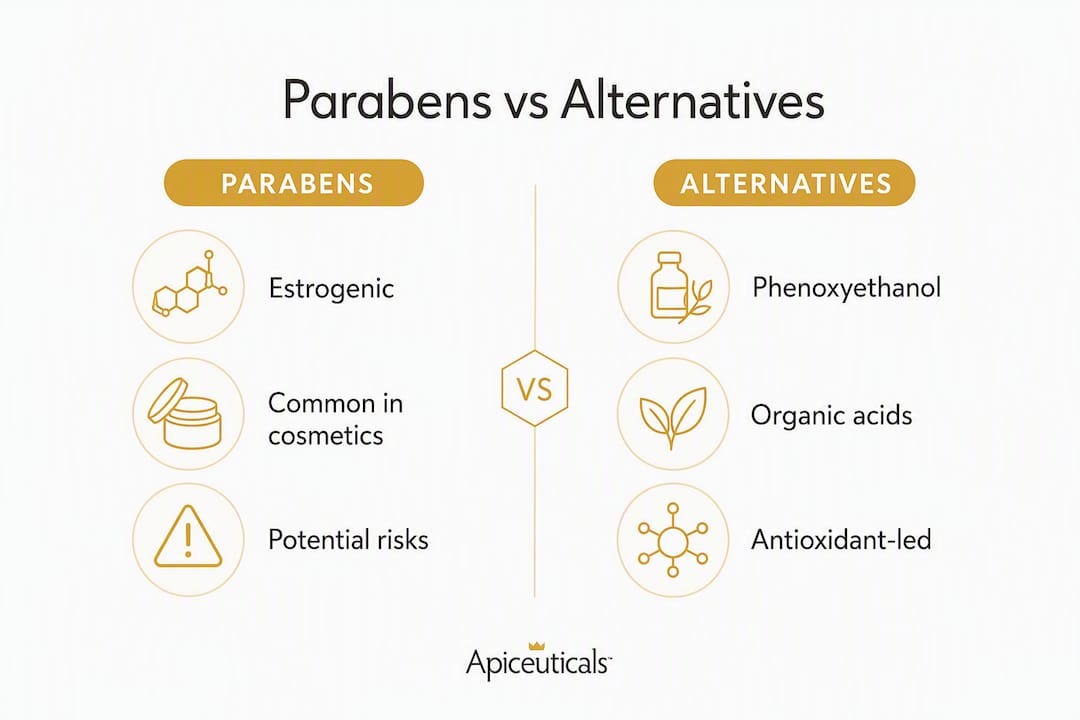
Commonly used paraben alternatives include phenoxyethanol, benzyl alcohol blends, organic acids (sorbic acid, benzoic acid), and combinations of chelating agents with low-level antimicrobials. These systems work, but they carry their own safety debates: phenoxyethanol, for example, has been flagged by the EU SCCS as potentially harmful in products applied to the face of infants. No single replacement is universally uncontroversial.
The more scientifically interesting direction is multi-hurdle preservation combined with antioxidant-led formulation strategies. Waterless formats remove the aqueous environment that bacteria and mold require to proliferate, dramatically reducing the preservative burden. Antioxidant delivery systems add a second layer of product stability by neutralizing oxidative degradation, which is a distinct but complementary mechanism to antimicrobial preservation.
Formulators and dermatological experts increasingly view antioxidant-led preservation, validated by independent labs and university partners, as a promising strategy to protect product integrity without relying on controversial synthetic preservatives. Apiceuticals’ PROPOWAX™ technology is a working example of this approach: a patented Living Honeycomb system that continuously releases antioxidants onto skin, scalp, and hair, validated by the Aristotle University of Thessaloniki and holder of a global patent for the highest antioxidant activity in cosmetics. The system operates on the principle that robust antioxidant activity stabilizes both the product and the skin’s own oxidative environment, reducing the need for synthetic preservative chemistry. Understanding the best antioxidants for skin helps contextualize why this approach represents a genuine advance rather than a marketing repositioning.
Pro Tip: When evaluating a brand’s “paraben-free” claim, ask specifically about their preservative system and whether it has undergone independent microbiological challenge testing. A brand that can cite a named testing institution is making a verifiable claim; one that cannot is making a marketing claim.
Key Takeaways
Parabens are synthetic preservatives with documented estrogenic activity, detected in the urine of over 90% of Americans tested, and linked in animal and human studies to reproductive effects and endocrine disruption, with urinary levels of propylparaben falling by roughly 40–45% within three days of switching to paraben-free products.
| Point | Details |
|---|---|
| Primary health concern | Parabens mimic estrogen and are linked to reproductive effects and endocrine disruption in animal and human studies. |
| Ubiquity of exposure | Propylparaben is detectable in over 90% of Americans tested; daily product stacking creates a continuous internal burden. |
| Evidence strength | Animal and in vitro evidence is strong; human epidemiology shows associations, not definitive causation, with cumulative exposure as the key risk driver. |
| Practical reduction steps | Swap leave-on products first; urinary paraben levels can drop roughly 40–45% within three days of switching. |
| Apiceuticals’ approach | Apiceuticals formulates without parabens, using the PROPOWAX™ Living Honeycomb antioxidant system, validated by the Aristotle University of Thessaloniki, as a science-backed alternative. |
The Paraben Debate Deserves More Nuance Than It Gets
The conversation around why parabens are avoided tends to collapse into two unhelpful camps: dismissal (“the dose makes the poison; they’re safe”) and alarm (“they cause cancer”). Neither framing serves a health-conscious consumer well.
The honest scientific position is this: parabens are biologically active at concentrations relevant to human exposure, the evidence for reproductive effects in animal models is consistent, and the human epidemiology is suggestive enough that a precautionary reduction in exposure is a rational choice, not a paranoid one. The EU SCCS did not ban long-chain parabens on a whim; it did so after repeated reviews of accumulating evidence. That regulatory action is itself a data point.
What the debate often misses is the formulation opportunity. The question is not only “are parabens harmful?” but “what does a well-preserved, biologically compatible product actually look like?” Antioxidant-led preservation, particularly in waterless formats, answers that question with chemistry rather than compromise. Apiceuticals’ PROPOWAX™ Living Honeycomb patent, independently validated by the Aristotle University of Thessaloniki, demonstrates that the highest antioxidant activity in cosmetics is achievable without synthetic preservative chemistry. For consumers who want to understand the role of innovation in skincare, this is where the most credible science is pointing.
Paraben-Free, Antioxidant-Preserved: Apiceuticals’ Formulation Commitment
Every Apiceuticals product is formulated without parabens, SLS, SLES, silicones, and mineral oils, excluding over 2,000 potentially harmful ingredients across its full range. The brand’s paraben-free commitment is not a label claim; it is built into the formulation architecture through the PROPOWAX™ Living Honeycomb system, which holds a global patent for the highest antioxidant activity in cosmetics, independently validated by the Aristotle University of Thessaloniki.

The product range covers the categories where paraben exposure is highest: antioxidant haircare and bodycare through the PROPOWAX™ Series, waterless facial care through the HONEY BALM™ Series with clinically proven 26% wrinkle reduction, and an antioxidant body lotion formulated for daily leave-on use. All bee ingredients are organic and ethically harvested from over 1,000 beehives in Arcadia, Greece, with 0% irritation in dermatological testing on sensitive skin.
If you are ready to replace paraben-containing leave-on products with formulations backed by independent university validation, explore the full Apiceuticals antioxidant skincare range and find the products that fit your daily routine.
Useful Sources
The following sources were used in preparing this article and are recommended for readers who want to examine the primary evidence directly.
- EWG: What Are Parabens, and Why Don’t They Belong in Cosmetics? — Covers biomonitoring data, reproductive findings, and regulatory summaries in accessible language.
- Cleveland Clinic: What You Should Know About Parabens — Clinical overview including metabolism, half-life, and practical exposure-reduction guidance.
- PubMed: Parabens as the Double-Edged Sword — Peer-reviewed mechanistic review covering toxicology, environmental detection, and reproductive associations.
- FDA: Parabens in Cosmetics — U.S. regulatory position and current safety assessment status.
- CDC Biomonitoring: Parabens Fact Sheet — NHANES biomonitoring data on paraben detection rates in the U.S. population.
| Source Type | Best Used For |
|---|---|
| EWG explainer | Consumer-facing summary of reproductive and biomonitoring findings |
| Cleveland Clinic | Clinical metabolism data and practical reduction advice |
| PubMed peer-reviewed review | Mechanistic toxicology and environmental evidence |
| Springer toxicology review | Study-design methodology and cumulative-exposure framing |
| FDA page | Current U.S. regulatory stance and safety assessment updates |
FAQ
Why are parabens so bad for you?
Parabens mimic estrogen and can disrupt hormonal systems; animal studies link butylparaben to reduced sperm concentration and propylparaben to altered FSH levels, while cellular research shows low doses can activate growth-signaling pathways in breast cancer cell lines. Human epidemiology shows associations rather than definitive causation, but the breadth of evidence supports a precautionary approach.
Which is worse, parabens or sulfates?
They pose different risks: parabens are endocrine disruptors with reproductive and hormonal concerns, while sulfates (SLS/SLES) are primarily irritants that can compromise skin barrier function. For health-conscious consumers concerned about systemic effects, parabens carry the more significant toxicological profile based on current evidence.
Is it better to buy paraben-free products?
For leave-on products such as moisturizers, deodorants, and sunscreens, choosing paraben-free formulations is a practical, evidence-supported step; intervention studies show urinary paraben levels can drop roughly 40–45% within three days of switching. The key is verifying that the replacement preservative system has also been independently tested.
Does avoiding parabens make a measurable difference in the body?
Yes. Because parabens are rapidly metabolized, urinary concentrations of propylparaben can decline by roughly 40–45% within 72 hours after removing exposure sources, as confirmed by the Cleveland Clinic and multiple intervention studies. The short half-life means the body responds quickly to behavioral changes.
Are all parabens equally harmful?
No. Longer side-chain parabens (butylparaben, isobutylparaben, isopropylparaben) show stronger estrogenic activity than shorter-chain variants like methylparaben and ethylparaben. The EU SCCS banned isopropyl- and isobutylparaben specifically on this basis, while shorter-chain parabens remain permitted at restricted concentrations.
What do paraben-free products use instead?
Common alternatives include phenoxyethanol, benzyl alcohol blends, organic acids, and waterless formulations that reduce the need for preservatives altogether. Antioxidant-led systems, such as Apiceuticals’ patented PROPOWAX™ Living Honeycomb, represent a scientifically validated approach that stabilizes products through continuous antioxidant release rather than synthetic antimicrobial chemistry.
Recommended


Related posts

How bees and biodiversity sustain each other, what the science says about Greece and the Aegean, and how antioxidant beauty can start from a hive...

How organic propolis extraction works, from hive to extract: collection, solvents, EU organic rules, Greek propolis phenolics and what it means for skincare.

Build an anti pollution skincare routine that fits Greek city life: what pollution does to skin, the morning and evening steps, and the antioxidants with...

Honey moisture content explained: the EU and Greek limits, how to take a refractometer reading, what excess water does to honey, and why it matters...

How antioxidant activity measurement works: DPPH, ABTS, FRAP and ORAC explained, why results differ, and what a lab number can and cannot say about skin...















