
No products in the cart.
Return To Shop
Why Probiotics in Skincare Actually Change Your Skin
TL;DR:
- Probiotics in skincare, including live microorganisms and postbiotics, aim to restore microbial balance and improve skin health. Clinical evidence most strongly supports their use for acne reduction, with strain-specific formulations and antioxidant synergy enhancing effectiveness. Due to regulatory gaps, consumers should prioritize products with documented strains and clinical data for safe, evidence-based skincare benefits.
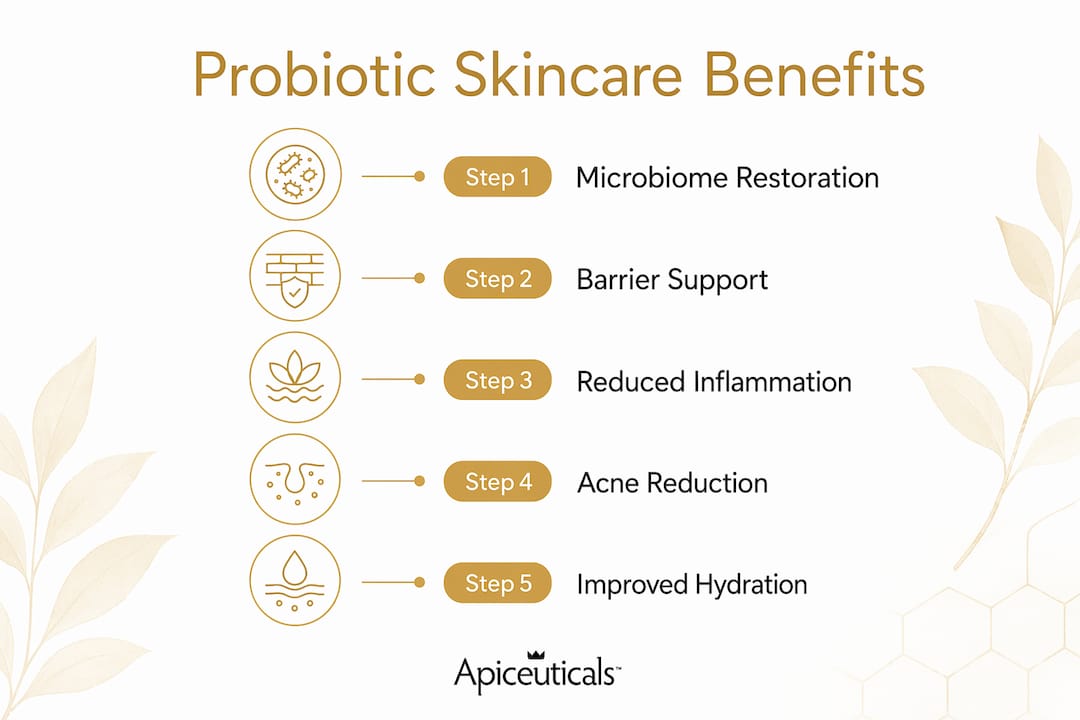
Probiotics in skincare are defined as live microorganisms that, when applied topically or ingested in adequate amounts, confer measurable benefits to skin health by restoring microbial balance, modulating immune responses, and reinforcing the skin barrier. The scientific term for this field is microbiome-targeted dermatology, and it represents one of the most evidence-driven shifts in modern beauty science. Understanding why probiotics in skincare matter requires moving beyond marketing language and into the biology of the skin’s living ecosystem. At Apiceuticals, the intersection of antioxidant science and microbiome health is where formulation decisions are made, with PROPOWAX™ Living Honeycomb serving as a validated reference point for how bioactive ingredients can work synergistically with the skin’s own defenses.
Why probiotics in skincare are backed by clinical science
The strongest clinical evidence for probiotic skincare currently centers on acne vulgaris. A 2026 systematic review of 33 studies found that probiotics produce a pooled lesion reduction of 45.2%, with inflammatory lesions reduced by over 60%. That figure places probiotics ahead of many adjunctive therapies in terms of measurable impact on active breakouts.
The same review confirmed that multistrain probiotic formulations can reduce lesion counts while simultaneously improving barrier hydration, a dual benefit that distinguishes them from single-mechanism treatments. This matters because acne and barrier dysfunction frequently coexist, and addressing both simultaneously accelerates visible improvement.
Beyond acne, the evidence becomes more nuanced. A placebo-controlled pilot study on topical Lactobacillus lactis lysate cream found no significant improvement in atopic dermatitis severity, transepidermal water loss, or quality-of-life metrics. The study was small and short in duration, but it illustrates a critical point: probiotic benefits are not universal across skin conditions.
- Probiotics show the strongest evidence in acne support, with both topical and oral formats producing meaningful lesion reductions.
- Barrier hydration improvement has been documented in acne patients using multistrain capsules.
- Atopic dermatitis results remain inconsistent, with some trials showing tolerability but no significant clinical change.
- Adverse event profiles across studies are mild, supporting the general safety of probiotic skincare.
The safety record is worth noting. Across the 33 studies reviewed in 2026, adverse events were mild and infrequent, which means the risk profile for incorporating probiotics into a skincare routine is low even when efficacy remains uncertain for a given condition.
Pro Tip: When evaluating a probiotic skincare product, look for the specific strain name on the label, such as Lactobacillus rhamnosus GG or Bifidobacterium longum. A product listing only “probiotic complex” without strain identification cannot be assessed for clinical relevance.
How topical probiotics, postbiotics, and lysates differ
Not all probiotic skincare products work through the same mechanism, and the distinctions among live probiotics, postbiotics, and lysates determine both their efficacy and their shelf stability. The ISAPP 2026 consensus defines probiotics strictly as live microorganisms that confer benefits when administered in adequate amounts. Postbiotics, by contrast, are preparations of inanimate microorganisms or their components that still confer health benefits. Lysates and ferments occupy a third category: processed microbial materials that retain bioactive compounds without any living cells.
| Category | Composition | Stability | Primary mechanism |
|---|---|---|---|
| Live probiotics | Viable microorganisms | Requires careful preservation | Colonization, competitive exclusion, immune modulation |
| Postbiotics | Heat-killed bacteria or cell fragments | High, suitable for topical use | Anti-inflammatory, antioxidative, barrier support |
| Lysates/ferments | Processed microbial extracts | High, formulation-flexible | Bioactive metabolite delivery, skin conditioning |
A 12-week randomized controlled trial on heat-killed Lactobacillus acidophilus IDCC 3302 found the postbiotic safe and well tolerated, with a modest exploratory improvement in skin elasticity. No significant wrinkle reduction was observed, but the researchers noted that longer, adequately powered studies are needed before conclusions can be drawn. This is the honest state of postbiotic science: promising mechanistically, still maturing clinically.
The formulation challenge for live probiotics in topical products is significant. Maintaining viability through manufacturing, packaging, and shelf life requires technical precision that many products on the market do not achieve. Postbiotics and lysates sidestep this problem entirely, which is one reason they are increasingly favored in probiotic skincare formulations. Their antioxidative and anti-inflammatory effects are linked to skin homeostasis through multiple protective pathways, making them scientifically credible even without live cell activity.
Pro Tip: Postbiotics and lysates are generally more stable in cream and serum formats than live probiotics. If a product does not specify refrigeration or use a specialized delivery system, it likely contains postbiotics or ferments rather than viable organisms.
What role does the skin microbiome play in skin health?
The skin microbiome is a community of bacteria, fungi, viruses, and archaea that colonizes the skin’s surface and follicular structures, functioning as a biological shield against pathogens and environmental insults. Think of it as a living security system: when the microbial community is balanced, the skin barrier remains intact, inflammation stays low, and immune responses are calibrated. When that balance is disrupted, a state called dysbiosis, the consequences are visible.
Dysbiosis is directly associated with acne, rosacea, eczema, and accelerated barrier breakdown. In acne, an overgrowth of Cutibacterium acnes in an oxygen-poor follicular environment triggers inflammatory cascades that produce the characteristic lesions. In atopic dermatitis, a reduction in microbial diversity and an overrepresentation of Staphylococcus aureus correlates with flare severity. The skin microbiome’s role in barrier protein expression and bioactive metabolite production means that restoring microbial balance has downstream effects on hydration, elasticity, and inflammatory tone.
Probiotics influence this ecosystem through several mechanisms:
- Competitive exclusion: Beneficial strains occupy receptor sites that pathogenic bacteria would otherwise colonize.
- Antimicrobial peptide production: Commensal bacteria stimulate the skin to produce defensins and other antimicrobials that suppress pathogens.
- Immune modulation: Probiotic-derived signals interact with toll-like receptors in the skin, calibrating inflammatory responses without suppressing immunity.
- Barrier protein upregulation: Certain strains stimulate the expression of filaggrin and ceramide-related proteins, directly strengthening the stratum corneum.
Antioxidant activity intersects with microbiome health in a meaningful way. Oxidative stress damages the skin barrier and creates an environment that favors pathogenic over commensal bacteria. PROPOWAX™ Living Honeycomb, Apiceuticals’ patented technology validated by the Aristotle University of Thessaloniki for the highest antioxidant activity in cosmetics, addresses this oxidative dimension by continuously releasing antioxidants onto the skin. Reducing oxidative burden supports the conditions under which a healthy microbiome can thrive. The PROPOWAX™ technology represents a scientifically grounded approach to the antioxidant-microbiome connection.
How to incorporate probiotics into your skincare routine effectively
Incorporating probiotic skincare products effectively requires more than selecting a product with the word “probiotic” on the label. The strain-specific and dose-dependent nature of probiotic benefits means that product selection must be grounded in the clinical evidence available for the specific strain and format being used.
- Identify the strain and category. Confirm whether the product contains live organisms, postbiotics, or lysates. Check for a named strain with published clinical data. Products without this information cannot be evaluated for efficacy.
- Layer probiotics at the correct step. Apply probiotic serums after cleansing and before heavier moisturizers. This preserves the bioactive integrity of the ingredient and allows it to interact with the skin surface before occlusive layers reduce absorption.
- Avoid pairing with high-concentration acids immediately. Low-pH exfoliants can compromise the viability of live probiotic strains and may denature lysate proteins. Use acid exfoliants on alternate evenings if you are using live-culture products.
- Combine with antioxidant ingredients for synergistic benefit. Oxidative stress undermines the conditions that allow probiotics to function. Pairing probiotic products with antioxidant-rich formulations, such as those built around organic bee science, addresses both the microbial and oxidative dimensions of skin health simultaneously.
- Set realistic timelines. Clinical studies showing meaningful lesion reduction in acne run for 8 to 12 weeks. Expect gradual, cumulative improvement rather than rapid transformation.
The regulatory context adds another layer of consumer responsibility. The FDA currently lacks specific regulations for probiotics and postbiotics in cosmetics, meaning companies are not required to disclose premarket safety or efficacy testing. This places the burden of evaluation on the consumer and underscores the importance of choosing products backed by published clinical evidence rather than marketing claims alone. A useful starting point is understanding what clinical testing actually means in the context of skincare validation.
Pro Tip: When building a routine that includes both probiotic and antioxidant products, apply the probiotic serum first to allow microbiome-modulating activity at the skin surface, then follow with an antioxidant-rich moisturizer to protect the barrier and reduce oxidative stress.
Key takeaways
Probiotic skincare delivers its most evidence-backed benefits through strain-specific formulations that restore microbial balance, reduce inflammatory lesions, and strengthen the skin barrier, with antioxidant synergy amplifying these effects.
| Point | Details |
|---|---|
| Strongest evidence is in acne | A 2026 systematic review of 33 studies found over 60% reduction in inflammatory lesions with probiotic use. |
| Strain specificity is non-negotiable | Benefits cannot be generalized across strains; always verify the named strain and clinical evidence before purchasing. |
| Postbiotics offer formulation advantages | Heat-killed strains like Lactobacillus acidophilus IDCC 3302 are stable, safe, and bioactive without requiring live-cell viability. |
| Regulatory gaps require consumer vigilance | The FDA does not require premarket testing for probiotic cosmetics, making independent clinical evidence the most reliable guide. |
| Antioxidant synergy supports microbiome health | Reducing oxidative stress through validated antioxidants creates conditions where probiotic activity is most effective. |
The honest state of probiotic skincare science
At Apiceuticals, we find the probiotic skincare category genuinely exciting, and genuinely overstated in equal measure. The 2026 systematic review data on acne is the most compelling clinical signal this field has produced, and it deserves serious attention. But the market has moved faster than the science, and the proliferation of products making broad microbiome claims without strain identification or clinical backing is a problem that informed consumers should not have to navigate alone.
What concerns us most is the regulatory vacuum. Without harmonized standards for probiotic cosmetics, a product can carry the word “probiotic” on its label while containing an uncharacterized lysate at a concentration with no established efficacy. The lack of regulatory standards for probiotic cosmetics means the responsibility for rigorous evaluation falls entirely on the brand. That is a responsibility we take seriously.
The most defensible approach, in our view, is to treat probiotics as one component of a broader skin health strategy rather than a standalone solution. Pairing microbiome-targeted ingredients with validated antioxidant science addresses the skin’s biology at multiple levels. The future of this field lies in personalized microbiome profiling and strain-matched formulations. We are watching that research closely, and building toward it.
— Apiceuticals
Discover antioxidant and probiotic skincare from Apiceuticals
Apiceuticals was built on the principle that skin health requires science, not claims. The PROPOWAX™ Living Honeycomb technology, globally patented and validated by the Aristotle University of Thessaloniki for the highest antioxidant activity in cosmetics, addresses the oxidative dimension of skin health that probiotic science increasingly recognizes as foundational. Every Apiceuticals formulation is dermatologically tested on sensitive skin with 0% irritation, free from SLS, SLES, parabens, silicones, and mineral oils, and built from ethically harvested organic bee ingredients sourced from the forests of Arcadia, Greece.

If you want to understand how antioxidant and microbiome science work together in practice, explore the full antioxidant skincare range or read the science behind PROPOWAX™ technology directly. For a curated starting point, the Apisets Well-Beeing Packs bring together Apiceuticals’ most scientifically grounded formulations in one place.
FAQ
What are probiotics in skincare, exactly?
Probiotics in skincare are live microorganisms or their derivatives that, when applied topically or taken orally in adequate amounts, confer measurable benefits to skin health. Per the ISAPP 2026 consensus, the term applies strictly to viable organisms, while heat-killed preparations are classified as postbiotics.
Can probiotics help acne?
Yes, with meaningful clinical support. A 2026 systematic review of 33 studies found that probiotics reduce total acne lesions by a pooled average of 45.2%, with inflammatory lesions reduced by over 60%, making acne the condition with the strongest evidence base for probiotic skincare.
What is the difference between a probiotic and a postbiotic in skincare?
A probiotic contains live microorganisms; a postbiotic contains inanimate bacteria or their components that retain bioactive activity. Postbiotics like heat-killed Lactobacillus acidophilus IDCC 3302 offer greater shelf stability and are increasingly used in topical formulations where maintaining live-cell viability is technically difficult.
Are probiotic skincare products safe?
Clinical studies consistently report mild and infrequent adverse events with both topical and oral probiotic products. The safety profile across the 2026 systematic review of 33 studies was favorable, supporting the general tolerability of probiotic skincare even when efficacy for a specific condition remains uncertain.
How do I know if a probiotic skincare product is scientifically valid?
Look for a named strain with published clinical data, a specified concentration, and independent testing documentation. Because the FDA does not require premarket safety or efficacy testing for probiotic cosmetics, products without this transparency cannot be assessed for clinical relevance. Reviewing clinical testing standards helps distinguish evidence-backed formulations from marketing-driven claims.
Recommended


Related posts

How bees and biodiversity sustain each other, what the science says about Greece and the Aegean, and how antioxidant beauty can start from a hive...

How organic propolis extraction works, from hive to extract: collection, solvents, EU organic rules, Greek propolis phenolics and what it means for skincare.

Build an anti pollution skincare routine that fits Greek city life: what pollution does to skin, the morning and evening steps, and the antioxidants with...

Honey moisture content explained: the EU and Greek limits, how to take a refractometer reading, what excess water does to honey, and why it matters...

How antioxidant activity measurement works: DPPH, ABTS, FRAP and ORAC explained, why results differ, and what a lab number can and cannot say about skin...















