
No products in the cart.
Return To Shop
Why Use Fragrance-Free Skincare for Sensitive Skin
TL;DR:
- Fragrance-free skincare products do not contain any added scent ingredients, reducing the risk of skin irritation and allergy. Fragrance molecules can penetrate the skin barrier and trigger inflammatory or allergic reactions, especially in sensitive or compromised skin. Choosing truly fragrance-free formulations and verifying ingredient lists helps protect skin health and supports barrier repair.
Fragrance-free skincare is defined as products formulated without any added fragrance ingredients, making them the most reliable choice for reducing skin irritation and allergic reactions. Fragrance is the leading cause of cosmetic contact dermatitis, affecting 1–4% of the general population and 8–15% of dermatology patients. The American Academy of Dermatology recommends fragrance-free formulations specifically for eczema and allergy-prone skin, placing this choice firmly within clinical guidance rather than personal preference. Understanding why use fragrance-free skincare means understanding how fragrance interacts with the skin barrier at a molecular level, and why eliminating it is a scientifically supported standard. Apiceuticals’ PROPOWAX™ Living Honeycomb, validated by the Aristotle University of Thessaloniki for the highest antioxidant activity in cosmetics, represents the kind of functional ingredient that belongs in a fragrance-free formula: one that actively supports skin health rather than simply appealing to the senses.
Why use fragrance-free skincare: what fragrance actually does to your skin
Fragrance in skincare is a blend of synthetic chemicals and natural essential oils added solely for scent. It carries no functional skincare benefit such as moisturizing, repairing, or treating skin. Its role is entirely perceptual: it signals freshness, quality, and efficacy at the point of sale, none of which translate to measurable skin improvement.
The biological problem begins at the skin barrier. Fragrance molecules are small enough to penetrate the stratum corneum, the outermost protective layer of skin. Once inside, they can trigger an immune response, disrupt lipid organization in the barrier, and initiate inflammatory cascades. Common allergens such as linalool and limonene appear in both synthetic fragrances and natural essential oils, meaning “natural” scent is not a safer alternative.
Two distinct reactions are possible. Irritant contact dermatitis is an immediate, non-immune response causing redness, stinging, and dryness. Allergic contact dermatitis is a delayed immune reaction that can appear 24–72 hours after exposure and worsen with each subsequent contact. The second type is particularly insidious because it develops silently over months or years of exposure before becoming clinically apparent.
- Linalool and limonene are among the most common fragrance allergens, found in lavender, citrus, and many synthetic blends.
- Parfum on an ingredient list can represent a single compound or a proprietary blend of hundreds of chemicals, none of which require individual disclosure.
- Essential oils such as bergamot, ylang-ylang, and peppermint carry the same sensitization risk as synthetic fragrance chemicals.
- Masking fragrances are added to neutralize a product’s natural odor, making a product smell neutral while still containing allergenic compounds.
Pro Tip: When reading an ingredient list, search for “parfum,” “fragrance,” “aroma,” and the names of individual essential oils. Any of these signals added fragrance, regardless of whether the product smells strongly scented.
Fragrance-free vs. unscented vs. hypoallergenic: which label actually protects your skin?
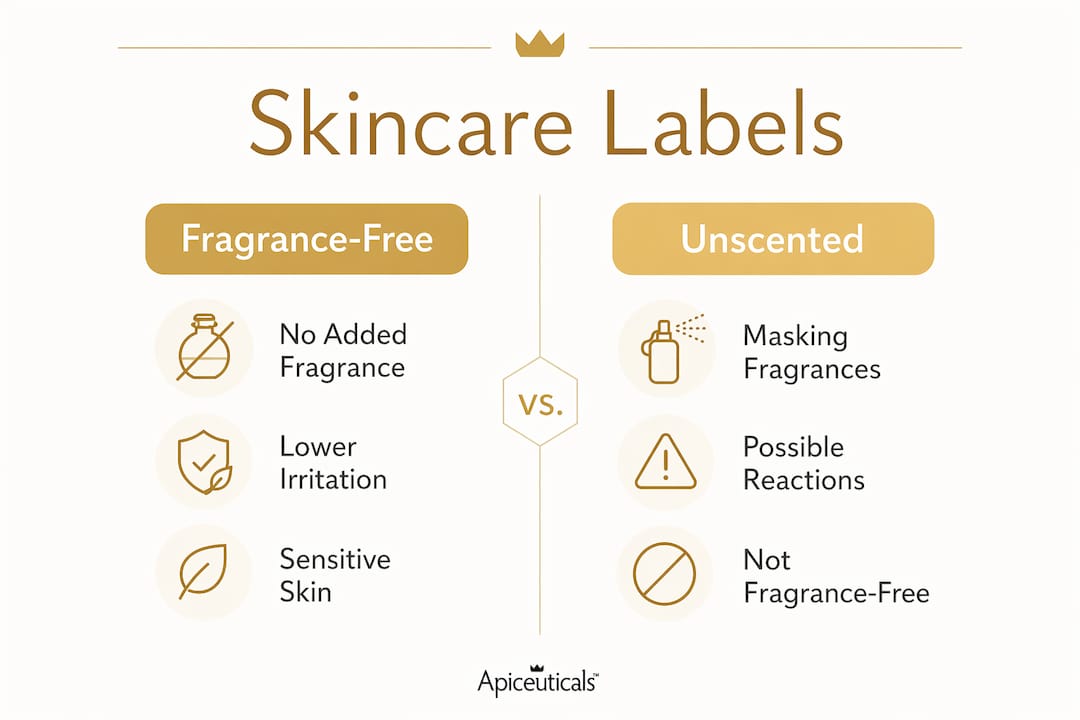
The distinction between these three labels is one of the most misunderstood areas in skincare. Fragrance-free means no fragrance ingredients were added to the formula. Unscented means the product has no perceptible scent, but it may still contain masking fragrances that neutralize odor while remaining allergenic. For people with sensitive skin, an unscented product can trigger the same reaction as a scented one.
Hypoallergenic is a marketing term with no legal or standardized definition in the United States or most global markets. A brand can label any product hypoallergenic without removing fragrance, conducting allergy testing, or meeting any regulatory threshold. The word creates a perception of safety that the formulation may not support.
The fragrance-free label itself also lacks universal legal protection. No standardized regulation governs fragrance-free claims in most markets, meaning a product labeled fragrance-free may still contain fragrant botanical extracts not classified as “fragrance” under current labeling rules. Ingredient list verification remains the only reliable method of confirmation.
| Label | What it means | Fragrance risk |
|---|---|---|
| Fragrance-free | No added fragrance ingredients | Low, if INCI list is verified |
| Unscented | No perceptible scent | Moderate to high (masking fragrances possible) |
| Hypoallergenic | No standardized definition | Variable, no regulatory guarantee |
| Natural/organic scent | Fragrance from plant sources | Same risk as synthetic fragrance |
Pro Tip: Check the INCI (International Nomenclature of Cosmetic Ingredients) list directly. If you see “parfum,” “fragrance,” “aroma,” or any essential oil name, the product contains added fragrance regardless of front-label claims.
Who benefits most from fragrance-free skincare?
The benefits of fragrance-free products are most pronounced in people whose skin barrier is already compromised or whose immune response is heightened. That said, the case for fragrance avoidance extends well beyond those with diagnosed conditions.
People with eczema face a particularly high risk. Approximately 16% of eczema patients in Europe are sensitized to fragrance ingredients. Sensitized skin reacts to even trace amounts of allergen, meaning a product that causes no visible reaction in most people can trigger a significant flare in someone with eczema. Rosacea-prone skin shares a similar vulnerability: its chronically inflamed state makes it highly reactive to fragrance-induced irritation.
Those undergoing active dermatologic treatments with retinoids, alpha hydroxy acids, or beta hydroxy acids carry an elevated risk for a different reason. These actives intentionally increase cell turnover and temporarily thin the skin barrier. Adding fragrance to a compromised barrier is like applying an irritant to a wound. Fragrance-free products reduce cumulative inflammatory stress during these treatment phases, supporting rather than undermining the treatment’s goals.
- Eczema and atopic dermatitis: High sensitization rates make fragrance-free a clinical necessity, not a preference.
- Rosacea: Chronic inflammation lowers the threshold for fragrance-triggered flushing and irritation.
- Acne-prone skin: Fragrance can cause follicular irritation and delay healing of active lesions.
- Post-procedure skin: After chemical peels, laser treatments, or microneedling, the barrier is acutely vulnerable to fragrance penetration.
- Preventative use: Even individuals without current sensitivity benefit from fragrance avoidance, since sensitization is cumulative and can develop after years of uneventful exposure.
Antioxidant ingredients play a complementary role here. Fragrance-free formulas that incorporate PROPOWAX™ Living Honeycomb, Apiceuticals’ patented technology with the globally validated highest antioxidant activity in cosmetics, go further than simply removing an irritant. They actively protect skin cells from oxidative stress, supporting barrier repair and long-term resilience. You can learn more about skin barrier protection strategies for sensitive skin.
How to select and transition to fragrance-free skincare effectively
Switching to fragrance-free skincare requires a methodical approach. The goal is to reduce cumulative fragrance exposure while minimizing the risk of flares during the transition.
- Start with leave-on products. Moisturizers, serums, and SPF formulas stay on the skin for hours. Leave-on products carry significantly higher sensitization risk than rinse-off products like cleansers or shampoos. Replace these first.
- Read the full INCI list. Front-label claims are unreliable. Search for “parfum,” “fragrance,” “aroma,” and individual essential oil names. Lavender oil, citrus peel extract, and rose water all count as added fragrance.
- Introduce one product at a time. Switching an entire routine simultaneously makes it impossible to identify which product caused a reaction. Allow one to two weeks between new introductions.
- Patch test every new product. Apply a small amount to the inner forearm or behind the ear for 48 hours before full-face use. This is especially important for people with a history of allergies and skincare reactions.
- Incorporate antioxidant support. Fragrance-free formulas enriched with PROPOWAX™ Living Honeycomb help repair the skin barrier during transition by continuously releasing antioxidants that neutralize free radicals. The PROPOWAX™ technology page details how this patented Living Honeycomb structure works at the skin surface.
Pro Tip: If your skin is currently in a reactive state, simplify your routine to three steps: a fragrance-free cleanser, a fragrance-free moisturizer, and SPF. Reintroduce actives only after the barrier has stabilized.
What are the most common misconceptions about fragrance-free skincare?
Several persistent myths prevent people from making the switch to truly fragrance-free formulations. Addressing them directly clarifies what fragrance-free skincare can and cannot do.
Fragrance-free does not mean minimalist or gentle by default. A product can be fragrance-free and still contain potent actives, preservatives, or other potential irritants. The label addresses one specific category of ingredient. It does not guarantee a simple or soothing formula.
Natural fragrances are not safer than synthetic ones. Lavender essential oil, citrus oils, and rose extract can provoke the same allergic reactions as synthetic fragrance chemicals. The immune system responds to the chemical structure of an allergen, not its botanical origin. Choosing a product because it uses “natural” scent provides no protection against sensitization.
- Myth: “If I’ve used fragrance for years without a reaction, I’m not at risk.” Sensitization is cumulative and unpredictable. Tolerance today does not predict tolerance tomorrow.
- Myth: “Fragrance-free products don’t work as well.” Fragrance adds no therapeutic function. Removing it does not reduce efficacy.
- Myth: “Hypoallergenic means fragrance-free.” These terms are legally unrelated. A hypoallergenic product can contain multiple fragrance allergens.
- Myth: “Unscented is the same as fragrance-free.” Unscented products frequently contain masking fragrances that are allergenic.
Fragrance-free skincare is a meaningful risk reduction strategy, not a cure-all. It removes one of the most common triggers of cosmetic contact dermatitis. Pairing it with antioxidant-rich skincare addresses the oxidative stress dimension of skin aging and barrier compromise simultaneously.
Key Takeaways
Fragrance-free skincare is the most scientifically supported choice for sensitive, eczema-prone, and reactive skin because it eliminates the leading cause of cosmetic contact dermatitis while allowing functional ingredients to work without interference.
| Point | Details |
|---|---|
| Fragrance causes contact dermatitis | Fragrance affects 1–4% of the general population and 8–15% of dermatology patients with contact dermatitis. |
| Fragrance-free and unscented are not the same | Unscented products can contain masking fragrances that remain allergenic for sensitive skin. |
| Sensitization is cumulative | Long-term fragrance exposure can trigger allergies even in people who previously showed no reaction. |
| Leave-on products carry the highest risk | Replace moisturizers, serums, and SPF first when transitioning to fragrance-free skincare. |
| Antioxidants support barrier repair | Fragrance-free formulas with PROPOWAX™ Living Honeycomb actively protect and repair the skin barrier alongside eliminating irritants. |
Apiceuticals’ perspective on fragrance and skin integrity
Fragrance in skincare has always struck me as a fundamental contradiction. A product designed to support skin health should not contain an ingredient whose primary function is to influence perception at the expense of barrier integrity. The clinical data on fragrance sensitization is not ambiguous: it is one of the most documented causes of cosmetic adverse reactions, and its effects compound over time in ways that are genuinely difficult to predict for any individual.
What concerns me most is the gap between consumer understanding and label reality. The word “unscented” reads as safe. The word “hypoallergenic” reads as clinically tested. Neither guarantee is real. The only reliable protection is ingredient list literacy, and that requires effort most people are not equipped to apply without guidance.
The complementary role of antioxidant science matters here. Removing fragrance eliminates a source of oxidative and inflammatory stress. Adding PROPOWAX™ Living Honeycomb, with its globally patented and independently validated antioxidant activity, actively counteracts the oxidative damage that fragrance exposure and environmental stressors accumulate over time. These two strategies, fragrance avoidance and antioxidant support, address the same underlying problem from opposite directions. Together, they represent a genuinely science-backed approach to skin barrier health rather than a cosmetic trend. Readers who want to understand how to avoid harsh chemicals more broadly will find practical guidance on selecting gentle formulas for daily routines.
— Apiceuticals
Apiceuticals’ fragrance-free skincare with antioxidant protection
Apiceuticals formulates every product without added fragrance, free from SLS, SLES, parabens, silicones, and mineral oils, and excludes over 2,000 potentially harmful ingredients. Every formula is dermatologically tested on sensitive skin with 0% irritation, making the range suitable for the most reactive skin types.
At the core of each product sits PROPOWAX™ Living Honeycomb, a patented structure that continuously releases antioxidants onto skin, scalp, and hair. This technology holds a global patent for the highest antioxidant activity in cosmetics, validated by the Aristotle University of Thessaloniki and recognized by British Vogue as “arguably the global leader in antioxidant activity.” For people who want fragrance-free skincare that goes beyond simply removing an irritant, Apiceuticals’ antioxidant skincare range delivers measurable skin protection grounded in bee science from Arcadia, Greece.
FAQ
What does fragrance-free mean in skincare?
Fragrance-free means a product contains no added fragrance ingredients, including synthetic fragrance compounds, essential oils, and aromatic botanical extracts. It does not mean the product is odorless, as some ingredients have a natural scent of their own.
Is fragrance-free skincare better for sensitive skin?
Fragrance-free skincare is better for sensitive skin because fragrance is the leading cause of cosmetic contact dermatitis, affecting 8–15% of dermatology patients. Removing it eliminates one of the most common triggers of irritation and allergic reactions.
What is the difference between fragrance-free and unscented?
Fragrance-free contains no added fragrance ingredients. Unscented products often contain masking fragrances that neutralize odor but can still cause allergic reactions, making them a less reliable choice for sensitive or allergy-prone skin.
Can natural fragrances cause the same reactions as synthetic ones?
Natural fragrances, including lavender oil, citrus oils, and rose extract, contain the same classes of chemical allergens as synthetic fragrance blends. The immune system responds to chemical structure, not botanical origin, so natural scent carries equivalent sensitization risk.
How do I know if a product is truly fragrance-free?
Check the full INCI ingredient list for “parfum,” “fragrance,” “aroma,” and individual essential oil names. Front-label claims are not legally regulated in most markets, so ingredient list verification is the only reliable method of confirming fragrance-free status.
Recommended


Related posts

How bees and biodiversity sustain each other, what the science says about Greece and the Aegean, and how antioxidant beauty can start from a hive...

How organic propolis extraction works, from hive to extract: collection, solvents, EU organic rules, Greek propolis phenolics and what it means for skincare.

Build an anti pollution skincare routine that fits Greek city life: what pollution does to skin, the morning and evening steps, and the antioxidants with...

Honey moisture content explained: the EU and Greek limits, how to take a refractometer reading, what excess water does to honey, and why it matters...

How antioxidant activity measurement works: DPPH, ABTS, FRAP and ORAC explained, why results differ, and what a lab number can and cannot say about skin...















